With the death of the 3.5 mm jack on smartphones, the market has taken two directions: USB-C dongles and portable Bluetooth DACs (what I call “mobile DAC“). The Soundaware MDAT3 is part of the latter family and it boasts an impressive spec sheet, with best-in-class THD and SNR values. It is also a very well-designed and impressively-built device on top of that. It sits in the super-premium segment of the market, however, a positioning that’s hard to justify considering its overall performance.
Disclaimer: I received a unit on loan from Soundaware. The MDAT3 retails for $374 in the standard edition and $520 in the “15th Anniversary” edition. Additional information on the official website.
TL;DR: recap
| Pros |
Cons |
| + Flawless build quality
+ Support for high-quality codecs + Good power output |
– Does not support USB input, only Bluetooth
– No support for high-quality sound on Apple devices – Bluetooth range and stability issues – Average battery life – Too expensive for what’s on offer – Dubious claims about accessories and components |
Rating: 6/10
Packaging & Accessories
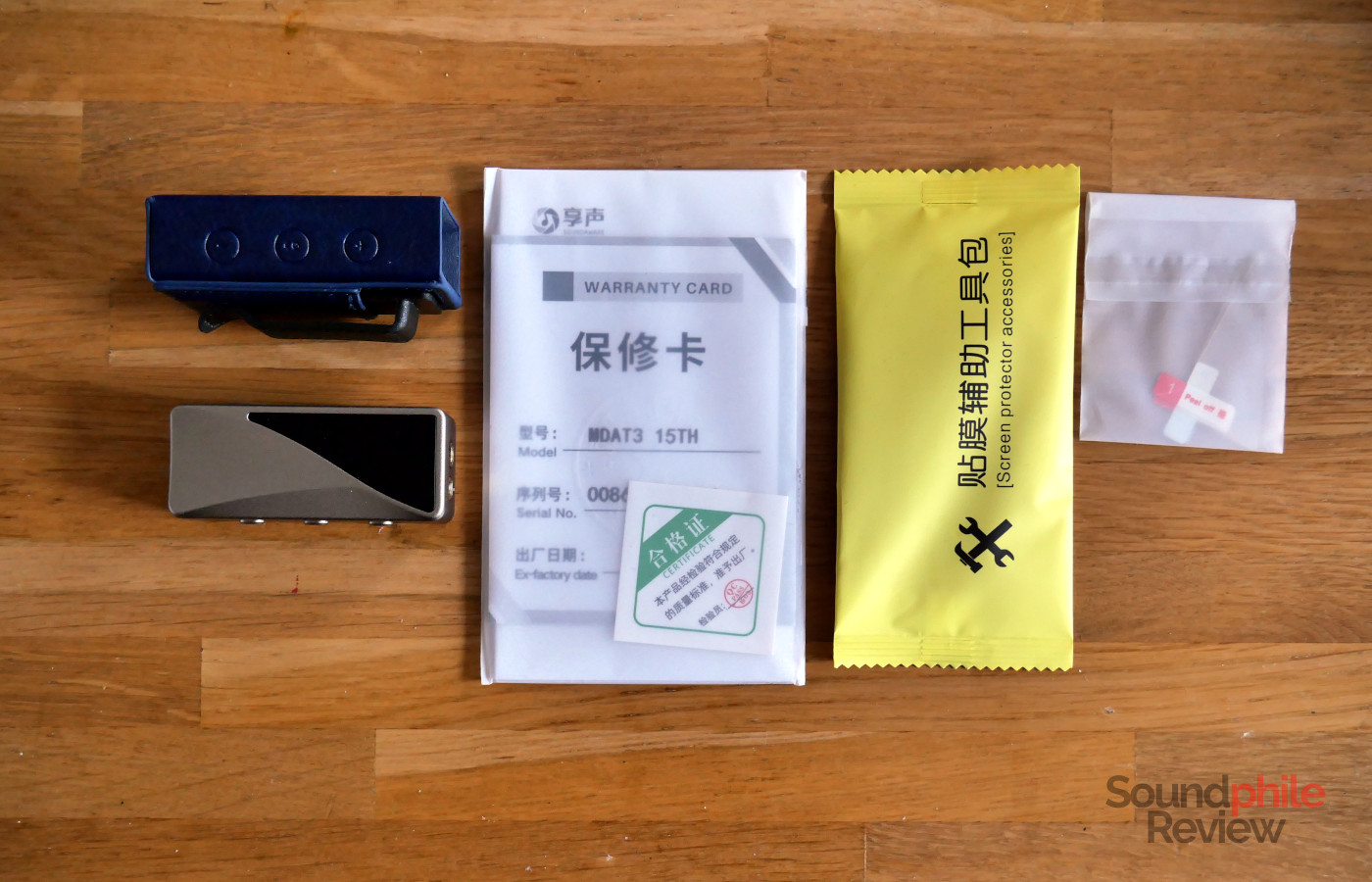
The MDAT3 comes in a cardboard box which contains the device itself, an optional faux leather case (which you have to buy separately) with a removable belt clip, a USB-C to USB-C cable, a plastic screen protector, as well as a manual and a quick start guide.
Design & Build
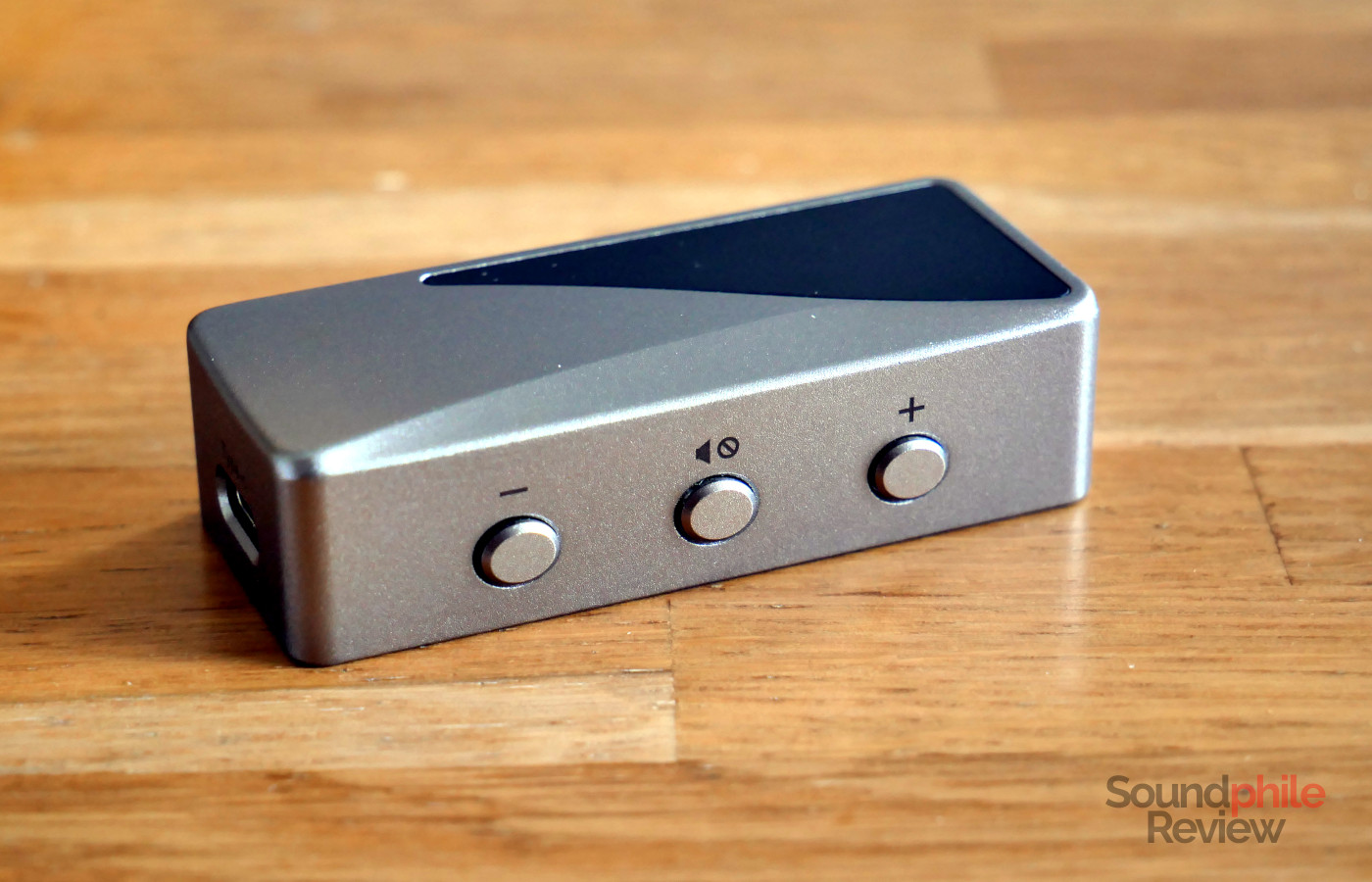
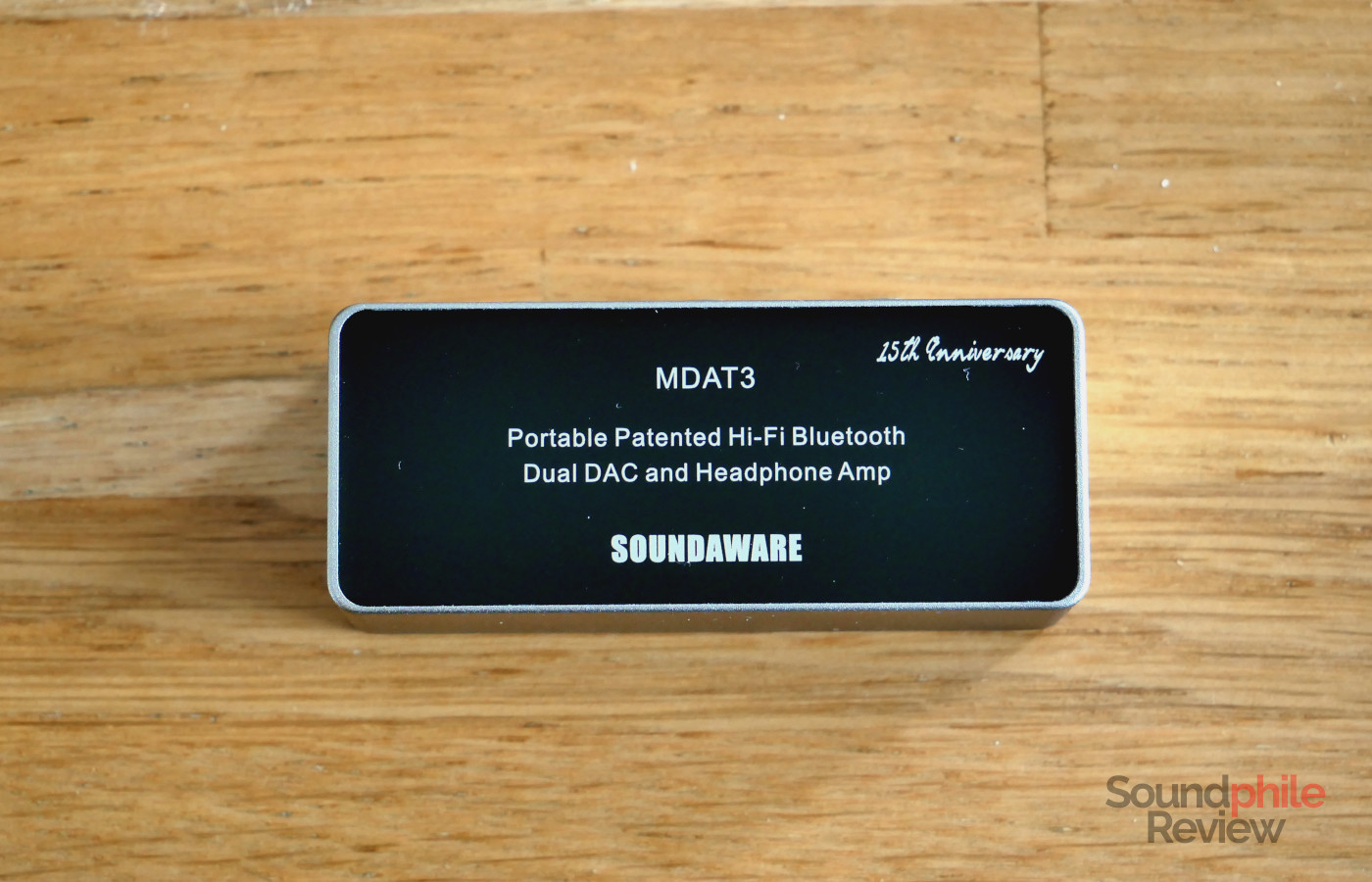
The Soundaware MDAT3 looks very refined and elegant, thanks to the blend of the chassis’s dark grey metal and the screen’s black glass. It adds a bit of flair with a wave-like pattern on the screen area, and with a three-dimensional effect that further divides the top into triangular areas. The bottom is covered in black glass, too, which bears some text describing what the MDAT3 is (“Portable Patented Hi-Fi Bluetooth Dual DAC and Headphone Amp” plus the Soundaware logo and the “15th Anniversary” marking on the top-right corner. The bottom is in fact the least-elegant bit, as the text is redundant, but to be fair it’s rarely seen.
Build quality is excellent, as all components appear to be manufactured to the highest standard and look and feel like those of a premium product. The metal is machined with incredible precision and feels super-smooth to the touch. All parts are assembled with low tolerances, so they fit perfectly together.
The top of the device only hosts the screen. It is very small, at just half an inch, and it’s black and white. The left hand side hosts the USB-C port, the “South” side (for lack of a better definition) hosts two volume buttons plus a multi-purpose button, and the right hand side hosts 3.5 mm and 4.4 mm jack sockets.
Specs & Features
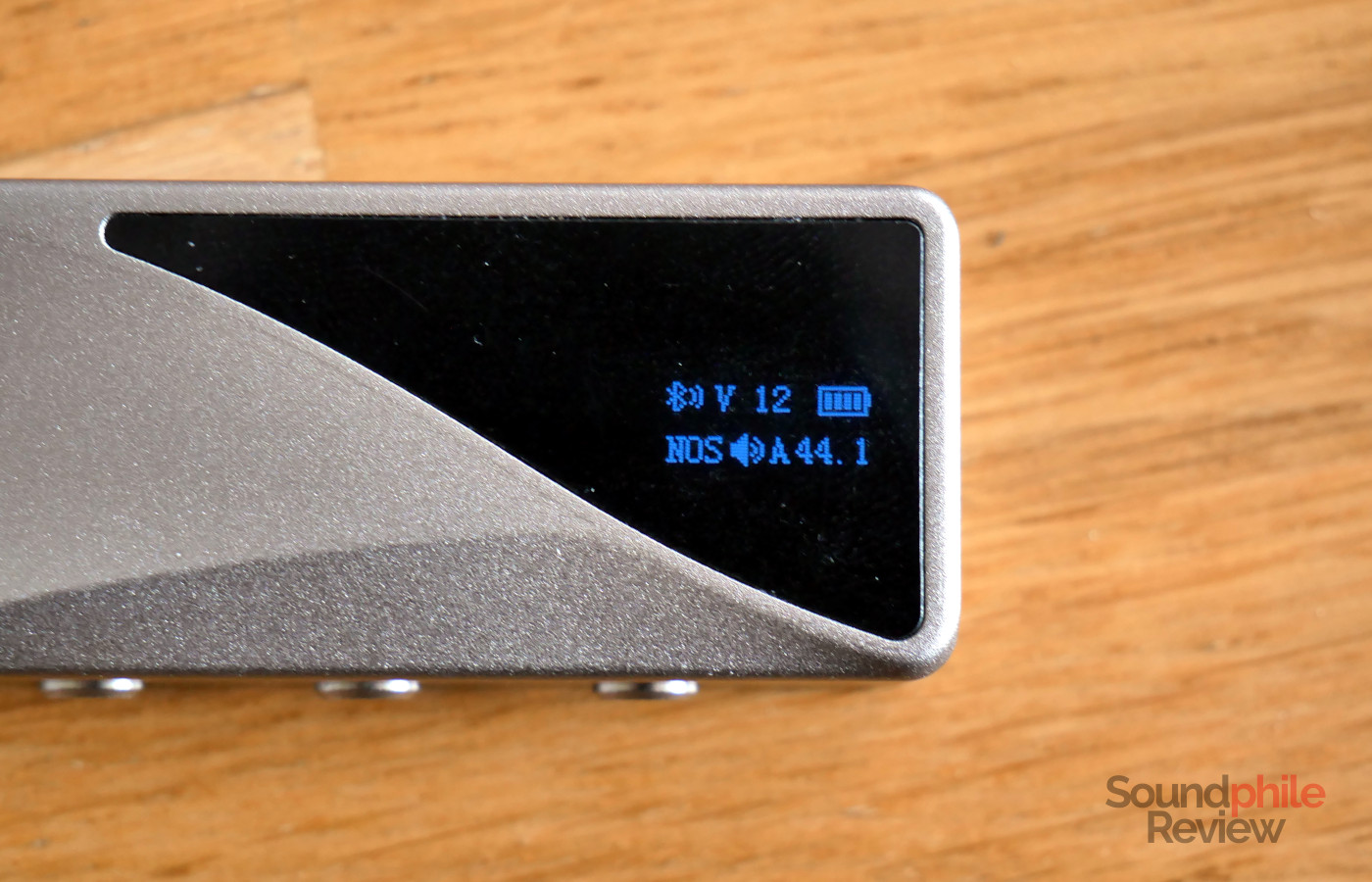
Despite being so small, the screen shows a whole lot of information. It does take some patience to decode it, however, as text and icons are very small and often require me to bring the device closer to my eyes. You can see the connectivity status, the active control mode (more on this in a moment), the battery level, the active filter, whether the unit is on mute, as well as the sampling rate. The control mode refers to the fact that you can double-press the centre button to switch between volume control, which makes the two buttons to the side control volume and the centre one mute or unmute sound, and playback control, which makes the centre button play or pause music and the two buttons skip to the following or previous track.
A very important aspect of the Soundaware MDAT3 is that it is a pure-play Bluetooth adapter. It does not work over USB, so you cannot connect it to, say, your computer and use it in wired mode as there is no wired mode. This is a major drawback compared to virtually all competitors out there which offer the ability to choose between wireless and wired, in case your preferred source device does not have a Bluetooth connection. The USB-C port is therefore only to recharge the internal battery. This means that the MDAT3 is compatible with all devices supporting Bluetooth connectivity, which includes smartphones, most computers, tablets, as well as gaming consoles, but there are some caveats as we’ll see in a moment.
The MDAT3 supports the SBC, AAC, aptX, aptX HD, aptX LL, aptX Adaptive and LDAC codecs. This makes it compatible with virtually every device out there. It has to be noted that only Android devices officially support all codecs. Windows has support for aptX, but not LDAC; Apple devices (iPhones, iPads and Macs) only support the AAC codec and are therefore entirely cut out of high-quality sound when using the MDAT3, as you cannot use it wired. Linux devices should support all available codecs, but that depends on distribution and installed packages (the Steam Deck should support everything out of the box).
The connection is generally stable and reliable, but it is very sensitive to interference and can sometimes start stuttering. This normally only lasts for a few seconds, but it repeats itself a few times before eventually stopping. It also offers a relatively small range, as the sound starts stuttering after moving about 3 metres away (without obstacles in between). One thing to note is that the company sent me two units: the first had such severe connectivity issues that it was barely usable; the second unit reduced the issue, but didn’t eliminate it, which would suggest this is a design flaw rather than a case of a faulty unit. Considering this is a Bluetooth-only device, this is a major flaw, and one I would not expect from a device costing $100 – much less so one that costs $374 for the base model, and $520 for the version I actually tested.
Soundaware MDAT3 |
| Input | Bluetooth (up to 24 bit / 96 kHz PCM) |
| Suitable headphones impedance | 8 – 600 Ω |
| Output impedance | < 1 Ω |
| Maximum output power | 205 mW (32 Ω) |
| Frequency response | N/A |
| THD+N (@1 kHz) | 0.0002% |
| SNR | 135 dB |
| Crosstalk | N/A |
The Soundaware MDAT3’s claim to fame is the fact that it offers best-in-class distortion and SNR. At 0.0002%, distortion is in fact in desktop DAC territory, as is the 135 dB SNR. Not only this, as the company says that it has developed an ultra-precise clock source which offers superb accuracy at just 4 errors per million oscillations on the standard MDAT3 and 0.05 errors per million oscillations on the 15th anniversary edition. These figures sound impressive, but are largely meaningless: 4 errors per million oscillations is an amount of jitter that is orders of magnitude below audibility, and 0.05 errors per million oscillations is even less audible. That’s the entire point, but clock jitter at audible frequencies simply is not an issue at these levels. The company makes some bombastic claims about the influence of the clock source on sound, mentioning how the standard edition is “warm, durable, full, and smooth” while the 15th anniversary edition, thanks to its improved clock source, offers “reference level density/contrast/dynamic analysis power and details [which] are very vivid and realistic” – which doesn’t actually say anything about anything. The company does not disclose which DAC chip they use inside the MDAT3.
Battery Life
The MDAT3 gives you around 8 hours of battery life, which is enough to accompany you for a full working day. This is a result that is in line with most cheaper competitors (e.g. the Shanling UP4 2022, which launched four years ago at $119) and does not make the MDAT3 stand out from the crowd.
Sound
I tested the Soundaware MDAT3 using a variety of headphones, including the HiFiMAN Edition XV, the Sennheiser HD 6XX, the HiFiMAN HE-560 and the Moondrop A8.
As you can probably imagine, the Soundaware MDAT3 sounds exactly like every other Bluetooth DAC/amp I’ve tried, which means it’s entirely neutral. Even with relatively hard-to-drive headphones like the Sennheiser HD6XX, or very easy-to-drive ones like the HiFiMAN Edition XV, I cannot hear a difference when comparing it to other devices. I’ve compared it against the Shanling UP4 2022 and found no difference at all.
Soundaware claims that using their Soundaware LP1s power supply makes the MDAT3 sound better and more powerful. Unfortunately I have not been able to confirm either claim, as the MDAT3 sounds exactly the same with or without the LP1s. There is no change in volume indicating more power being available when connecting the LP1s (as that would be supremely weird!) nor in sound quality, even when using sensitive earphones and headphones. Considering the LP1s is a linear regulator that only suppresses noise in case there are issues with voltage stability, an improvement in sound when using it would entail that the battery and power circuitry surrounding it are not of high quality, which does not seem to be the case (and would be an implicit admission that the device is flawed, which it isn’t).
Final Thoughts
Better specs are always a better thing, at least in theory. There comes a point, however, when it simply does not make much sense to chase further improvement as the law of diminishing returns applies. In the case of the Soundaware MDAT3, it’s quite clear how this is true. It’s a fantastic device: it’s well designed, superbly built, and it offers quite a few options. It also has enough power to drive most headphones out there. It has a few shortcomings, however, like the lack of USB input and a battery life that’s only average.
Despite all its positive qualities, at $374 the MDAT3 is a hard sell. Not because it isn’t good, but because that price is three or more times that of competitors, without any significant, tangible advantage over them. In fact, the MDAT3 offers relatively lower power output and it has fewer features than comparable devices – namely, the ability to use it as a USB DAC as well. Soundaware’s claims about better sound quality do not turn into actual advantages when you listen to the device and compare it to alternatives: the declared specs feature distortion which is an order of magnitude lower than the competitors and much higher SNR, but in both cases we’re talking about a difference which is well beyond the threshold of audibility and therefore does not make any practical difference, especially considering we are talking about Bluetooth which already limits sound quality.
The MDAT3 is, according to the specs, objectively better, but it is at a point where it is impossible to tell and only measurement instruments are able to discern a difference. It is a great display of engineering prowess, but it appears futile as it is well beyond the ability of people to detect it. Competitors might be worse in terms of distortion and SNR, but they offer more power, more features and specs which still flaunt fantastic levels in terms of distortion and SNR. To put things in perspective, the MDAT3 costs 50% more than the Shanling UP6 while offering half its output power, and it has the same price as the Shanling H5 which offers four times the power. The FiiO BTR15 offers 50% more power (300 mW) for 1/3 of the price; the BTR13 offers the same power output while costing one fifth! And this is considering the MDAT3’s base model, as the 15th anniversary one is even more expensive at $520, and only considering output power without regard for other features – all models offer USB input as well, as an example.
For the reasons in the previous two paragraphs, I think you should buy the device that offers the best features and the most power at the cheapest price available. If you are going to buy a Bluetooth DAC, also make sure that its connection is stable and reliable: the MDAT3’s issues in this regard are not insignificant and are a major drawback for a device that only features Bluetooth.
The Soundaware MDAT3 is a good device, and one which I could recommend were it not for price. However, at $374 for the base model and $520 for the higher-tier one, it’s very difficult to recommend it over the multitude of equally good-sounding devices out there which cost much, much less while paradoxically offering more. There’s no stand-out feature that makes the MDAT3 worth three times (or even more!) the price of competitors. It doesn’t offer a large amount of power, nor super-long battery life, nor compatibility with some exciting new format – in other words, it does not stand out from the competition. In fact, as things stand, the MDAT3 is the equivalent of super-expensive cables: a luxury item which costs more for the sake of market positioning (see the dubious claims of influence from components and accessories, like the LP1s), rather than of intrinsic value you can get from it. Like all luxury items, then, it’s useless to make further considerations – it’s an object bought for the perception you have of it. It’s a good device, it just costs way too much for what it is.