Noise is the enemy of good sound, and this is something that all audiophiles agree upon – from the staunchest subjectivist to the most science-based objectivist. And yet, there is a lot of controversy around how to remove that noise. The Soundaware LP1s does absolutely nothing to quieten this debate, as the company makes lofty claims of marvellous improvements but provides no data. And my testing does not paint as rosy a picture…
Disclaimer: I received a unit on loan from Soundaware. They sell the LP1s for $160. Further information on their website.
Soundaware LP1s At A Glance
| Pros |
Cons |
| + Excellent build quality | – Blocks data over USB
– Questionable utility – Very expensive |
Rating: 3/10
Packaging & Accessories
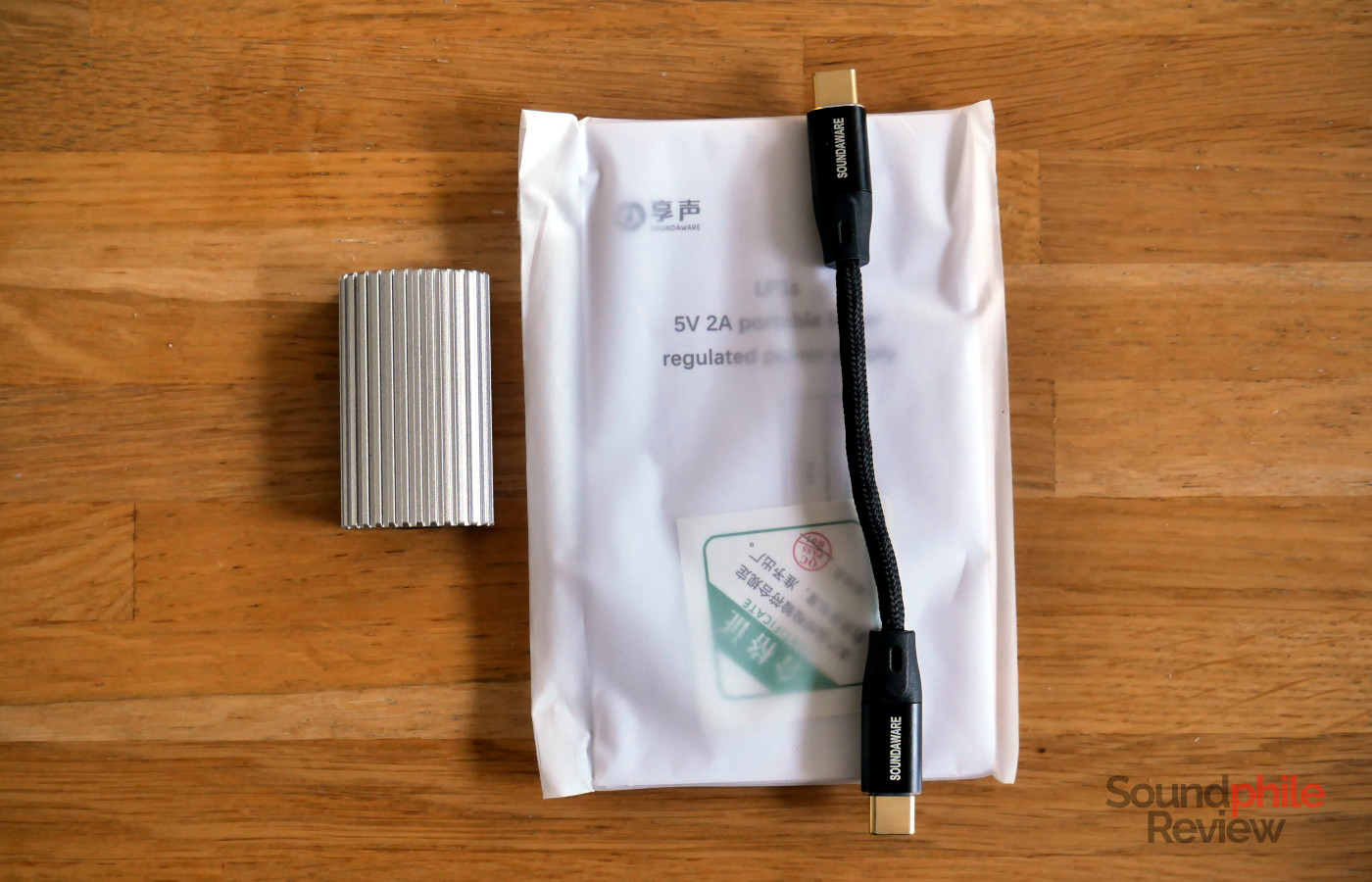
The LP1s comes with a USB-C to USB-C cable and a manual.
Design & Build
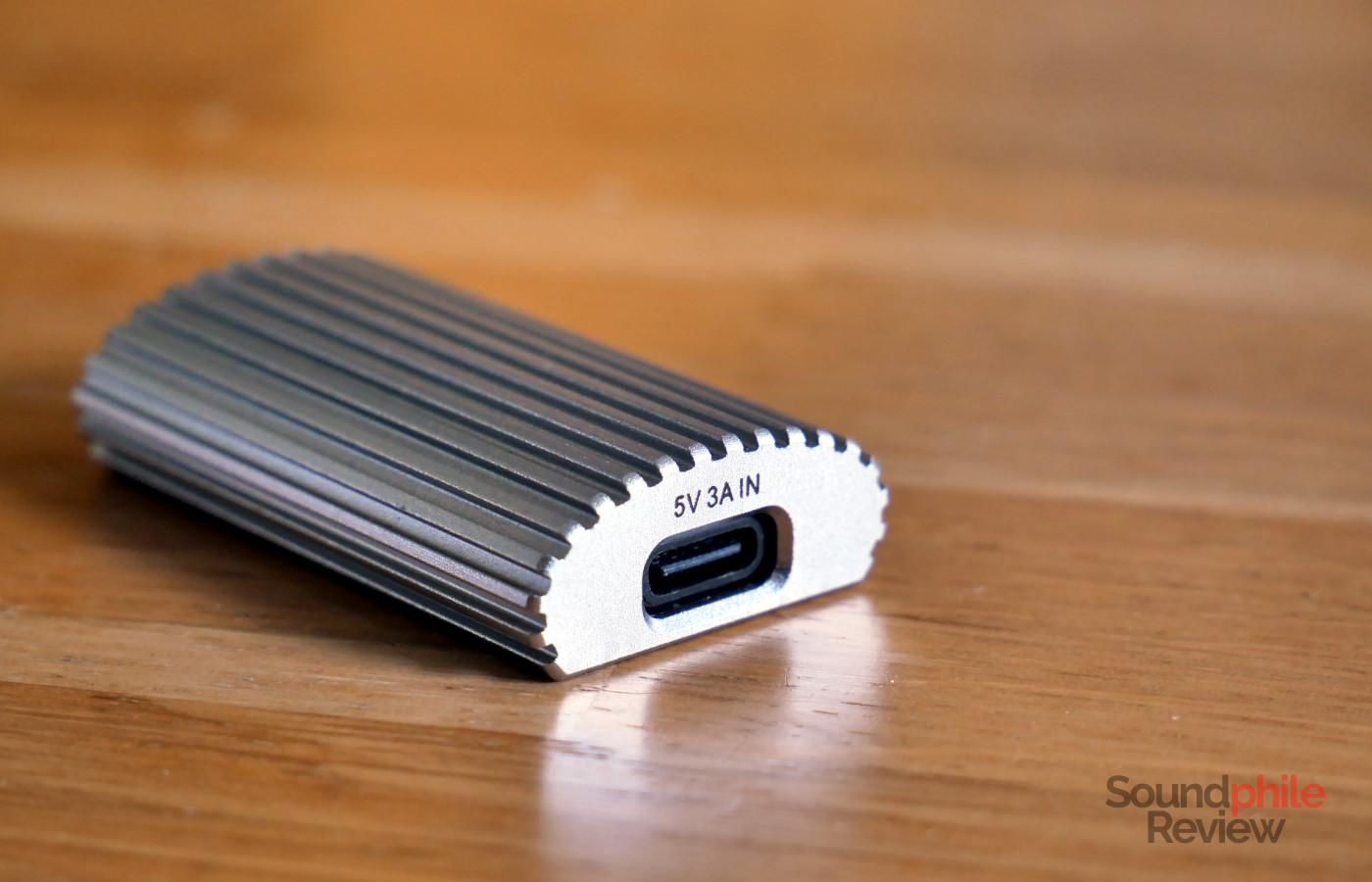
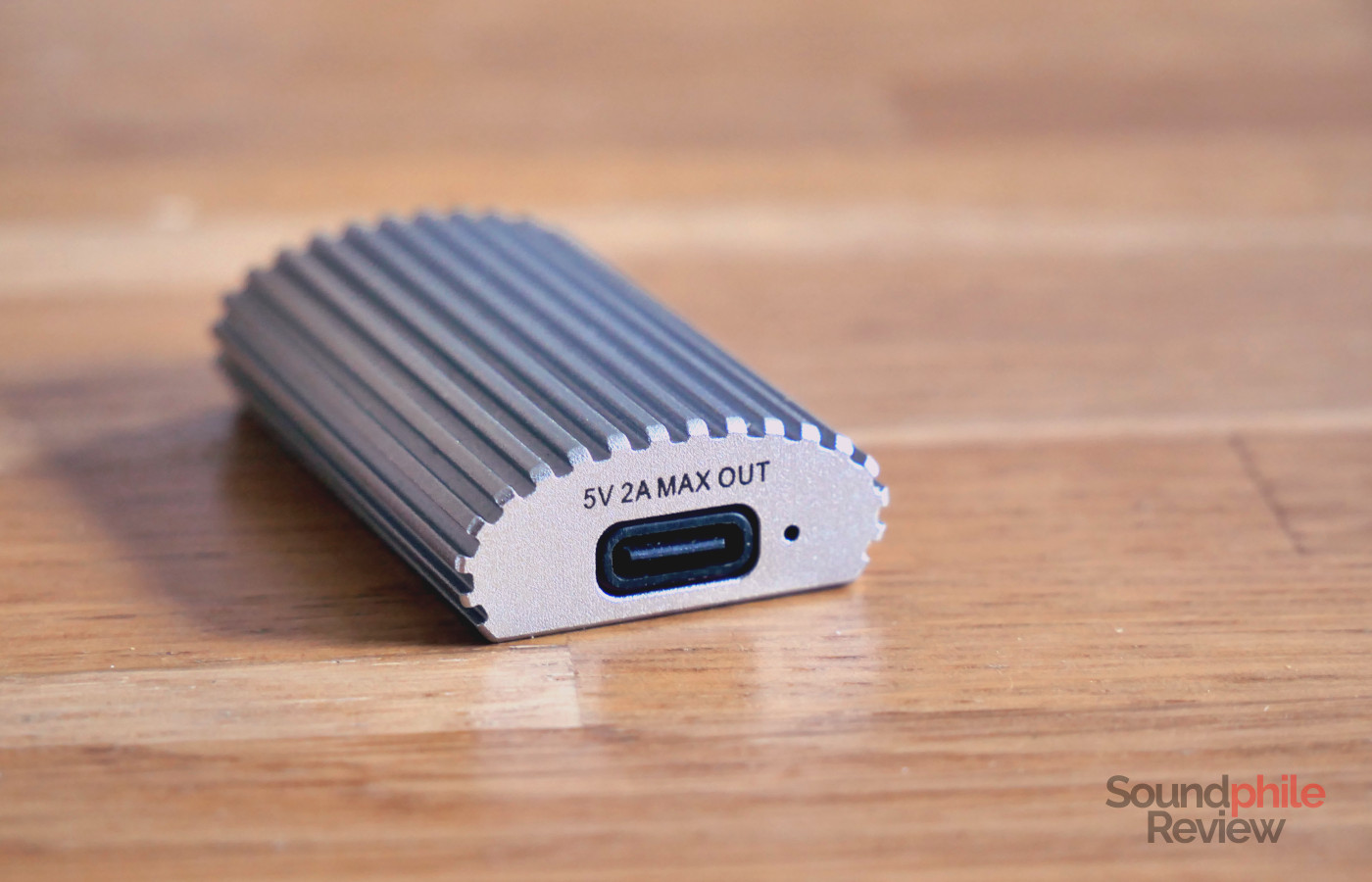
The Soundaware LP1s is a small machined metal box, akin to a Bluetooth DAC/dongle. It is surprisingly light, at just 20 g. It is made of two pieces of metal, one for the bottom and the other for the rest; the top and sides are curved in an oval-like shape. The right hand side and left hand side of the device are straight and carry a USB-C port each, one for the input and the other for the output. The device appears to be very well assembled, as there are no visible signs of a mechanism to lock the two pieces in place; the only indication that this is not a single piece is the fact that there is clearly a cutout on the bottom.
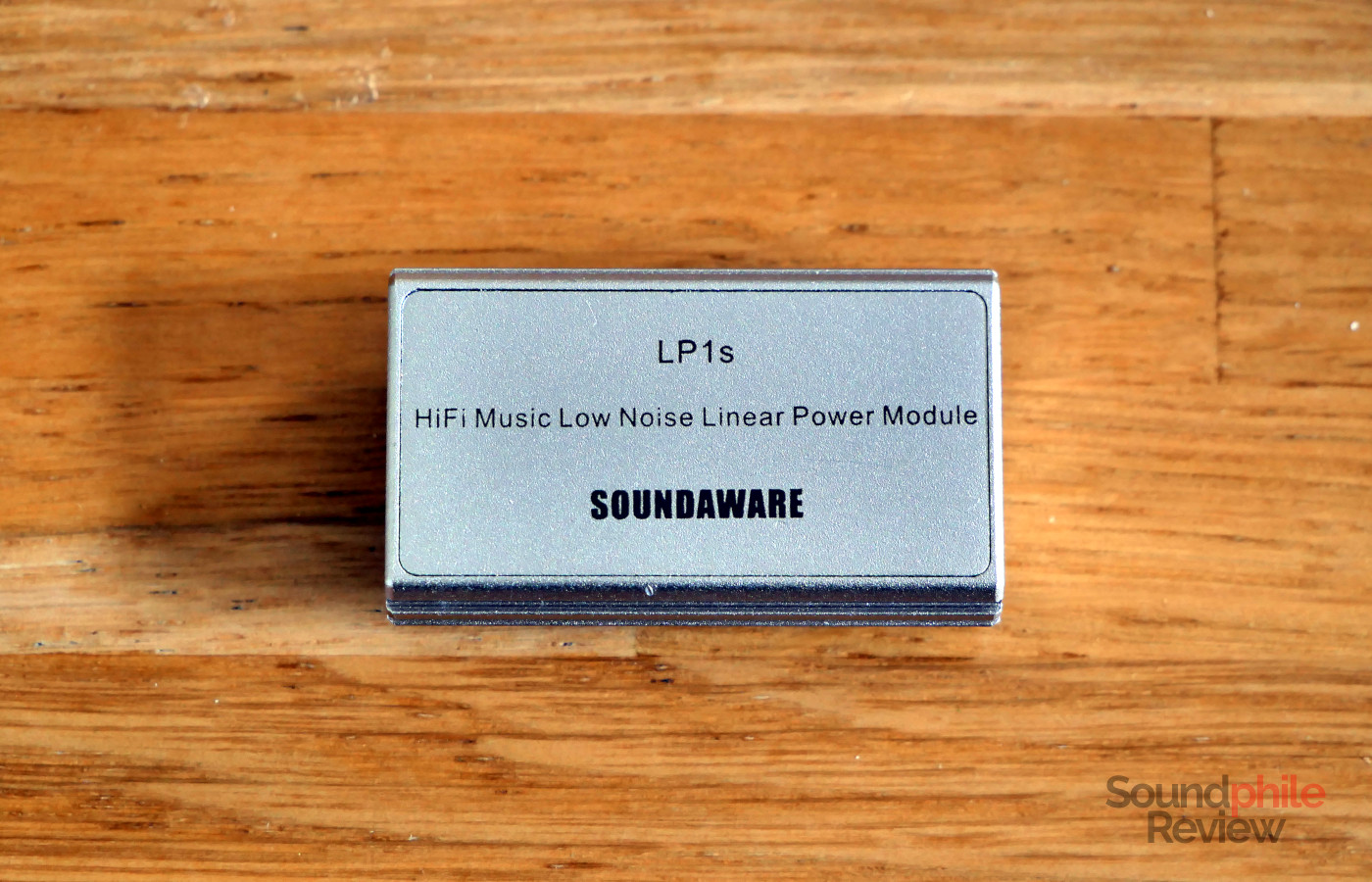
The bottom features the Soundaware logo, the name of the device as well as a description of what it is (“HiFi Music Low Noise Linear Power Module”). Next to the output port there’s a status LED; both ports are accompanied by information on power (“5 V 3A in” and “5V 2A out”).
Features & Specs
At its core, the LP1s is a linear regulator that acts like a filter by dissipating excessive voltage as heat. This makes it so that voltage is stable and does not present any ripples and peaks which would then show themselves down the line as audible noise. In technical terms, the Soundaware LP1s has a high power supply rejection ratio. In theory, this means that it is going to remove unwanted noise caused by fluctuations in the voltage provided by the power supply. The company claims that the LP1s “supports wide voltage input”, without clarifying whether that would mean that it supports a variety of voltage levels, but then also states that the only supported voltage is 5 V.
It should be noted that the LP1s only fixes the very specific issue of irregularities in voltage supply, and it does not fix other issues such as noise coming from a ground loop. It is therefore only useful in case your power supply does not provide a clean output (which is easily fixed by getting a better power supply). As I had no way to actually know whether my PSUs were any good, I bought a USB power metre capable of drawing graphs of the voltage supply and then I proceeded to test virtually all the power supply units I have at home, plus the various USB ports on all my various devices (computers and NAS). The result is that every single USB charger and port has (almost) perfectly stable output with no significant deviation, bar one; the only charger that gave me issues had a 0.5 V swing, exactly once and immediately after I connected the power metre, stabilising afterwards to 5 V. There are often minor fluctuations in the voltage provided, with a magnitude of 0.01~0.05 V; on top of this, a different case is that sometimes the PSU provides a stable voltage that’s above 5 V (the worst example I’ve seen being 5.2 V, but this only happened with a single charger, as most others were between 5 V and 5.1 V), thus providing flat but out-of-spec power. The conclusion I have come to, then, is simply that most USB power sources, be they your computer’s USB ports or a USB charger, are nowadays of good enough quality that they’re not really an issue.
Measuring the LP1s itself, what I saw was that it stabilises the voltage to 5.02 V, with constant but very minor fluctuations of ±0.02 V which is no different from the swings I measured directly on my chargers. This confirms that the LP1s does what it claims: it brings the voltage closer to the 5 V standard. The only case where this matters is when you have a charger that offers stable but out-of-spec output, like in the case of my charger which provides 5.2 V, which the LP1s corrects to 5.02 V. But my measurements show that there is no additional benefit for the vast majority of sources that already offer stable output at 5V, as the ripple is of the same magnitude as that of a decent source charger. One caveat to this is that my metre is not able to detect very high-frequency (tens to hundreds of kHz) ripple, but this should not be too much of an issue given we’re talking about the audio band. The LP1s works as intended, but it is a very expensive solution to an issue that is much more easily fixed by purchasing a well-built $10 charger.
The other thing to note is that the LP1s uses a lot of power, relatively speaking: according to specs, if you provide it with 3A at 5 V, it will output 2 A – meaning it will dissipate 5 W, or one third of the total power. This implies both a significant amount of heat production as well as a significant power drain, which is especially relevant if you are going to use the LP1s with a power bank like Soundaware recommends. The device gets very hot (to the point it’s uncomfortable touching it) when using it to charge devices that require its full power output, to the point it would be highly impractical to keep it in one’s pocket or in another enclosed space.
I tried charging power banks using the LP1s, but that didn’t work; the LP1s itself would start blinking its status LED and the power bank would report that the charging was constantly being disconnected and re-connected. Interestingly, it did work with a smartphone. What I think happens is that the LP1s makes it impossible for the power bank to correctly negotiate the power, thus acting as a block and not allowing the power bank to charge.
Another important thing to note is that this does not allow for data to pass through. You therefore cannot use the LP1s with devices that require the cable to provide both data and power, like USB DACs (e.g. the iFi ZEN DAC 3) or DAC dongles (e.g. the Questyle M12i), or even earphones or headphones with a USB-C connector (e.g. the Questyle NHB15). This means you can only use it with devices that use a separate USB-C cable for power alone, and which are limited to 10 W in total power absorption.
Sound
I’ve tested the Soundaware LP1s with multiple devices, including a Soundaware MDAT3, a Hidizs AP80 PRO MAX, an xDuoo XQ-50 Pro3 and an SMSL D1.
The company claims that “the sound is rich in musical expression”, that it is “warm, full, dynamic, and full of musicality, which can significantly enhance the music expression and live sound of portable and desktop products”, and then adds that “[t]he sound of LP1s is based on the quality of the output cable, so the HIFI USB cable at the output end is necessary”. In my experience, which is indeed subjective (more on this in a second), the LP1s makes exactly zero difference in terms of sound quality. This is both unexpected and not unexpected in the slightest: it is unexpected because it could remove noise from the power supply line on the USB cable, thus making the sound cleaner; it is not unexpected because power supply is nowadays very clean already and, on top of that, contemporary devices generally do a great job at rejecting noise from USB.
Moreover, the fact is that you can’t use the LP1s with devices that rely on USB for both data and power, which severely curtails the amount of devices you can actually use the LP1s with. I’ve chosen a variety of devices (a portable Bluetooth DAC, a DAP, a desktop Bluetooth DAC and a desktop DAC) to test whether there would be any difference between using them with the LP1s, with a USB cable connected to my computer and with a USB cable connected to a multi-port USB charger. This would be especially relevant with the xDuoo XQ-50 Pro3 and the SMSL D1, which do not have a battery and rely on USB for power only. Unfortunately, I couldn’t find any differences.
I specifically pointed out that my experience is subjective as there are no published measurements about the filtering ability of the LP1s, nor about any measured improvements in the signal quality when using it, and the company only makes claims about entirely subjective points like “musical expression”. I therefore feel like it is fair to counter these subjective claims with my subjective experience, on top of having measured multiple USB power sources.
Final Thoughts
At $160, the Soundaware LP1s is very expensive for what it is – a very simple device with few components. You can buy a full desktop setup comprising DAC and amp for less than that these days! And yet, it could be potentially worth it if it really improved the way USB devices sound – even just by removing unwanted noise. In my experience, however, there is no difference between using the LP1s and not. This is mostly due to the fact that the LP1s tries to solve a very specific problem: that of voltage swings caused by imperfect output from the power supply, which end up causing noise.
I have many a misgiving about the claims of wondrous improvements made by Soundaware. They claim that the device improves the sound of any device it is connected to, but they give no tangible proof (e.g. measurements) of what this would mean in practice. It doesn’t make things worse and it doesn’t make them better, it simply does nothing. This is also because it blocks data, which means that you cannot use it to filter out noise from USB cables with devices such as DACs or dongles which use USB connections for both power and data, and this means that you can only use it to either charge devices with their own battery and not using USB to transfer data (which means there is not going to be any difference between using the LP1s or not, since the device will use the battery anyway), or with devices using USB just for power. In the latter case, my own testing found no discernible difference between using the LP1s and not.
Given all of this, the Soundaware LP1s is not a product I can recommend, especially given its high price.