Building the perfect setup takes a lot of time, trial & error… and money. Finding the right equipment is difficult. Many people try speakers in a showroom and think they look and sound fantastic, then buy them and try them at home only to be disappointed: they sounded better in the showroom. This makes many go down a bottomless rabbit hole, which makes them try everything from new DACs and amps to weird cables and esoteric things like magical stones that remove impure energies from the system. Not many, however, pursue a change in the biggest factor after your speakers in how your system sound: the room itself. All the different reflections and refractions in your room, which are unique to it, have a bigger effect than anything else (after your speakers). Controlling them is possible with acoustic panels which change the way that sound diffuses in your space. I’ve had the opportunity to test the GIK Acoustics Amplitude panels, which help control your room’s acoustics while also adding some flair to it, and here’s what I found.
Disclaimer: I received a full set of acoustic panels by GIK Acoustics for the purpose of writing this piece. I would like to thank them (also for their patience, as it took me a few months to publish this!). Additional information on GIK Acoustics’ website.
Why you should use acoustic panels
We’ve all been there. You go to a store and try some speakers and you’re blown away: they sound fantastic and just what you’d like. You then buy them, go back home and install them. The magic moment arrives: you turn everything on and start playing music… and you feel a huge letdown, because what you’re hearing is nothing like what you heard at the store. I’ve seen people argue about the brand of cables they were using, or resorting to complete quackery like “acoustic dampeners” that are nothing more than cheap rubber you put in the unused Ethernet port of your network streamer or all-in-one. Many spend thousands looking for that one bit of equipment which is going to give them that “magic”. Somehow, however, very few people embark into the one journey that would lead somewhere – or, if we want to be less charitable, spend their money in the only way that doesn’t only fill the pockets of snake oil sellers – and that is by doing proper acoustic treatment of their listening space.
It’s not by chance that all serious recording and production studios, big or small as they may be, have treated their rooms acoustically. What this means varies greatly: some coat all the walls in foam, others simply make sure that the surfaces are such that there are no unwanted reflections and reverberations, others employ a mix of those two approaches. In a home environment, or in a small studio, there is also the possibility of using acoustic panels: big panels which look a lot like Magnepan planar speakers, but which are actually designed (and meant) to absorb sound, rather than emit it. The reason is simple: your speakers produce sound waves which propagate in space, with each frequency doing so at a different speed and with different properties (as an example, high frequencies tend to reflect more easily on hard surfaces). As a result, when you sit in your listening position, be it a chair at your desk or a comfy sofa, you have multiple sources of sound: the actual, physical source, which is the speakers, and all of the surfaces that reflect and refract what comes out of the speakers.
“As every sound wave is a different length, and every note relates to a sound wave, it enters into the room and then it interacts with those boundaries based upon its own length, and the way it. And the way that it then meets itself is what actually causes a lot of problems. The way to think about it is: every room is almost like its own musical instrument”, says David Shevyn, Head of Europe at GIK Acoustics. “Once you put a speaker into a room that boundary is going to affect the sound that you hear.”
While this might sound surprising to some, the effect of the environment is huge. It is seriously like night and day. Even the most linear, pleasant speakers can become fatiguingly bright or excessively boomy due to environmental effects. Let’s take bass as an example: many traditional cone-based speakers have a bass port that fires to the back; this is because the driver pumps towards the front, and therefore towards the listener, but then goes back and has to somehow disperse that energy, and the easiest (relatively speaking) way of doing so is to basically have a hole that points backwards.
This creates two waves: the first one is produced by the forward movement of the cone, and it is the actual signal and what you want to hear; the second one is produced by the backwards movement of the cone and exits through the back, only then to reflect off of the surface behind the speakers and bounce back towards you. “The sound wave is bouncing back and forth, and every time it meets itself, it creates a constructive or deconstructive interference, which comes out as a null of a peak and in a really bad situation you can not hear a complete note”, says Shevyn. It is exactly this which makes otherwise perfectly pleasant speakers boomy: you get not just what the speaker produces, but also a second portion of bass through the reflected output of the bass port. This example is not universal (some speakers have a front-facing bass port, as an example), but it helps us understand a core principle: sound is energy and the energy of sound waves going through the air doesn’t magically disappear once it’s reached your ears; it keeps on travelling in the space around you, until it is absorbed by both the surfaces and the air in the room.
“The reason that, as a company, we always very, very much emphasise on bass and the reason that bass is so important is that there’s a couple of different contexts. Most people know the SPL, which is the sound pressure level, the sound pressure level is simply how loud each frequency is. There’s nothing more than that. What we’re more interested in is the decay time of a sound wave and that’s basically how long a sound wave lasts in the room”, says Shevyn. “If you can reduce the decay time, you can stop that frequency bouncing around the room, and then it stops all of the troughs and peaks that you see in the SPL.”
We can take even a further step back from this. Remember when you were a child and you entered an empty room and started producing all sorts of sounds because you could hear an echo (I still do this at 34, i(t) just never get(s) old)? This is the basic phenomenon that we’re dealing with. If you put your fantastic speakers in an empty room, there is a fantastically good chance that they’ll sound horrible. Fill the room with things, possibly with varying shapes and textures (especially soft ones), and you’ll realise that, with every new piece you introduce into the room, its acoustic properties change. Add a rug on the floor and it will make a massive impact. Add then a sofa, a bookshelf, loads of books and other objects on said bookshelf, and you’ll see how that echo effect progressively fades away until you can’t notice it any more. This is basically what people do in recording studios, and an extreme version of it is what happens in anechoic chambers, where every single surface is coated in a material that absorbs sound, so that it is like working in a virtually infinite room (where the walls are infinitely far away, so they don’t reflect sounds) and therefore you only get the sound of your source.
Most people, however, can’t afford to build anechoic chambers to listen to their speakers, and probably wouldn’t want to either. What we can do is to introduce expedients to bring our listening environments somewhat closer to one. You can do it in many ways, from using egg cartons to coat your walls (I attempted this as a teenager, only for my parents to shut my efforts down) to actually using purpose-made acoustic panels. There are several kinds and shapes and sizes, made to fit different needs and different spaces; some are meant to be used to trap mid and high frequencies, while others (so-called “bass traps”) are placed strategically in those spaces which produce the most bass reflections. There are also diffusers, which work by refracting the mids and highs in a way that scatters them around; this avoids the “dead room effect”, which Shevyn explains “is when the highs and mids are being absorbed too much, and they are the sounds that you hear constantly your whole life, every second of every day. So if you were to over-deaden that and to stop that noise, what your brain says is ‘where’s noise? There must be danger!’, and you get exhausted. So it’s all about balance.”
The difference these panels can make is significant, as they reduce the surfaces which cause echoes, reflections and refractions, and help you preserve only what you actually want to hear, which is the sound waves produces by your speakers. That showroom at the store where you listened to your speakers? Go back and take a look, as there is a very good chance (if the store people know what they’re doing) that it is, in fact, acoustically treated. I myself visited a hi-fi store in Glasgow’s city centre a couple of years ago and found that they had a mid-sized room carved out of the centre of the store for demos, and they did this exactly so that they could cover the walls in foam and acoustic panels. Even the doors were treated! On the contrary, you might have visited a hi-fi show in a hotel and people showcasing their systems in rooms could have told you that the environment wasn’t great and that, if you really wanted to experience their system, you should do so in their showroom – and this is why: the hotel rooms they were in had no acoustic treatments.
GIK Acoustics Amplitude: stylish panels to improve your room

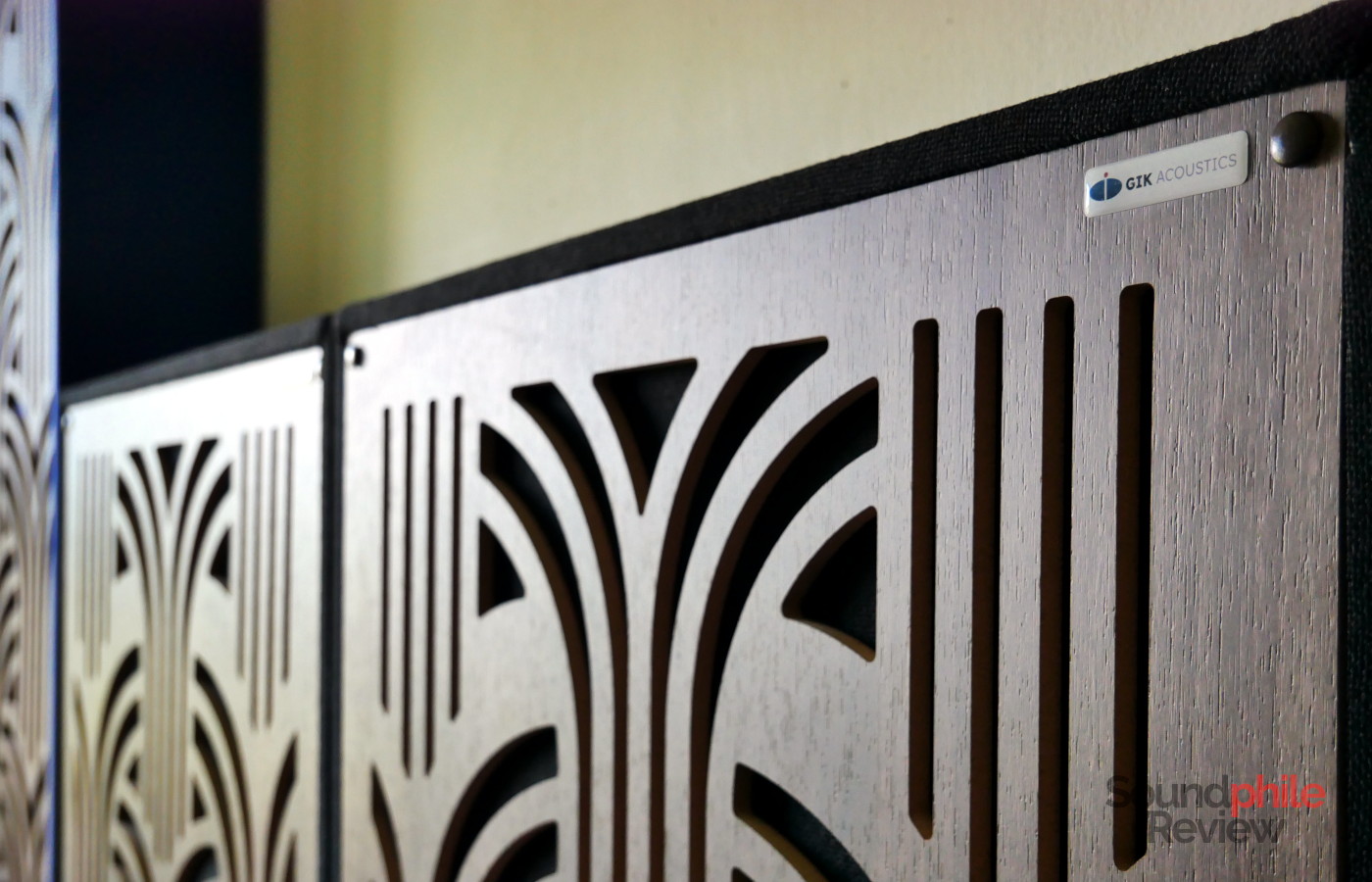
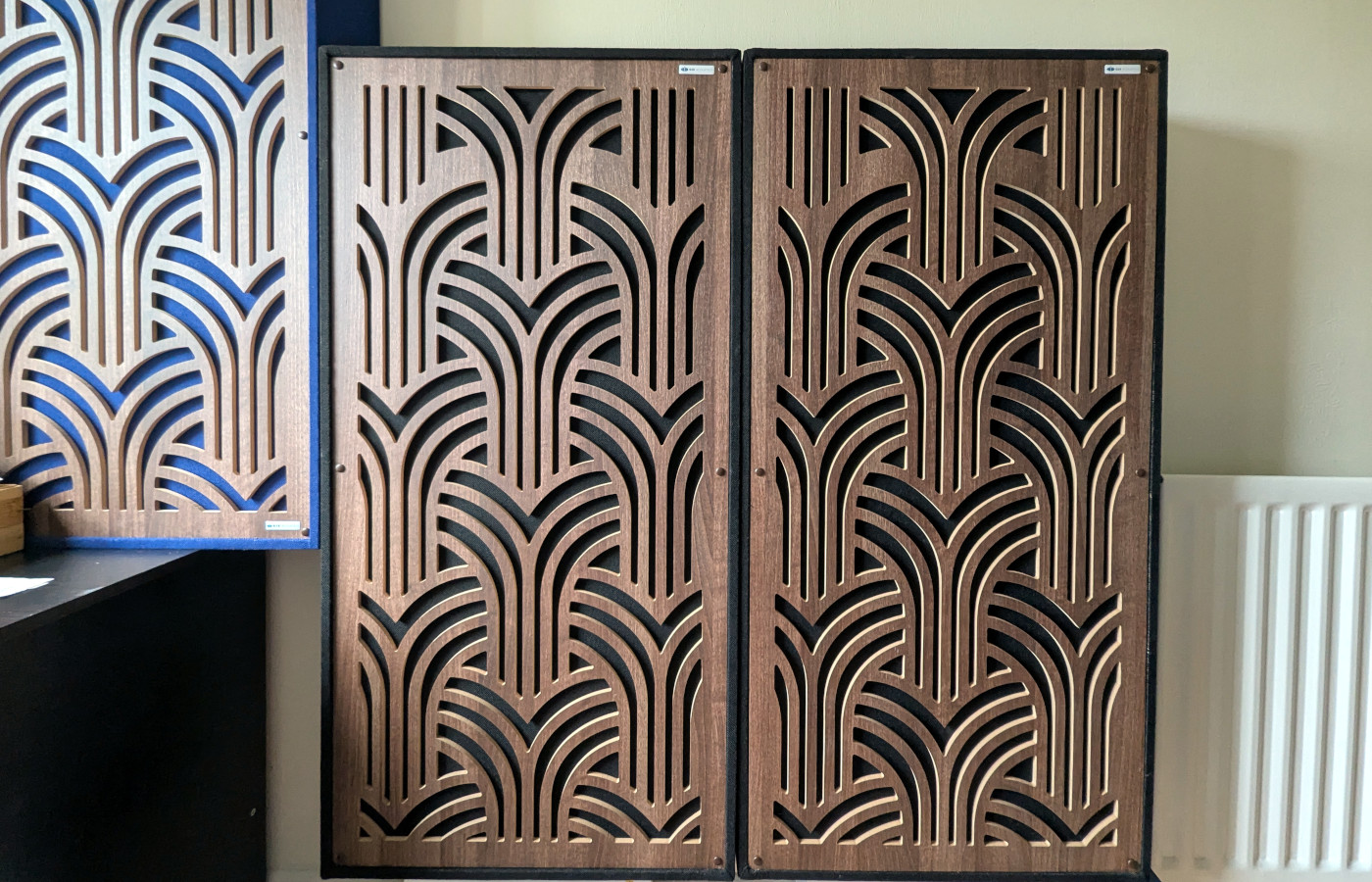
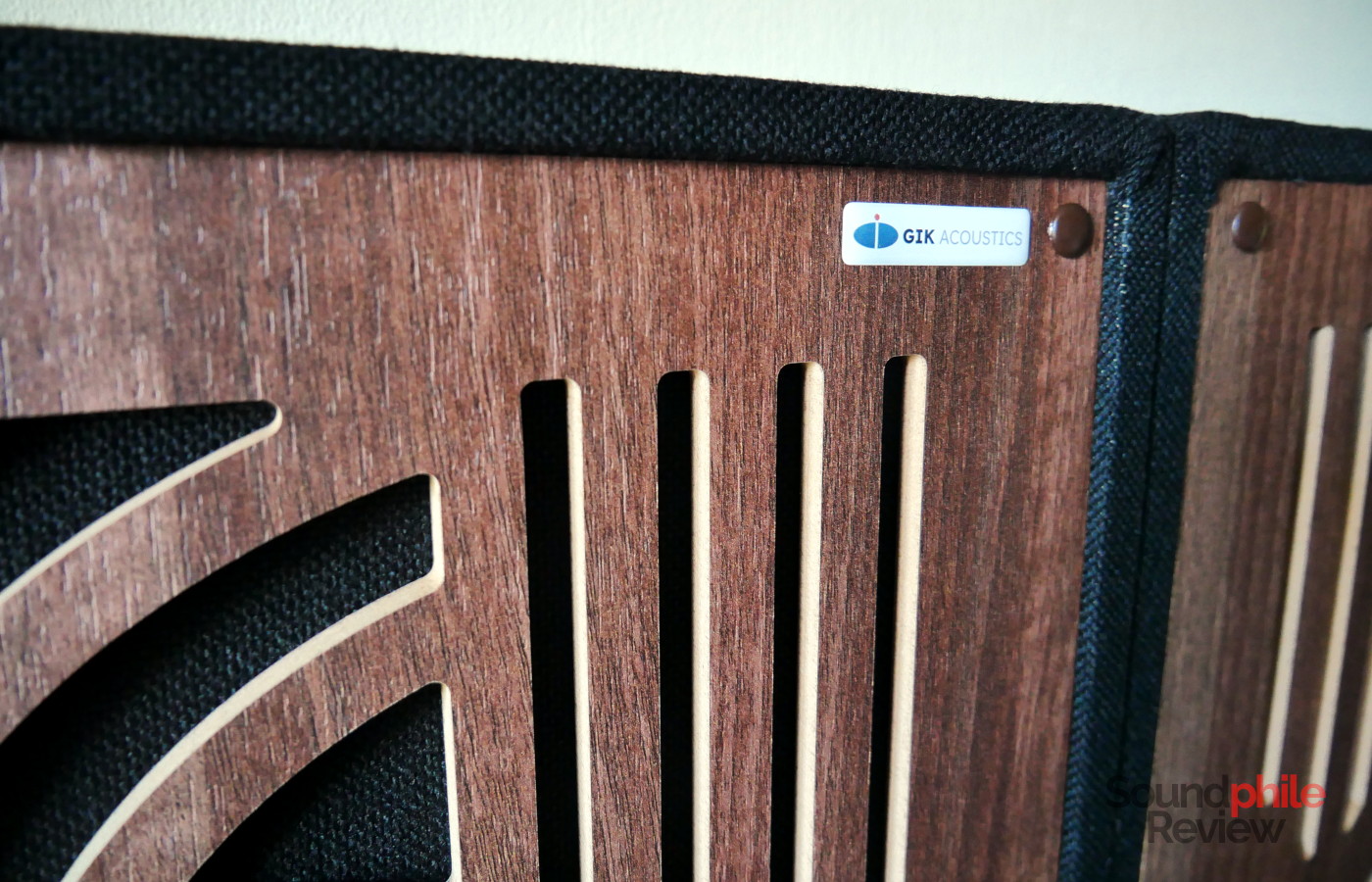
This brings us to the subject of this review. GIK Acoustic’s Amplitude acoustic panels are an option which brings together acoustic treatment and style. Acoustic panels (even those by GIK Acoustics itself) are normally quite simple: a wooden frame with some sound absorbing material inside, covered by acoustically transparent fabric. The Amplitude series brings something new to the table, as it places a decorative wooden panel in front of the sound-absorbing material so that the panels are not just practical, but they have aesthetic value as well. Rather than being a purely functional object, the GIK Acoustics Amplitude panels also become an integral part of your room’s design: while I’m all for functionality, in Italy the proverb says that “the eye wants its share as well”, meaning that you need to consider the appearance of things on top of other practical considerations.
There are several options to choose from; in the case of the panels I received, the design is called Gatsby and it is in fact reminiscent of the 1920s’ and early 1930s’ aesthetics. They come in four different shapes and sizes (a small square plus narrow, tall and medium rectangles) and in a variety of colours and designs: there are twenty colours, thirteen designs, and five wood finishes, for a grand total of 1,300 combinations, excluding the sizes (if we include them, we reach 5,200!). All this to say that there is probably something for everyone, whether you prefer a modern style or a more classic one.
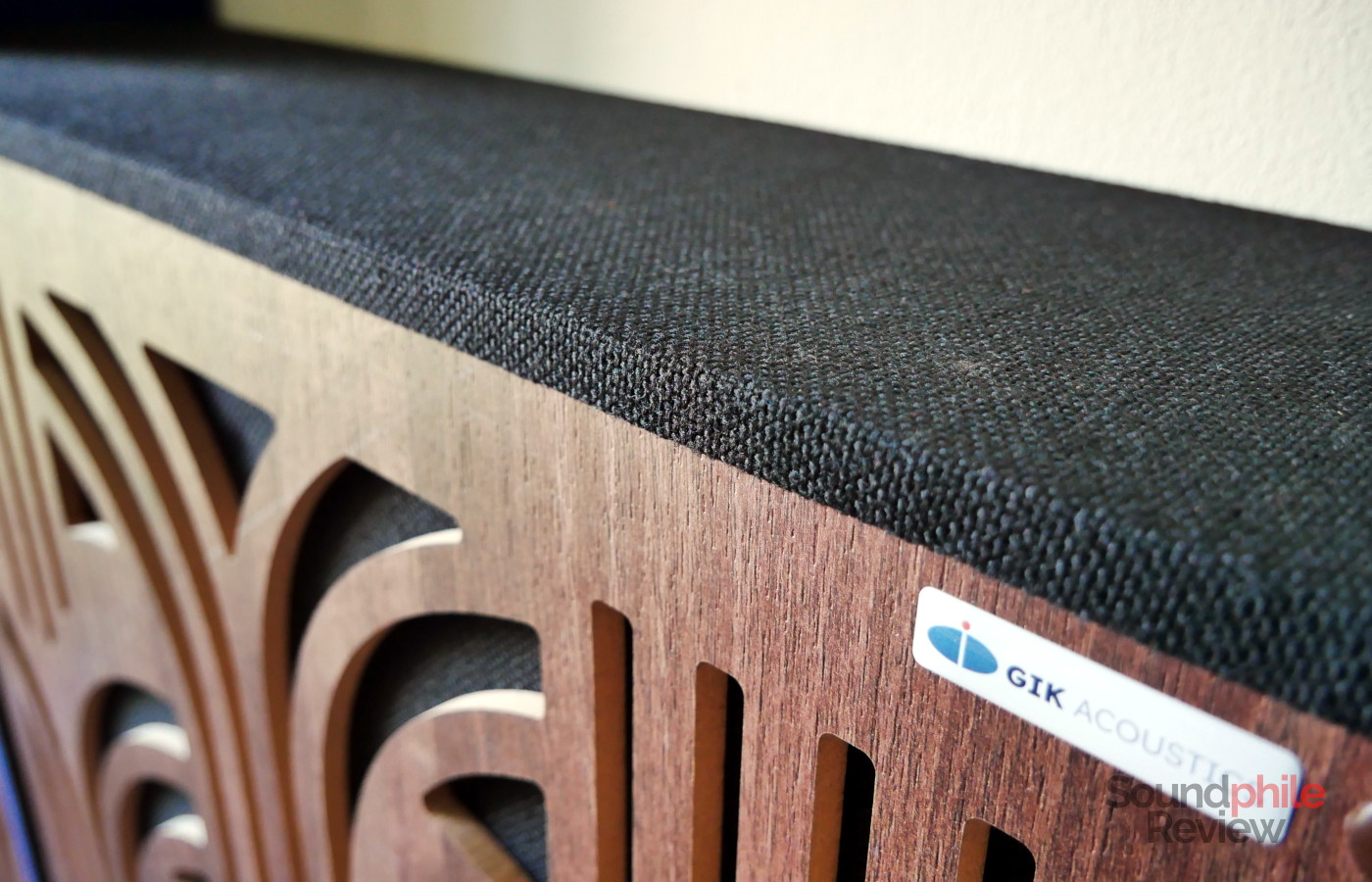
All of GIK Acoutics’ panels are covered in fabrics made by Camira, a manufacturer known for its specially-designed, acoustically-transparent fabrics. In the case of the Amplitude line, the fabrics are from the Camira Cara range. The wood is HDF with a printed layer in your chosen colour variation (beech, walnut, grey elm, black or white) that makes the wooden parts look stylish. Inside the MDF frame and under the fabric there is a mass of rock wool which is the actual sound-absorbing material which makes the panels effective. Build quality is good, as the panels feel solid enough and are assembled with care. Still, I would like to suggest some improvements: the fabric is often stretched thin around the corners, so that it shows the underlying wood; either painting the wood or stretching the fabric less would probably look better.
The panels can be installed in various ways. They can be either set up as free-standing, in which case they can be provided with metal feet, or they can be hung to the wall using sawtooth hangers. As the bass trap version is 16 cm thick, they can require some space in terms of depth, too, so you should take this into account when designing your room – which brings us to the next section.
An ad-hoc solution to your needs

The idea for this article started with a press release being delivered to my inbox about the new Amplitude line. I reached out and asked if it was possible to try the panels out and, after a few emails, we agreed to go through the same process that every customer does: first I would use GIK Acoustics’ online designer to recreate my room digitally, then I would send this digital model with actual pictures of the space to the company, and then we’d discuss what is feasible to get the best acoustics.
The room designer is very easy to use and allows you to recreate your space perfectly. It is compatible with any browser and gives you total design control; in my case it allowed me to recreate the shape of my office room and input all its dimensions, then to place virtual furniture similar to the real one. It took about half an hour to complete the process, and only because I realised that I had used wrong measurements and I had to correct them. It was an overall very smooth experience, accessible to everyone. Once this was done, I generated the link to the design and used the consultation page on GIK Acoustics’ website to send the link, the pictures of my space, as well as more information on it (including what issues I was facing, what my aim was and the speakers I would be using).
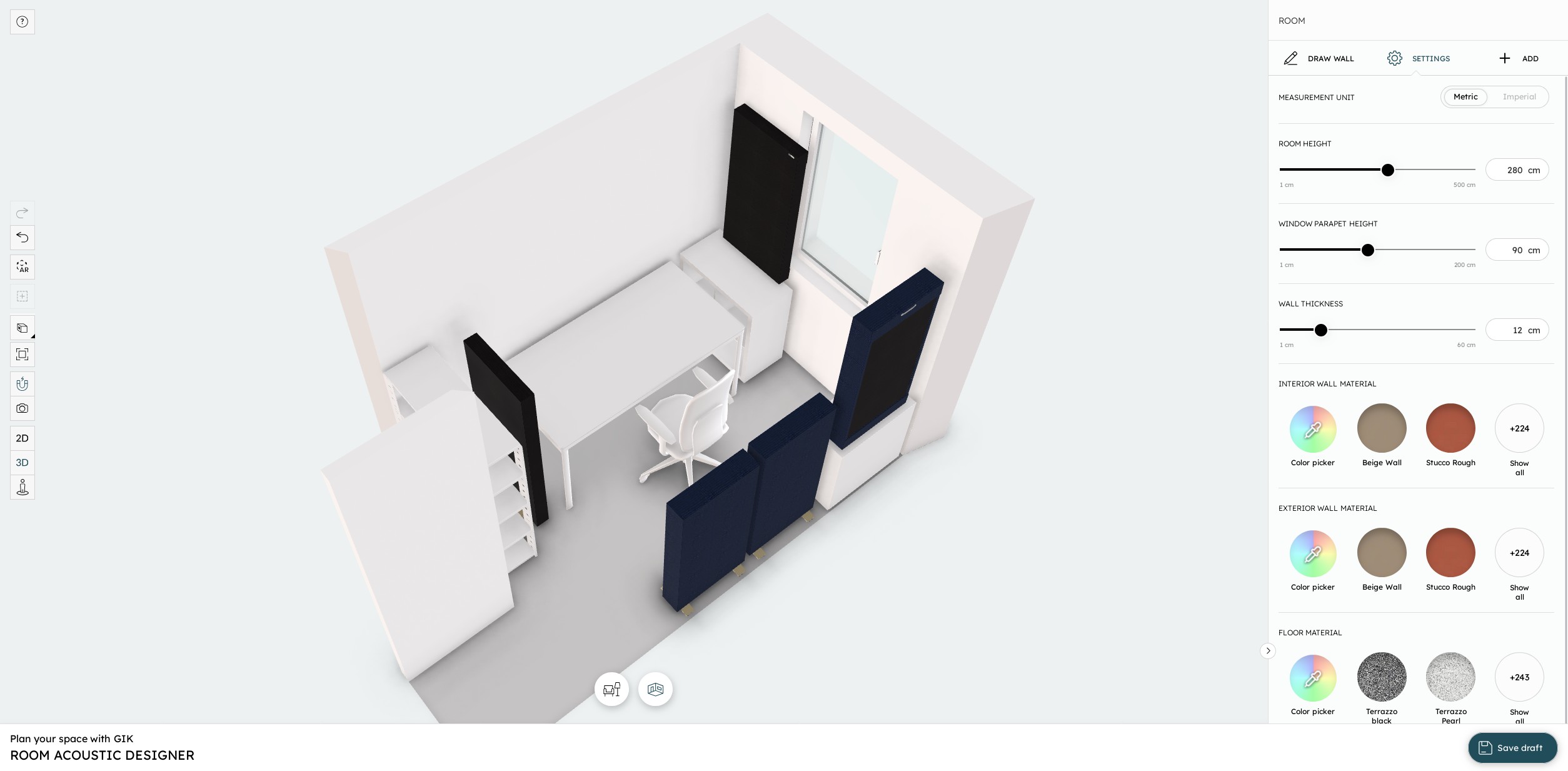
I received a reply just a couple of days later, containing a proposal of what could be done. The first draft included ceiling-mounted absorbing panels, as well as thick panels to put behind the office chair. My office room is unfortunately very small and the thick panels would severely limit the available space; the ceiling-mounted ones were not an option, either, as I am renting the flat and my contract does not allow me to drill into walls or ceilings. I gave this feedback to Lukas, GIK Acoustics’ expert, who kindly provided a couple of alternatives. After a bit of back and forth, we reached a conclusion: the ideal would be to use 15-cm-thick Amplitude panels behind the chair, and absorbing panels to the sides of the desk. You can see the result here.
This all felt very easy and natural. Lukas listened to (well, read) my needs and provided a variety of possible solutions to address them, acknowledging the pros and cons of each solution and advising what the best would be. I received the panels in mid-January; unfortunately two Amplitude panels arrived with broken wooden plaques and had to be replaced. The company took care of the replacement super quickly.
The shipment is, in fact, the only point where I think that things could have been improved. GIK Acoustics assured me that breakage during transport is a rather rare occurrence and, while couriers behaving not ideally (to put it mildly) are obviously the main culprit, they said that they also intervened in the part which they do control of the shipping process, which is the packaging. The new measures they told me they have introduce should further reduce the casualty rate.
How do the GIK Acoustics panels sound?

Before delving into the effects of the panels, a bit of context: I live in a very small flat and I’m lucky enough to have a wee room that I designated as my office, as I work from home. This is the room that underwent acoustic treatment with GIK Acoustics panels. It is very small: it is just 2.8 x 2.2 m; this means that there is only space for my desk, a set of shelves and a little bit of storage in the form of an IKEA Kallax and a chest of drawers. The small size makes it an acoustically difficult space, as there is a lot of flutter echo (a sort of quick echo caused by the reflection on close parallel surfaces). My desk is sitting along the long side of the room and this means that I have a completely empty wall behind me – which I can’t really fill with, say, a bookshelf either due to space constraints.
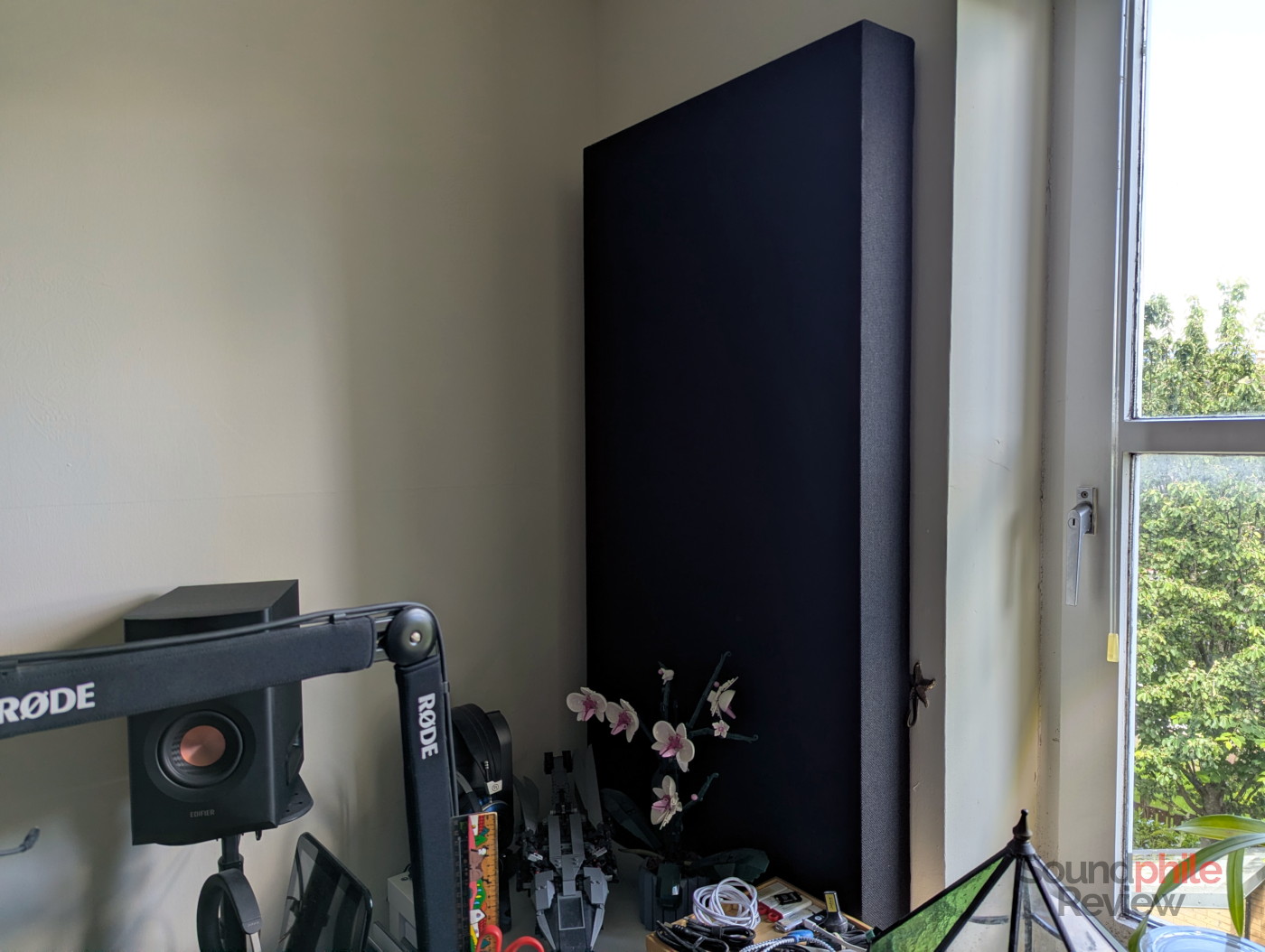
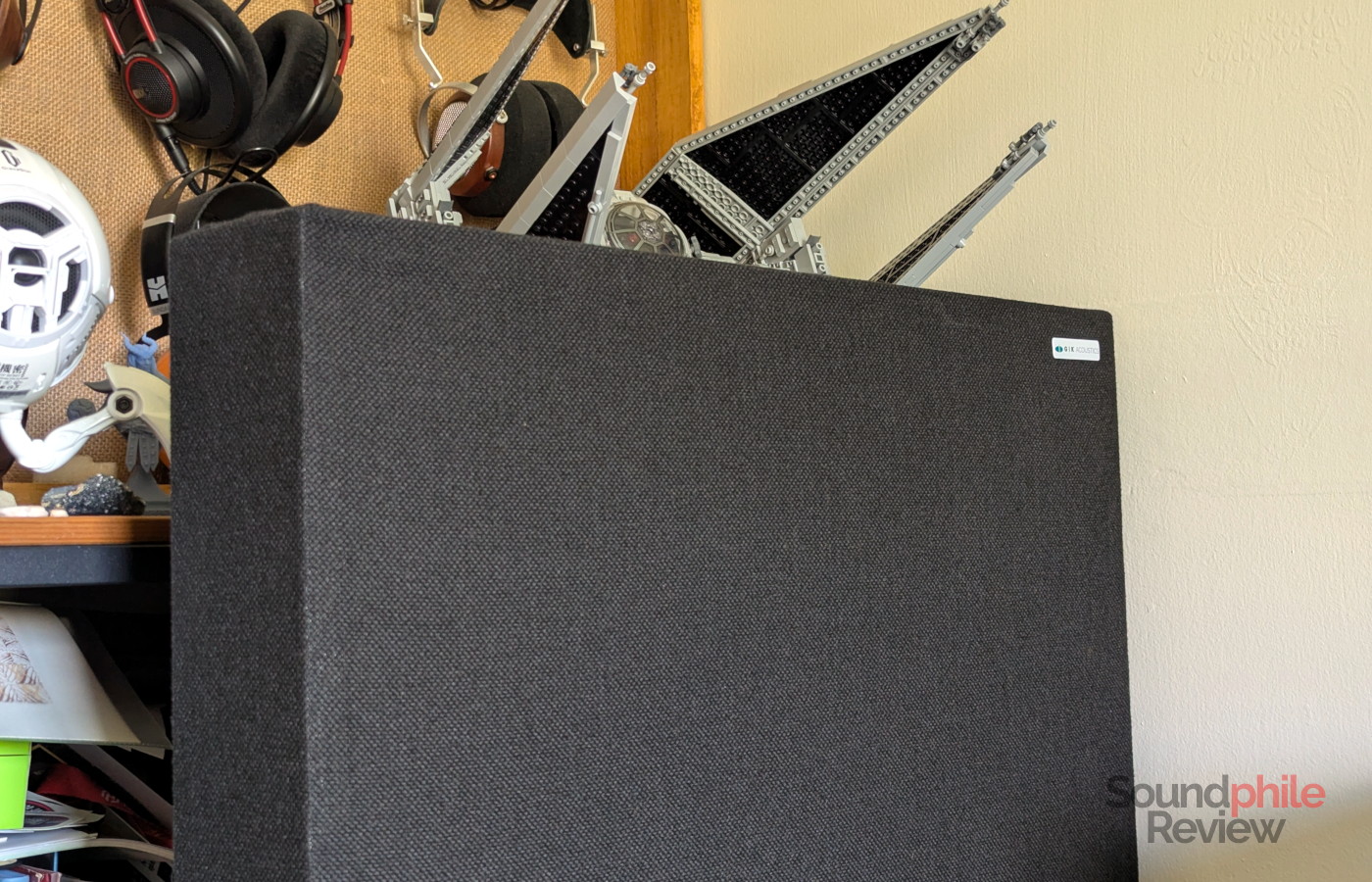
GIK Acoustics sent three Amplitude bass trap panels, as well as a 10-cm FreeStand panel and a Classic Acoustic Panel; the Amplitude panels would go behind my chair so that they’d cover the empty wall, while the other two panels would sit at each side of the desk. The company advised me to use panels on the ceiling as well, but alas that isn’t possible due to limitations imposed by my rent contract. For the same reason, I couldn’t hang the Amplitude panels to the wall and I had to use stands.
Given the space constraints as well as those imposed by renting, the final setup is one that still significantly improves the acoustics of the room. While it does not completely eliminate the flutter echo (that would probably require further panels behind the monitor screen and on the ceiling), it reduces it noticeably and brings to a level where it is barely noticeable. The situation was quite dire, as I would hear my echo while on call, while now I can only notice the echo if I shout – not something that ever happens, mind you. Music has significantly improved, too: I used to get a headache when listening to music in the room for longer than half an hour, whereas now I can listen to music for hours without issues. The difference is stark and immediately noticeable, even when using speakers in a near-field configuration, as the space is so small that using them that way makes little difference.
It was especially the mids that were problematic in my room, and particularly the middle and upper mids: anything between 1 kHz and 3 kHz was boosted, and I could notice a boost in the 5 – 8 kHz range, too. In short, things became too bright. My ELAC DBR62 speakers, which sound perfectly good in my living room, were very fatiguing in the office. The acoustic panels have reduced this problem to the point where it is now almost undetectable – I can still hear some additional emphasis on those frequencies, but it’s because I know it is there. I’ve also tried a pair of Edifier MR5 and found that they had similar issues, but they worked really well once I installed the panels, too.
My case is quite extreme and won’t be representative of everyone’s experience; it does, however, showcase how proper acoustic treatment can help to make even an arguably completely unsuitable space far more forgiving and even acoustically decent. In larger spaces, acoustic panels can help take things from “okay” to “good” or “great”.
Final Thoughts
People say that the biggest sound change comes from speakers, followed by the amplifier, and then by DACs, streamers and cables (turntables probably sit together with the amplifier). I would argue that we should always include another element, acoustic treatment, and that it should come right after the speakers. That is the reason why concert halls are built the way they are: because they are made to make the sound move across the space in such a way that it arrives intact to the ears of the listeners. Getting the perfect acoustics in a space which isn’t designed for such a purpose is hard, and sometimes it might be impossible, but a lot can be done to make things better.
The GIK Acoustics panels, be it the Amplitude line-up or the Classic or FreeStand panels, help a lot in this regard. They make it easy to improve the acoustics of your space and, in the case of the Amplitude models, they do so with style, too. What I found interesting is that the panels are relatively affordable, too: the whole setup for my room costs £1,075 (£109 for the Classic panel; £219 for the FreeStand one; £249 for each Amplitude panel). If you don’t need bass traps, the cost for a similar setup goes down significantly. While this isn’t cheap in absolute terms, I find it reasonable for the great results it offers – and definitely cheaper than the £1,000-per-metre Ethernet cables you can find on the market.
I’m overall not just satisfied, but very impressed with the GIK Acoustics panels. They changed my space for the better and made me appreciate my speakers and my listening space again. And that really is something special.