Nostalgia is very powerful, and we all yearn for those we perceive as simpler and better times. Ask Marcel Proust if you don’t believe me. The current wave of nostalgia that seems to cross generations is for the ’90s and the audio world is not immune to this phenomenon, as people are embracing CDs and wired headphones again. The Hidizs AP30 Music Boy rides this wave with a definite retro design coupled with very modern features. If the design wasn’t clear enough in its reference, the name leaves no doubt. The AP30 is a fantastic little device which, however, still needs some work with the firmware – read on for all the details.
Disclaimer: I received this unit free of charge from Hidizs. The AP30 has an official retail price of $119, which is reduced to $85 for the Kickstarter campaign. Additional information on the official website.
TL;DR: recap
| Pros |
Cons |
| + Super cute retro design
+ Can be attached to smartphones + Balanced output + Powerful enough for the majority of headphones + A Tetris clone to combat boredom |
– Firmware is immature and requires updates
– Battery is inexplicably small compared to the chassis |
Rating: 6.5*/10
Packaging & Accessories
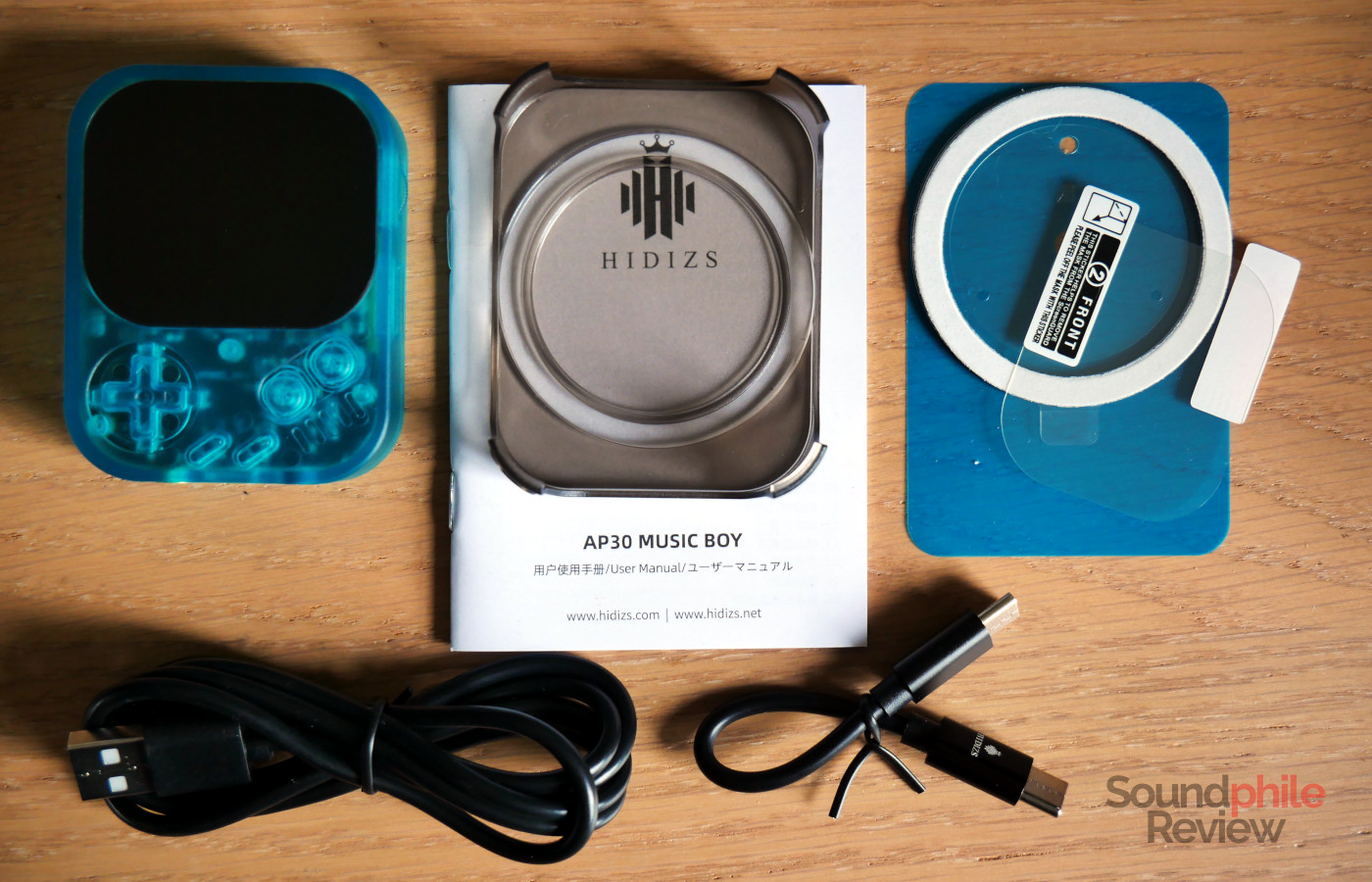
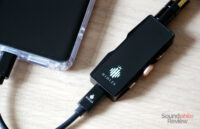
The Hidizs AP30 comes in a cardboard box inside a cardboard box. The fit is very snug and I found that it is better to open the box from the bottom end as that makes it significantly easier to take the inner box out. Inside we find the player itself, a USB to USB-C cable, a short USB-C to USB-C cable, a manual, a screen protector (though one is already factory applied) as well as a transparent plastic case and a metal ring. The latter can be divided into a ring of magnets, which are meant to be placed into the case, and a metal ring, which can be applied to phones and phone cases that do not already have a magnetic ring. This allows you to place the AP30 on the back of a phone and use it as a DAC.
Design & Build
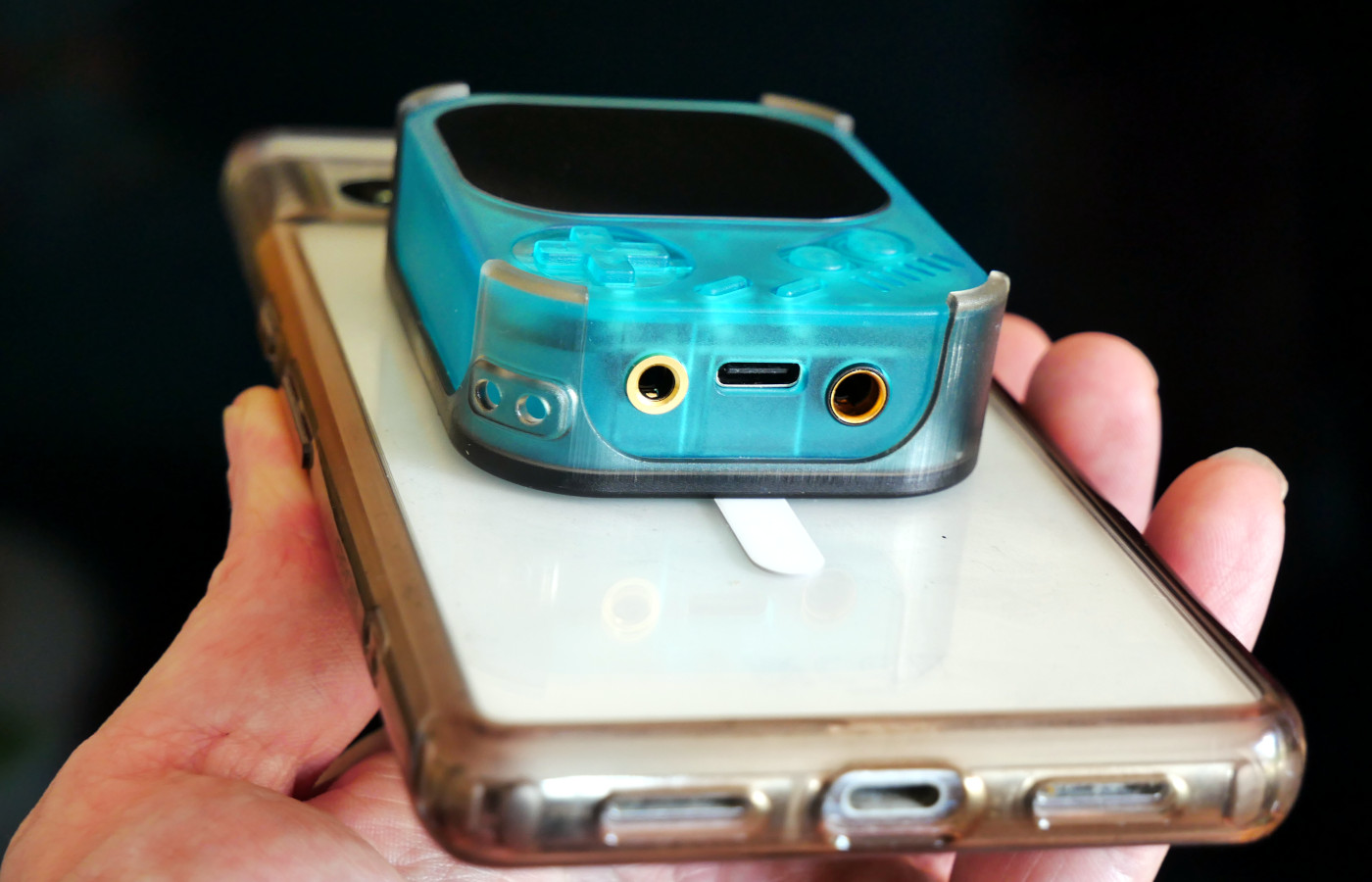
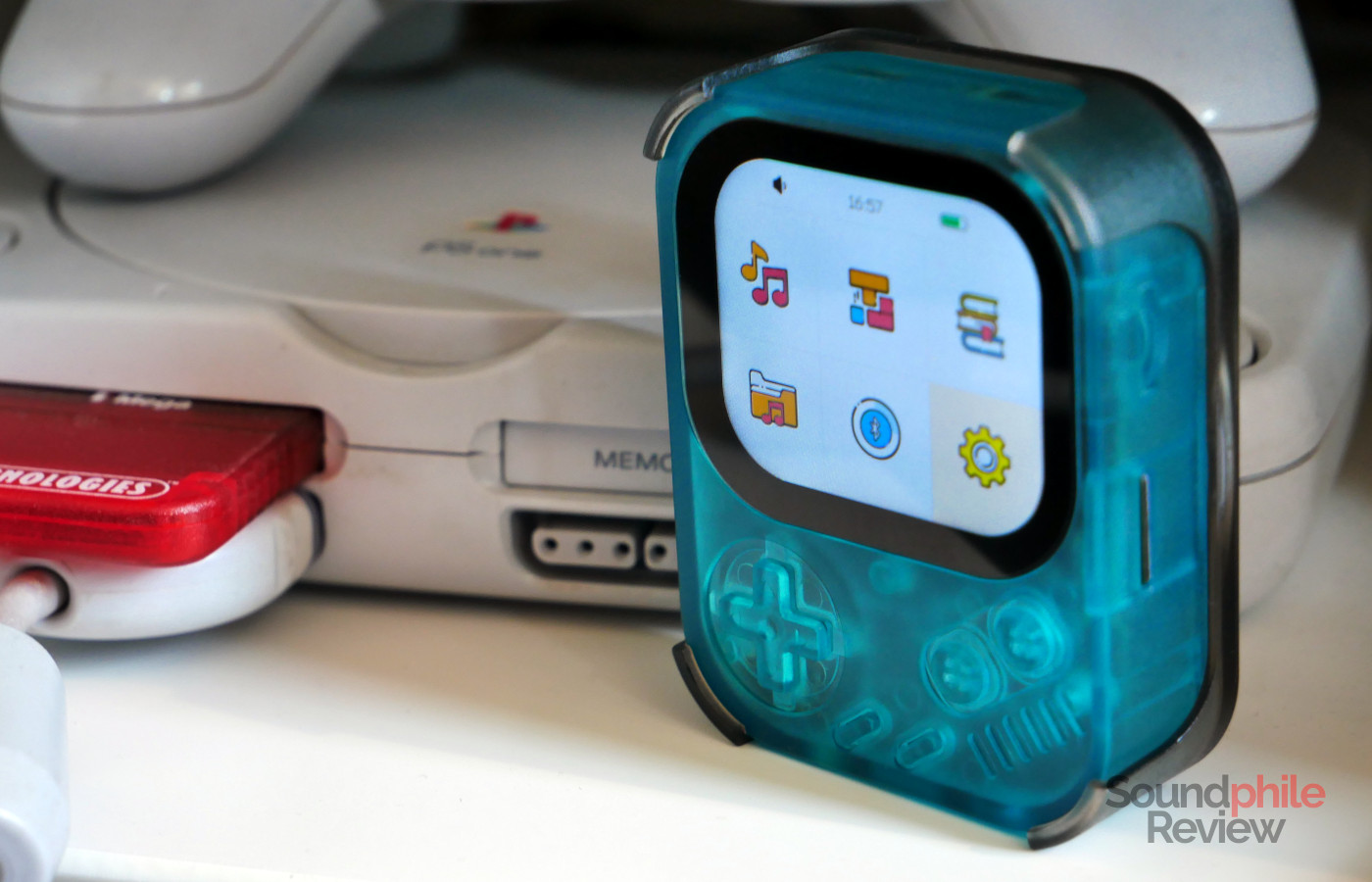
The Hidizs AP30 Music Boy is designed to look like a small Game Boy, complete with the classic D-pad and “start” and “select” buttons. Hidizs has chosen to use a very ’90s aesthetic in choosing the colours as well: the shell can be white, transparent blue, transparent black, purple and black. The difference in colour is also a difference in shell materials: the latter two are made of aluminium, while the former three are made of plastic. There’s a small weight difference between the two, as the plastic version weighs 56 g and the aluminium one 80 g. The transparent blue version Hidizs sent me is a real throwback to the late ’90s as it perfectly captures the so-called Y2K aesthetic and its use of transparency – and it reminds me a lot of Nintendo devices of the time. You can see every component inside the shell, which is very interesting and adds a touch of fun to the device.
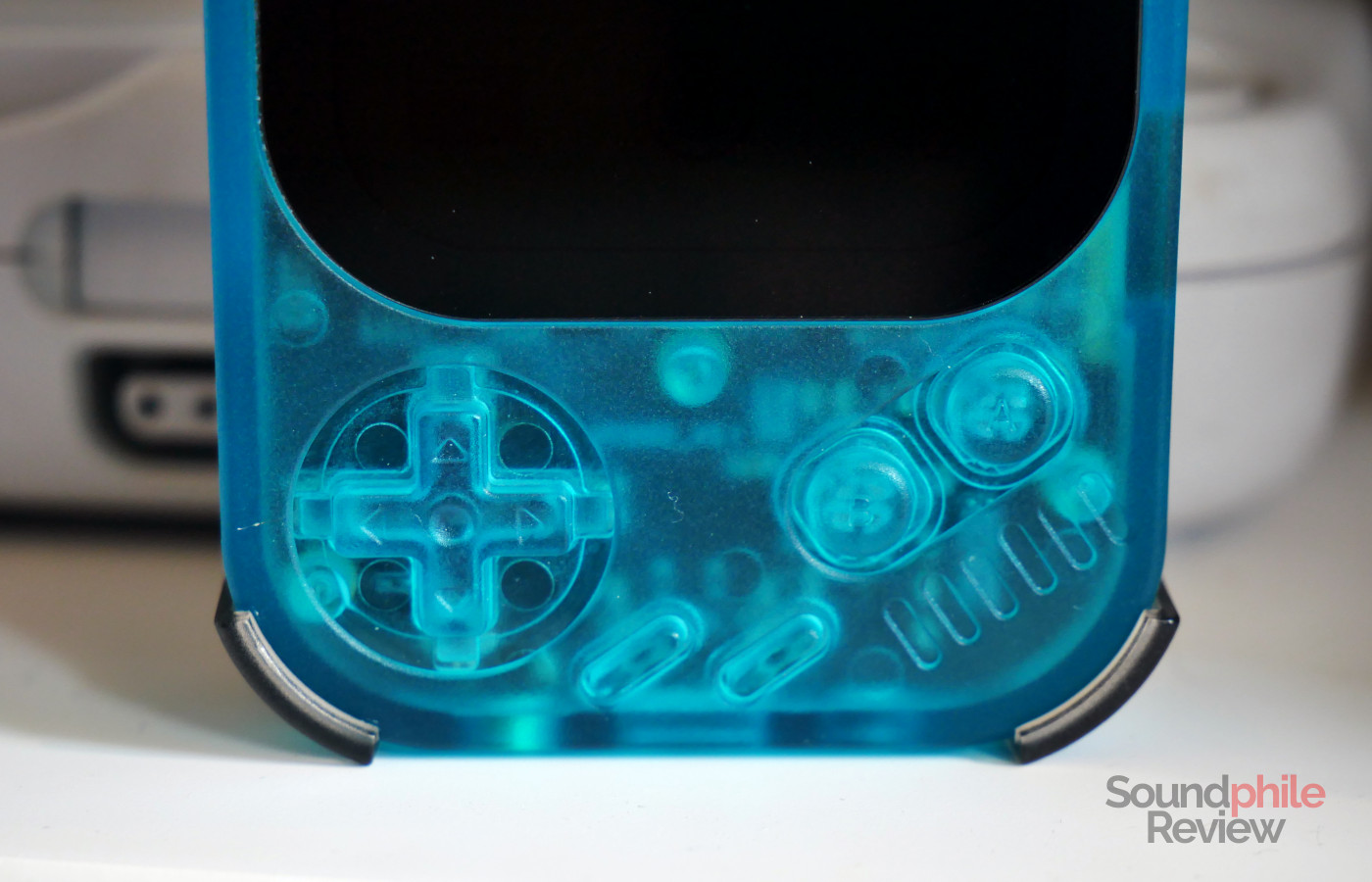
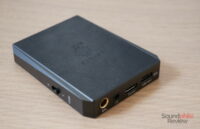
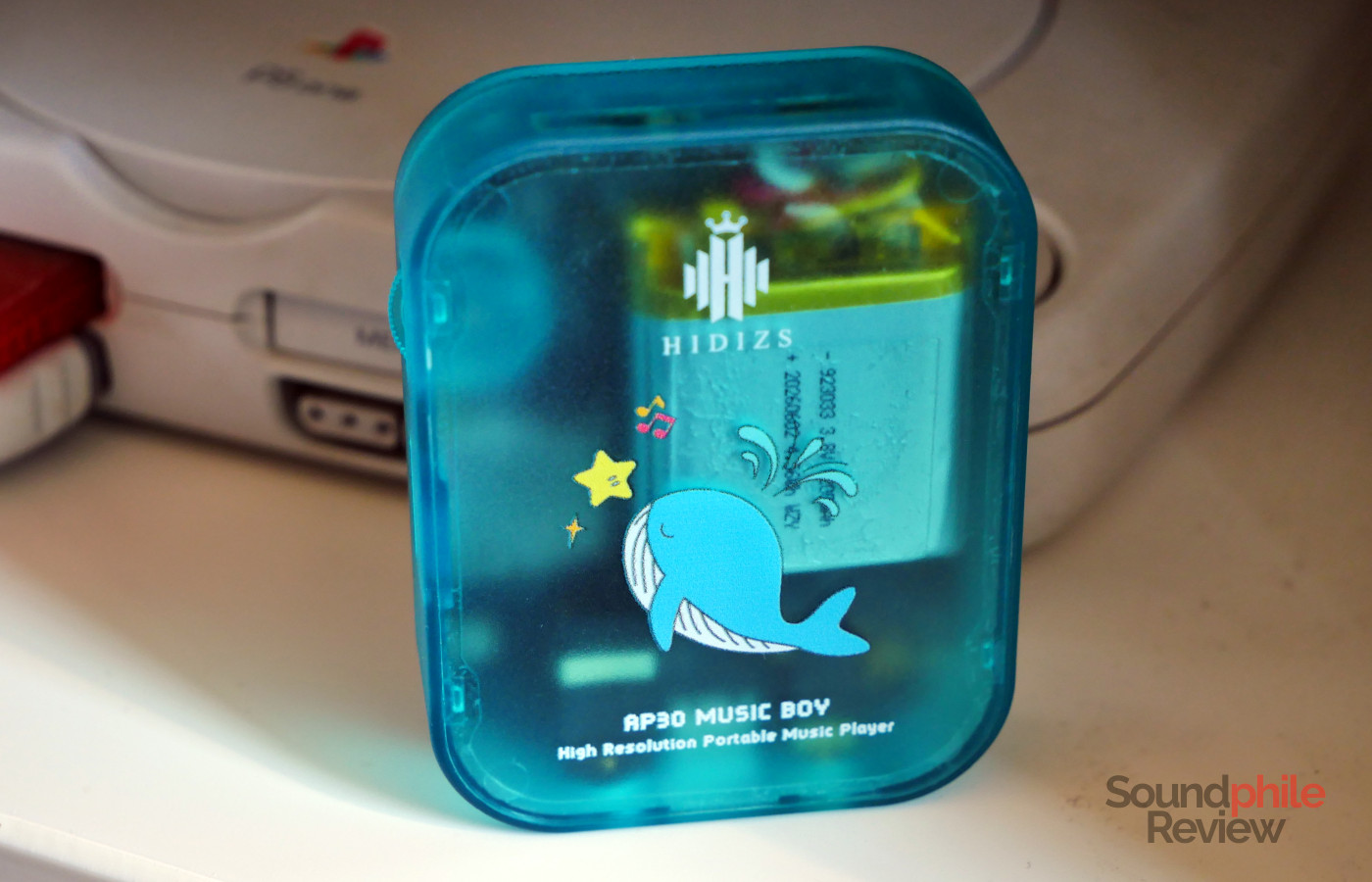
The front of the Hidizs AP30 hosts a 2-inch screen with a 296 x 240 resolution, which is enough to read text clearly, as well as a D-Pad and four other buttons (A, B, plus unmarked buttons on the bottom, which we’ll call “select” for the left one and “start” for the right one for convenience). The bottom side sports a USB-C connector flanked by two jack sockets (3.5 mm and 4.4 mm), while on the right hand side we find the volume wheel (which is knurled and also acts as a power button) and the microSD slot. The back has a whale drawing on it, as Hidizs has been partnering with the Whales and Dolphins Conservation charity which has been working for the protection of whales and dolphins since 1987; a portion of the revenue from the AP30 will go towards funding of the organisation, which is a laudable initiative by Hidizs.
The screen has good brightness and is legible even under direct sunlight. It is quite particular in the fact that it is not rectangular, as the corners are all rounded.
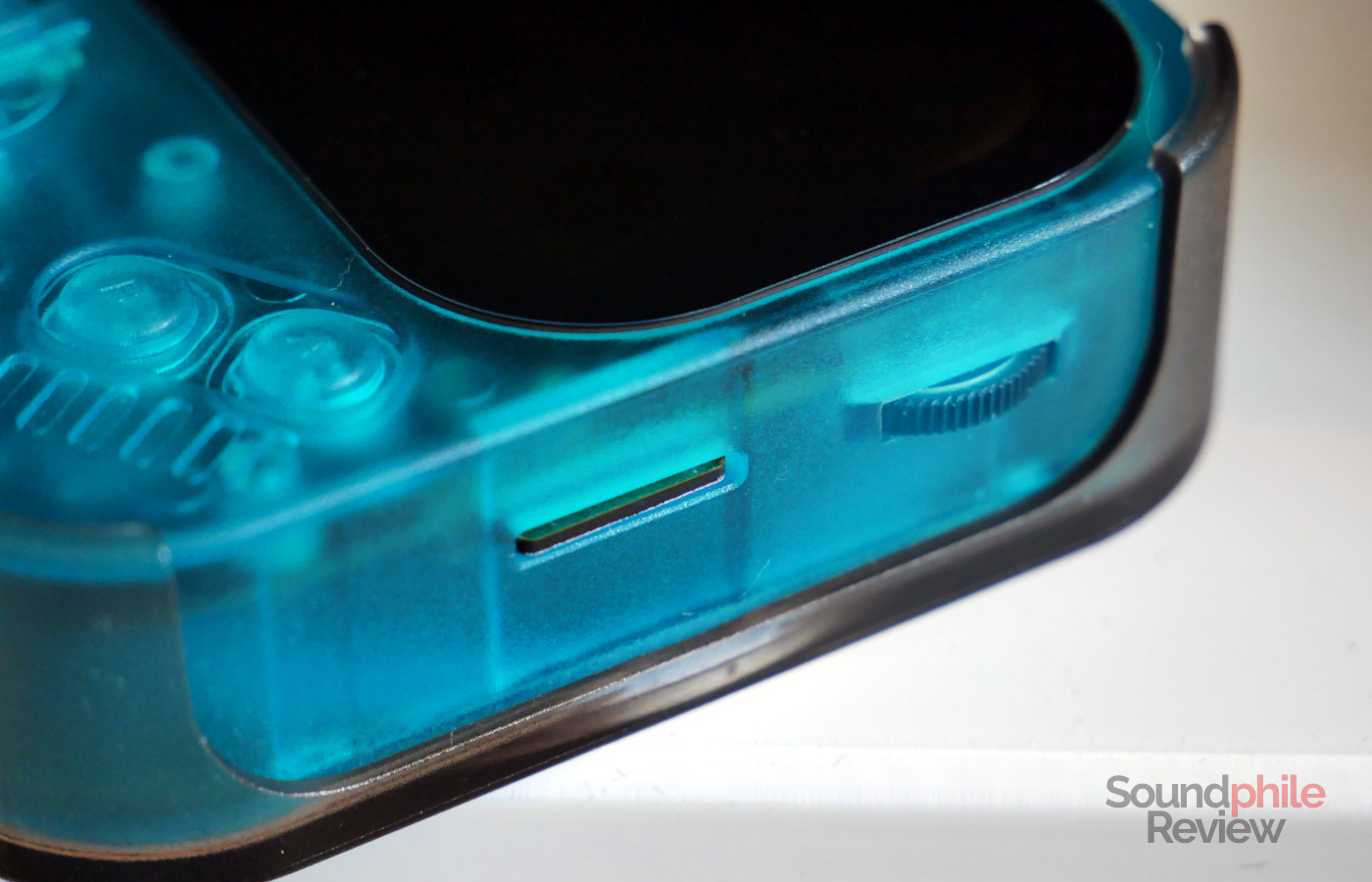
Build quality appears to be great, and the Hidizs AP30 Music Boy looks like a solid device which is well-assembled both inside and outside. The shell is made of two pieces, one being the back and one being everything else, which appear to be fused together.
The volume wheel spins in steps, which offer both tactile and acoustic feedback. It is very precise and it never misses a click.
Specifications
Hidizs AP30 Music Boy |
| DAC chip | Cirrus Logic CS43198 |
| Amp chip | Ricore RT6863 |
| Suitable headphones impedance | 8 – 100 Ω |
| Output impedance | N/A |
| Maximum output power | Single-ended:
Balanced:
|
| THD+N (@1 kHz) | 0.0008% (single-ended) 0.0015% (balanced) |
| SNR | 120 dB (single-ended) 127 dB (balanced) |
| Operating System | HidzsOS |
| Supported formats | PCM up to 24 bit / 192 kHz DSD up to DSD256 |
The Hidizs AP30 Music Boy is equipped with a Cirrus Logic CS43198 DAC chip, an older (but still valid) chip which is actually not used to its fullest capabilities in regards to supported bit depth and sampling rate. The op-amp is a Ricore RT6863, which is designed to be used in a variety of applications including mobile devices, according to the official documentation. Thanks to this pairing, the AP30 outputs 61 mW in single-ended mode and 137 mW in balanced mode, which is quite close to the more expensive AP80 PRO MAX.
Hidizs claims that the AP30 can support microSD cards up to 256 GB, but this needs to be put in context. The player is able to read a card larger than 256 without issues, as I have tested by using a 512 GB card; the library scan won’t however go beyond the 256 GB limit. More on this in the software section.
The AP30 Music Boy comes with Bluetooth 5.3, which only supports the SBC codec (so no high-quality codecs like LDAC) and only supports transmission (you can’t use the AP30 as a receiver like you can with the other AP-series devices). Likewise, you can only use the AP30 as a USB DAC, but you can’t use external DACs with it.
Battery Life
Hidizs chose to use a 1,200 mAh battery inside the AP30 Music Boy, which the company says grants 8-10 hours of playback in balanced mode and 10-12 hours in single-ended mode. When using Bluetooth, this is further reduced to 6-8 hours. These figures are realistic in my experience.
One criticism that can be moved to Hidizs in this regard is that they appear to have purposefully chosen to use a small battery. The transparent case shows very clearly that there is abundant space to fit a much larger battery inside, and therefore that the device could have had much better battery life.
Software
Before delving into the Hidizs AP30’s software, let me preface this by saying that the unit I got is a pre-production one with firmware that will (hopefully, and according to what the company told me) evolve and change over time. Hidizs has developed a new OS from the ground up and called it HidizsOS. It will feel quite familiar to those who have used previous products by the company, as the general feel is very similar. The top of the screen always shows a volume icon (with small audio waves that indicate the current volume level), the time and the battery level (through a battery icon).
The main screen allows you to access all of the various features of the device: the music library, the Tetris game, the ebook reader, the file explorer, the Bluetooth settings and the system settings. You navigate the screens by using the D-pad, using “A” to confirm and “B” to cancel or go back. The bottom right button controls playback (play/pause) and allows you to go straight to the “now playing” screen if you hold it. The button next to it allows you to bring up an options menu.
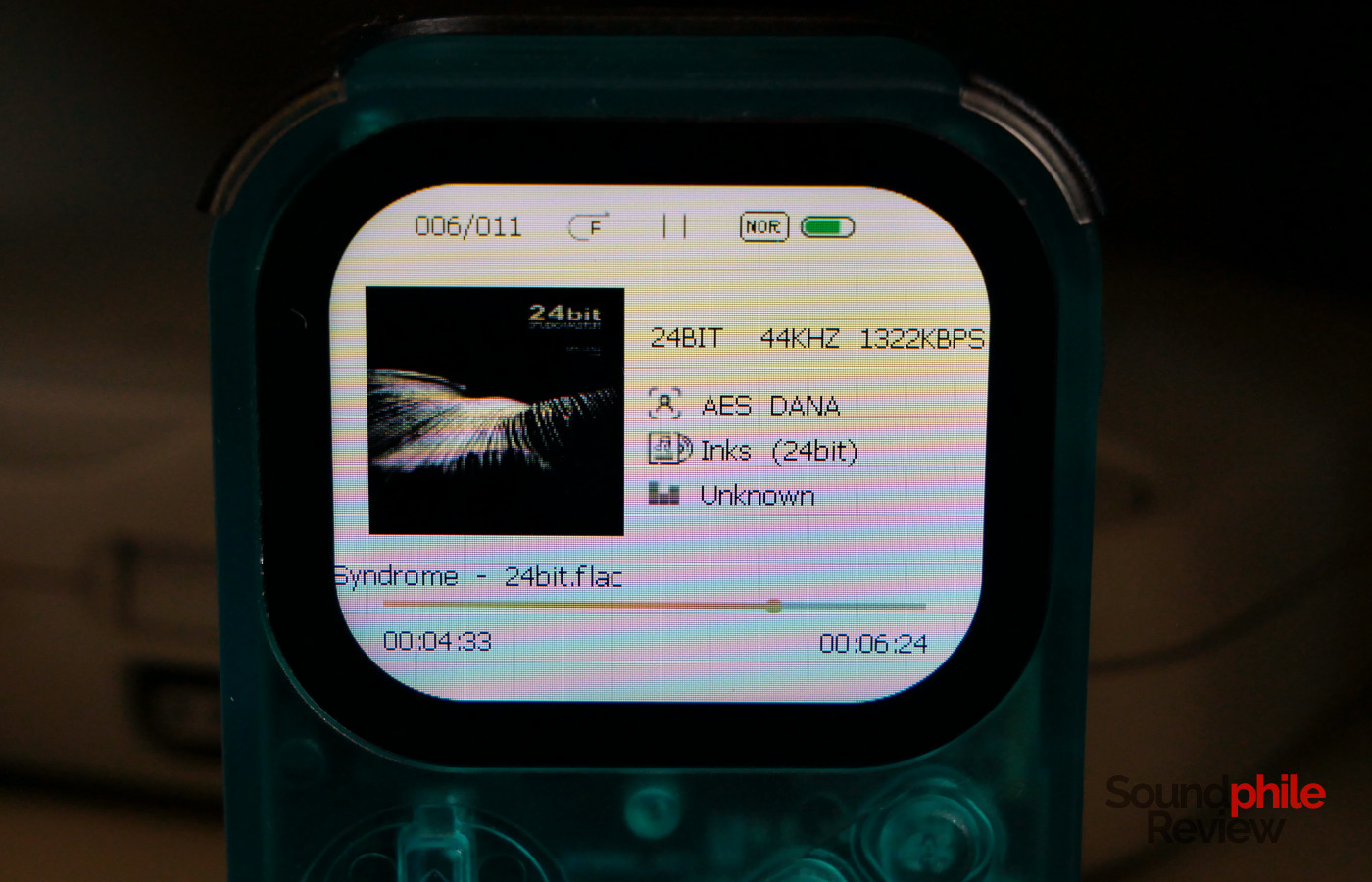
It takes about 10 minutes for the device to scan a 256 GB collection, which is a very reasonable time. Navigation through the collection, however, is very slow if you don’t go by anything that’s not folders pre-arranged by letter/artist/album. The reason is that by pressing right or left you move through pages of elements (e.g. artists), but the device is still only displaying 6 at a time and it takes a while to go through a long list of them. Even when you use the folder view, however, there are issues: the tracks are not always sorted alphabetically, which causes obvious issues when playing albums with tracks being out of order.
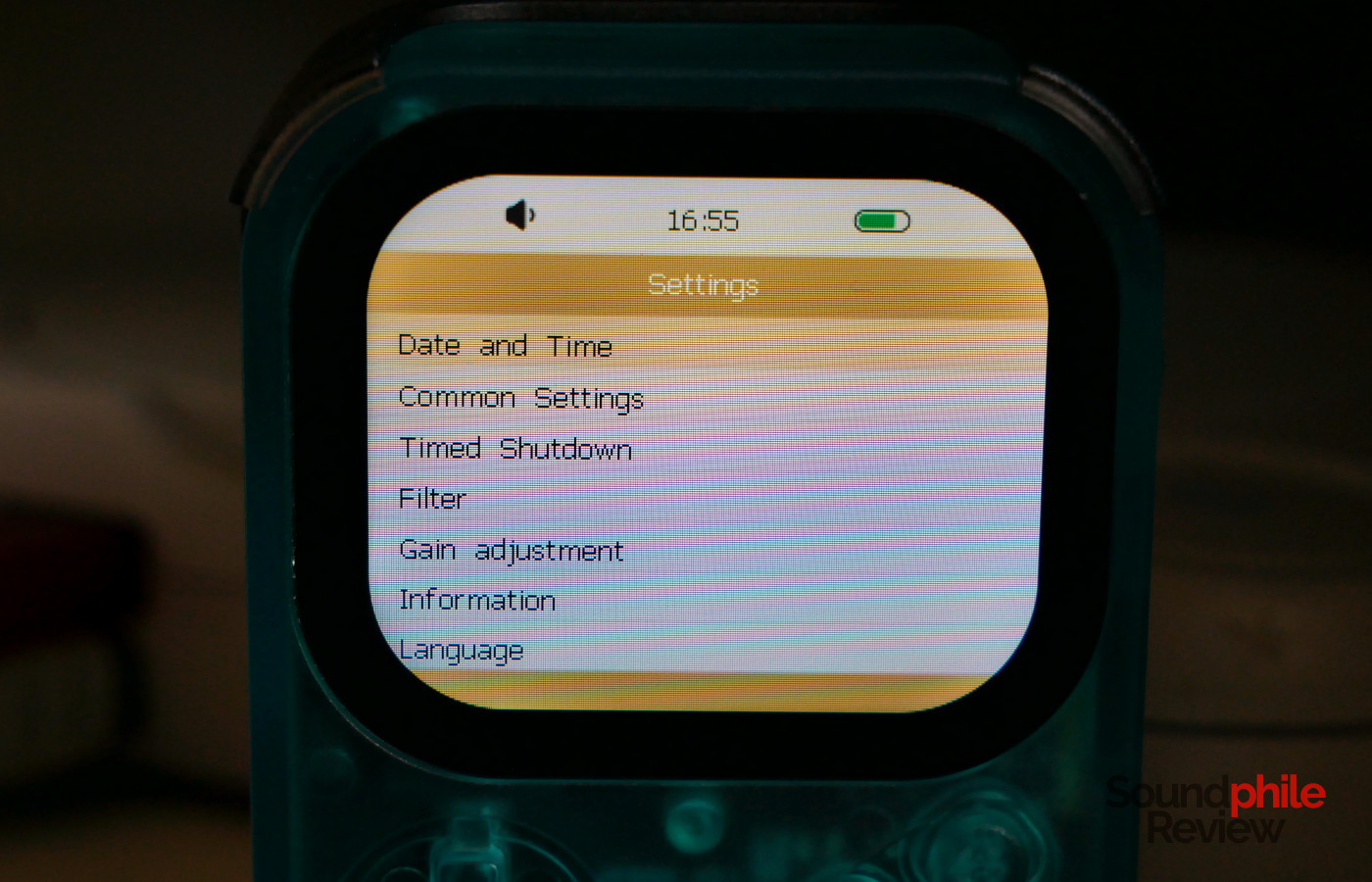
The settings are few and sometimes a bit bizarre. Apart from the standard ones (date and time, language, screen off timer, brightness, gain, audio filter, idle power off and shutdown timer), there are some in the playback section that are quite unusual like the times a track should be repeated or how many seconds of it should be repeated.
The experience is overall quite smooth and fast, with the system reacting promptly to user input. There are, however, situations in which the device can take a few seconds to respond, as well as cases where the firmware is showing that it is still in a pre-production stage (e.g. there is no way to exit the screen to reset the device, except by bringing up the “now playing” screen). Long-pressing the “start” button brings up the “now playing” screen, but sometimes that takes a few seconds to happen and leaves the whole interface frozen. There are multiple instances of that happening, and they leave you wondering whether the device is just stuck or it will recover (it always does, thankfully).
The firmware behaves strangely when using a microSD card bigger than 256 GB, as it actually reads the card but then struggles managing it. By that I mean that the player will allow you to scan the card to populate its library, and it will allow you to browse music files, but it will show some limitations: it will only scan the first 256 GB of the microSD card and ignore the rest and, if you manually play something by browsing the files rather than by using the library feature, it will not keep on playing from the same folder, reverting to a folder inside the 256 GB limit after a couple of tracks. In all fairness to Hidizs, they do say that 256 GB is the maximum supported size!
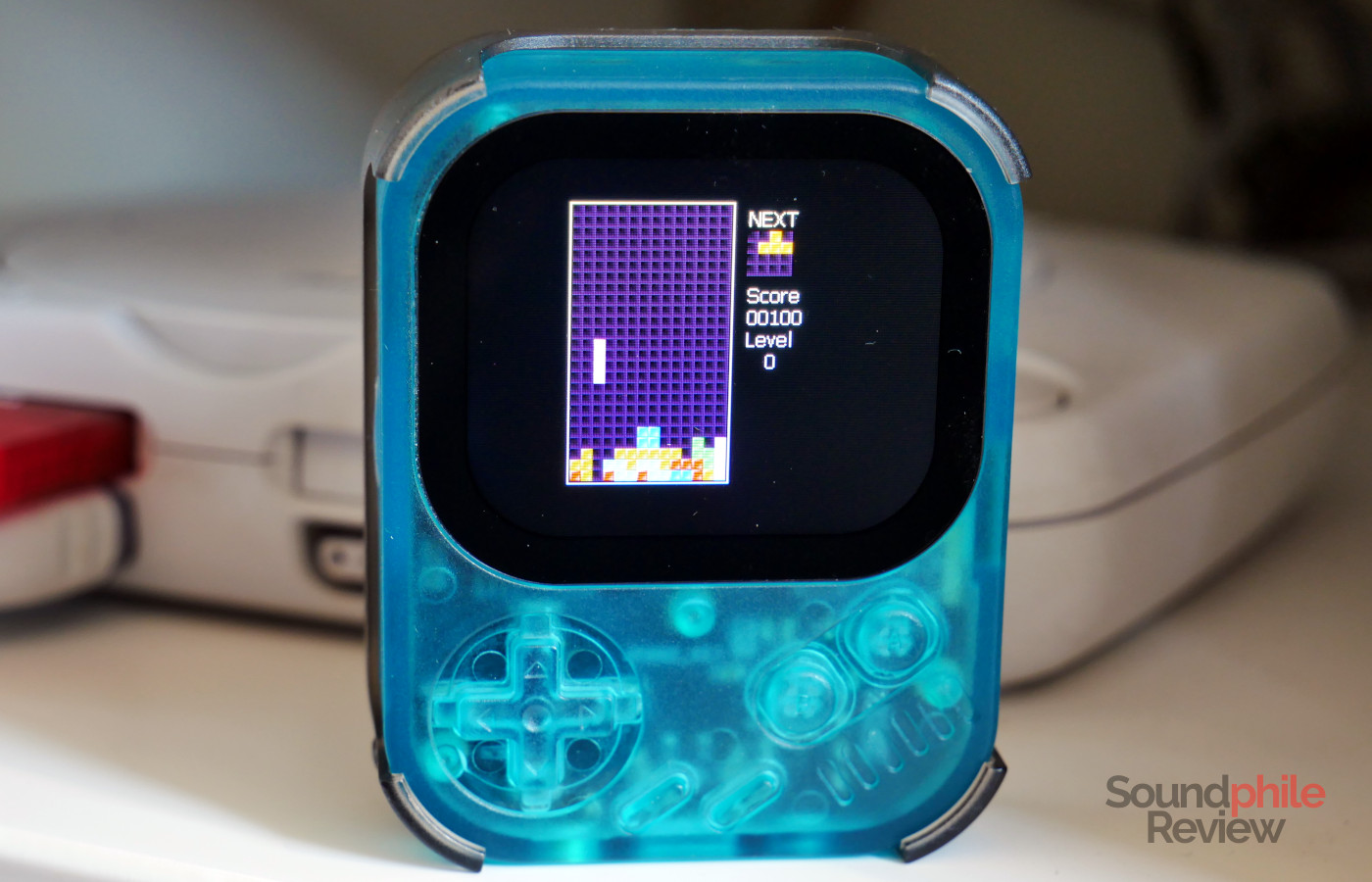
One of the weirdest features of the AP30 is that it includes a game of Tetris. Playing it on such a small screen is no small feat, as it really takes dedication – and more often than not you will find making mistakes as it is difficult to understand where the pieces will land due to the small size. It is nonetheless a well-made, if very simple, clone of Tetris that works well and is definitely in tune with the nostalgia theme of the device. The device also comes with an ebook reader, which is however made very difficult to use by the tiny screen – in fact, I find it unusable as the text is just too small and there is too little of it on the screen.
Sound
I tested the Hidizs AP30 Music Boy with several headphones, including the HiFiMAN Edition XV and the Hidizs MP145 Pro.
There is no background hiss when using the AP30, even when driving low-impedance, high-sensitivity earphones. The device is just completely silent, which is very positive.
As one could legitimately expect, the AP30 sounds perfectly neutral. Its output, especially in balanced mode, is powerful enough to drive most headphones out there to ear-splitting levels without breaking a sweat. Headphones with higher impedance or impedance spikes, such as the Sennheiser HD6XX/650/600, might however not be driven correctly as the DAP does not have enough power in single-ended mode to reproduce those frequencies corresponding to impedance spikes. Conversely, the same applies to headphones with constant impedance but low sensitivity, which then require a lot of power, like the HiFiMAN HE-560. In balanced mode there is ample power available and the issue is simply not there.
Final Thoughts
The Hidizs AP30 Music Boy plays heavily on nostalgia. It worked with me, as I replied immediately when Hidizs asked whether I was interested. The Game Boy-like design, the semi-transparent plastic, the small size that make it cute – all contribute to making the AP30 a very fun device. It is also one that is enjoyable to use, and which offers virtually all the functionality you might need. The fact that it is designed to be also used as a DAC you can stick magnetically to the back of your phone makes it even more interesting.
The only possible issue is firmware. At launch, Hidizs still has a few bugs to work out, although admittedly there are none which completely break the experience. Hopefully they will be able to iron out the kinks before actually shipping the final units out, but I have to take into account that these could as well not be fixed and base my judgement on the current state of the device. For this reason I’m awarding the Hidizs AP30 Music Boy a 6.5/10: it could go higher and reach 8/10 but, given its current state, it still requires some work. Given past experiences with players where the manufacturers promised updates that never materialised, it’s best to play it safe here. It has to be said that Hidizs does have a good track record in terms of support for their products. I will update this review if and when new updates come out.
Overall, then, the Hidizs AP30 Music Boy is a good device which has a lot to offer and works very well for basic playback of onboard files as well as a DAC to use with your phone or computer. The last thing to consider is pricing: it launches at a price of $85, which is just right and makes it very enticing.