Last year JBL renewed their line-up of portable speakers with the Flip 7. This year the company has shifted their attention to the headphone world and launched an entire new line-up, at the top of which lie the JBL Live 780NC. These over-ear headphones are part of the company’s midrange offering and include all the features that you’d expect from a modern-day product, from noise cancelling to LDAC, without breaking the bank. They’re incredibly rich feature-wise and feature one of the best apps in the industry, as well as good sound quality, but the way JBL has priced them varies wildly between areas.
Disclaimer: I got this unit gratis directly from JBL. The MSRP is $249.95/£169.99. Additional information on the official product page.
TL;DR: recap
| Pros |
Cons |
| + Well-built
+ Supports USB-C input + High-quality codecs + Superb battery life + An absolute ton of functionality, including good ANC + Incredibly good app + Overall good tuning |
– Comfort could be improved
– You need to use the app to unlock the best tuning – Pricey in USD |
Rating: 8/10
Packaging & Accessories

JBL decided to keep packaging and accessories to a minimum: the headphones come in a simple cardboard box, together with a drawstring bag. That’s it. There isn’t even a charging cable. Interestingly enough, however, the bag has a wee pouch that seems perfect to put a cable in. I’m not sure how to feel about the charging cable: on one hand, I appreciate that at this point we all have USB-C cables which we use for other devices and adding one more cable is not necessarily a good thing, especially if we look at the environmental side of things; on the other hand, there are people who do not have many cables and would need one. Given that USB-C cables are cheap, I’ll go with my environmental conscience and label this a good thing, though I’m quite sure it is going to be controversial (as all new things tend to be).
Design & Comfort
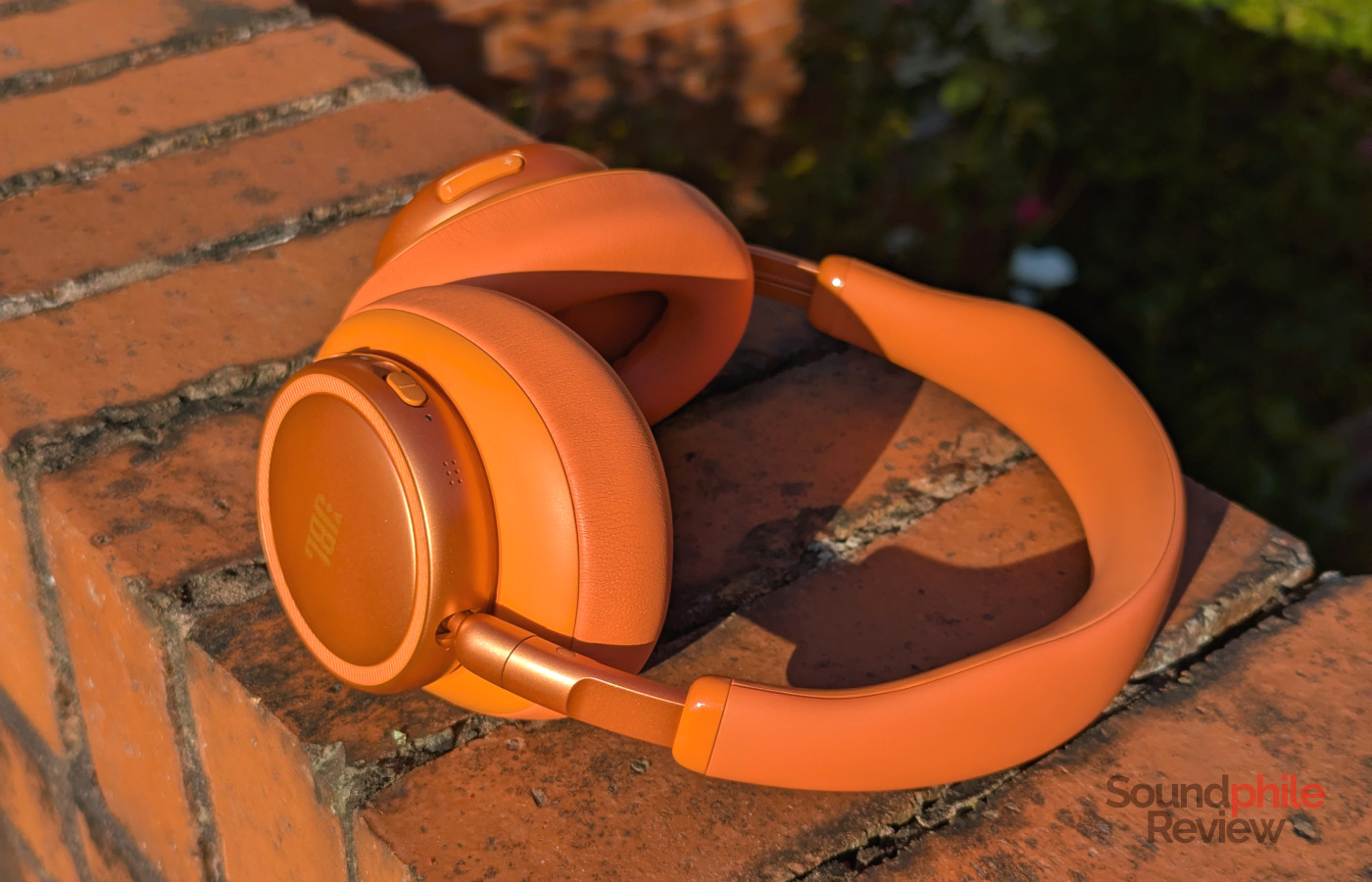
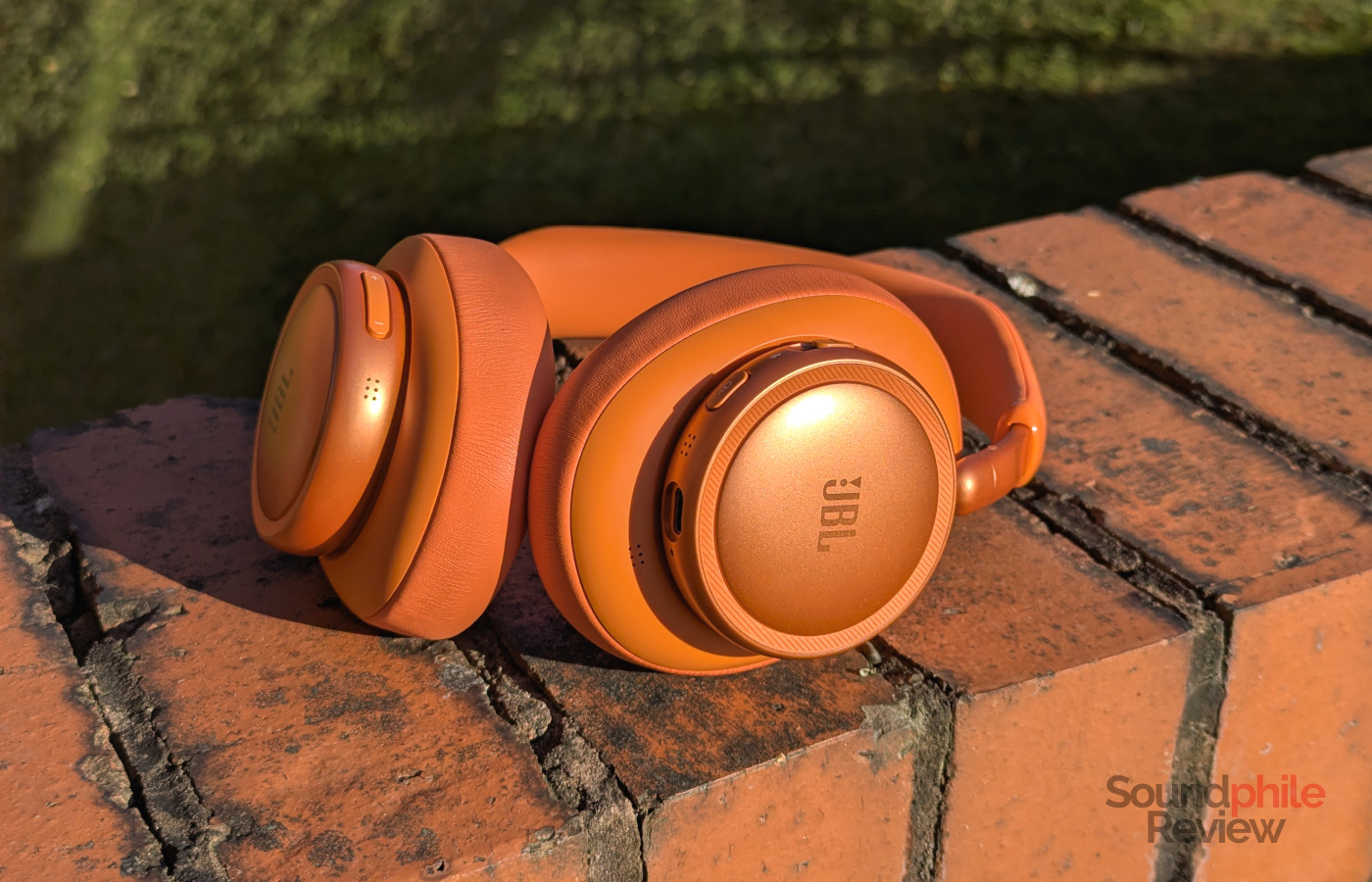
JBL has repositioned itself as a “young” company – meaning, one for young people. They went for a very colourful approach with the Live 780NC, which come in seven different colours: on top of the traditional black and white, there are also blue, green, orange (which you see in the pictures), violet and sand (a sort of light beige). JBL used bold colours for these headphones, in line with their market placement. All the different parts of the headphones are coloured: not just the padding or the plastic parts, but the metal ones too. Speaking of which: despite being mid-range headphones for the mainstream market, the JBL Live 780NC are built using metal for the entirety of the headband, which is rare.
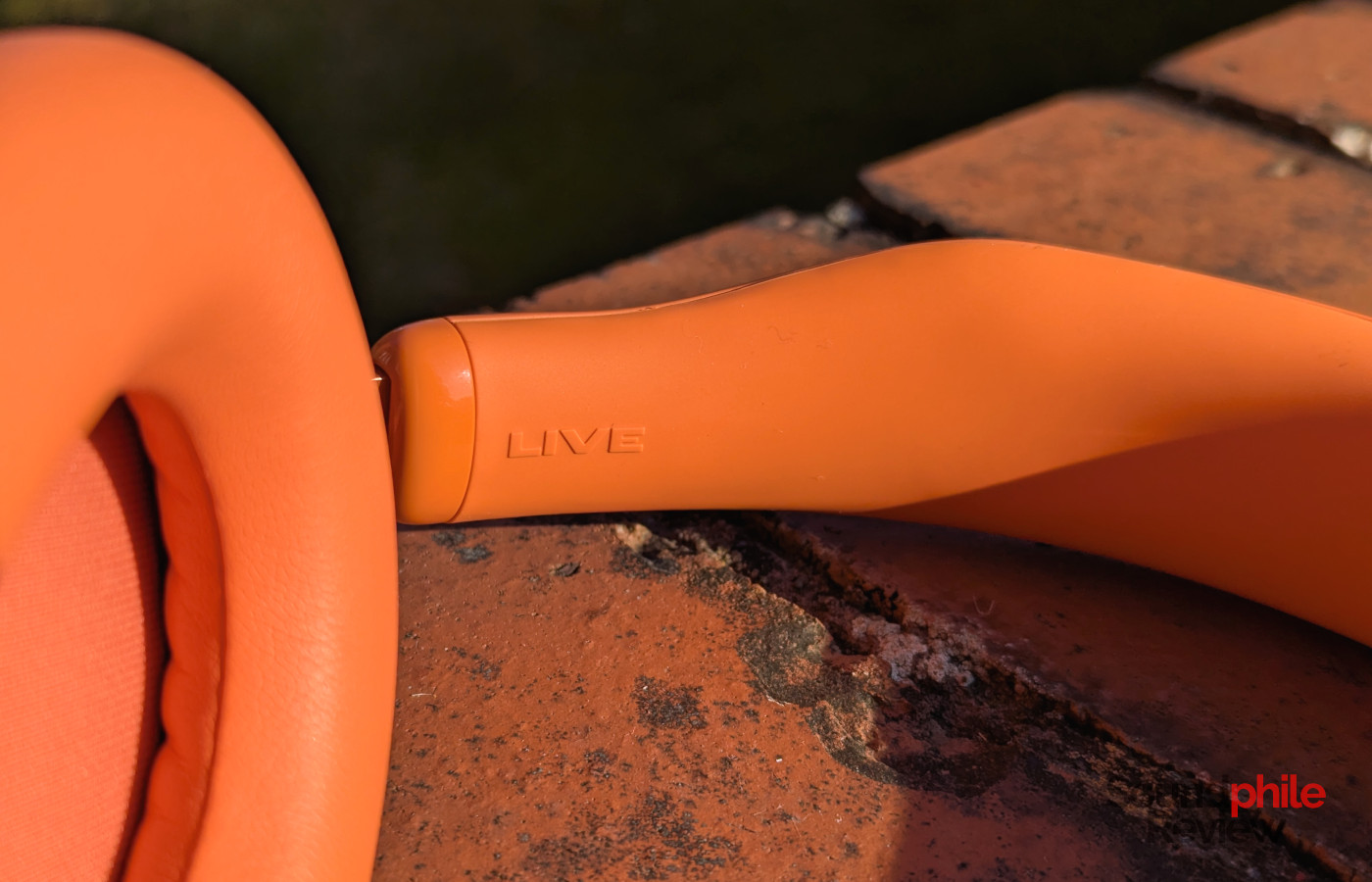
The headband is covered entirely in completely smooth silicone with a soft texture like that of faux leather, whereas the earpads are covered in actual faux leather (as in, having the visual and tactile texture of leather). The top of the headband, like the earcups themselves, is made of hard plastic. Interestingly, JBL has managed to replicate the exact same hue and texture on both the plastic earcups and the metal yoke.
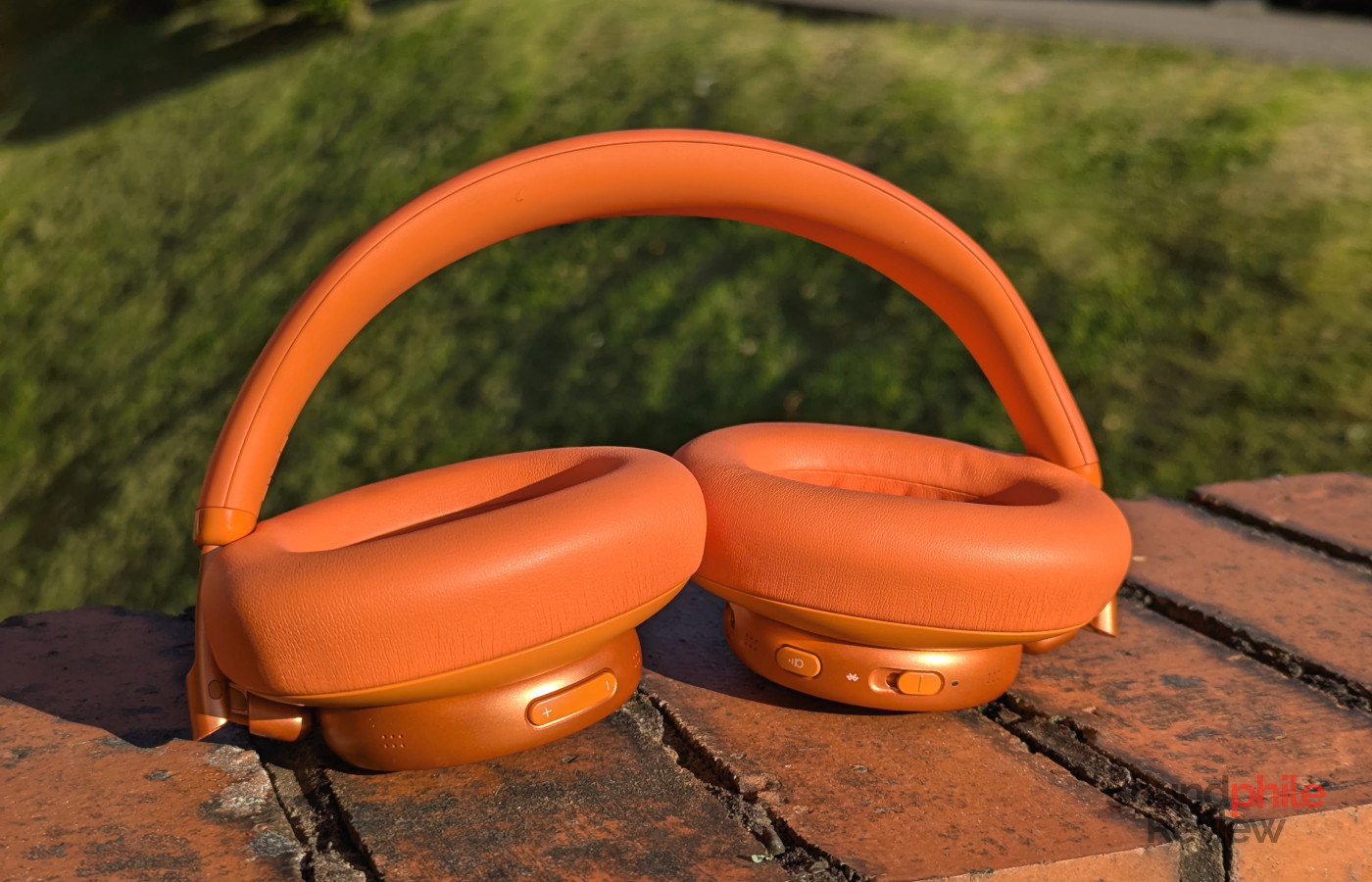
The yokes are made of a solid block of aluminium and feature a folding mechanism that allows you to fold the headphones so they take up less space; one thing to note about this is that the earcups are too big for the headphones to completely fold, so this mechanism only works if you make the headphones lie flat.
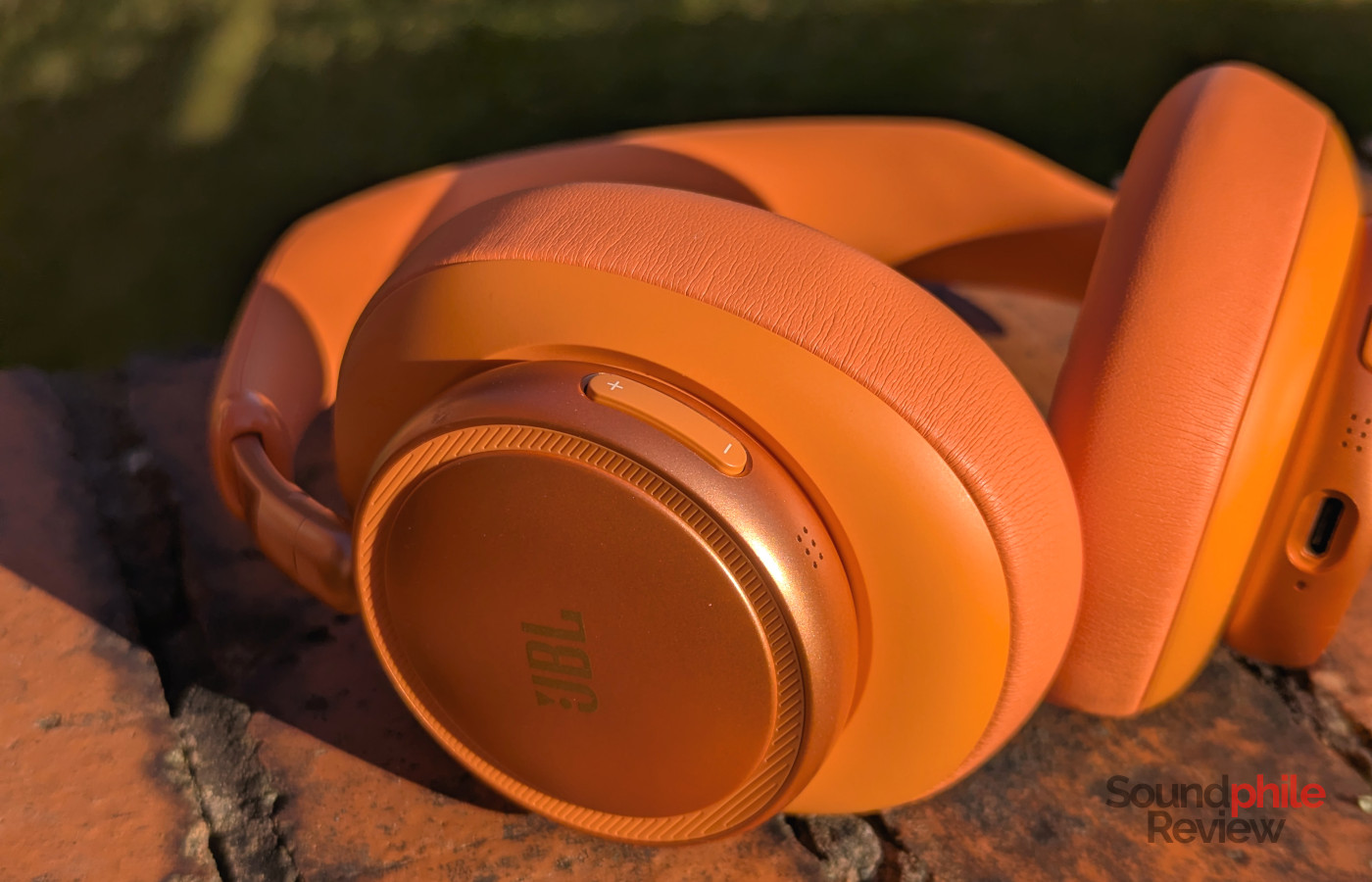
Both earcups host buttons: the one on the right hand side hosts a sliding button to control power (slide it down until it clicks) and Bluetooth pairing (slide it down completely until the pairing mode kicks in; the button bounces back when you stop pulling it), as well as a button to control ANC functionality. There are also a status LED next to the power slider and another next to the USB-C port on the bottom. The left hand side has a volume rocker. The surface of the earcup on the right hand side is sensitive to touch, so that you can use it for playback controls.
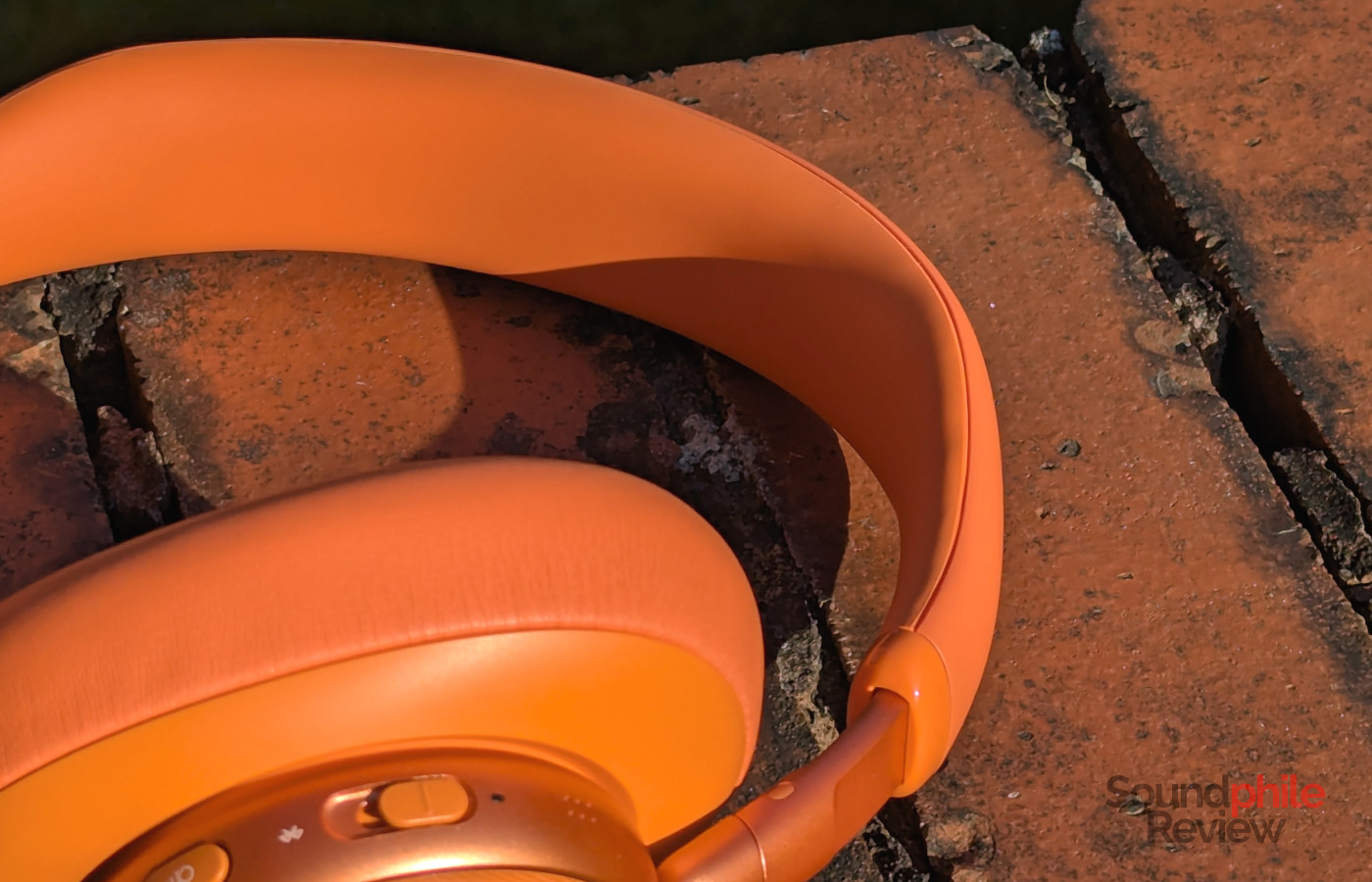
In terms of comfort, I find that that the JBL Live 780NC are a bit of a mixed bag. While the earpads and very soft and cosy, and remain so over the length of a listening session, the headband could do with some more padding as it becomes quite stiff quite quickly. There is not that much padding there, which means that you will feel the metal band inside it; in my case, that happens after a short amount of time – about half an hour. This makes them unsuitable for longer sessions, at least in my case; as comfort is a deeply personal matter, you may find them more comfortable than I do. I also find that the silicone on the headband gets a lot of purchase on hair, which holds the headphones still but, at the same time, can pull your hair in an unpleasant way. The lateral clamp is relatively strong, which some may not like, and the faux leather becomes clammy after a while – be aware of this if you live in a warm climate.
Passive isolation is minimal and is only enough to remove the quietest of sounds, but not much more than that.
Extra Features & Battery Life
JBL put quite a bit of emphasis on the connectivity capabilities of their headphones. The Live 780NC come with Bluetooth 6.0 supporting the SBC, AAC and LDAC codecs, as well as Auracast for broadcast transmissions, LE Audio for low-energy and low-latency audio, together with multi-point connectivity. It is interesting to note that you can connect two devices and have both of them use the LDAC codec.
Unfortunately, the JBL Live 780NC do not feature a 3.5 mm jack, so they cannot be used with a standard audio output. I have asked the company why they chose to do this, and the answer is that most phones do not have a 3.5 mm jack any more and it makes therefore no sense for them to include it. On the other hand, however, the headphones can be used with a USB-C cable, which does not rule out wired usage entirely. One thing to note is that using the cable still requires the headphones to be turned on, so you can’t use them if they’re out of battery.
The headphones include a proximity sensor which detects when you’re wearing them and automatically pauses or plays music when your remove the headphones or put them back on. This works really well and it is very reliable, and it works across devices and operating systems too (it even works when connected to my Linux computer, as an example).
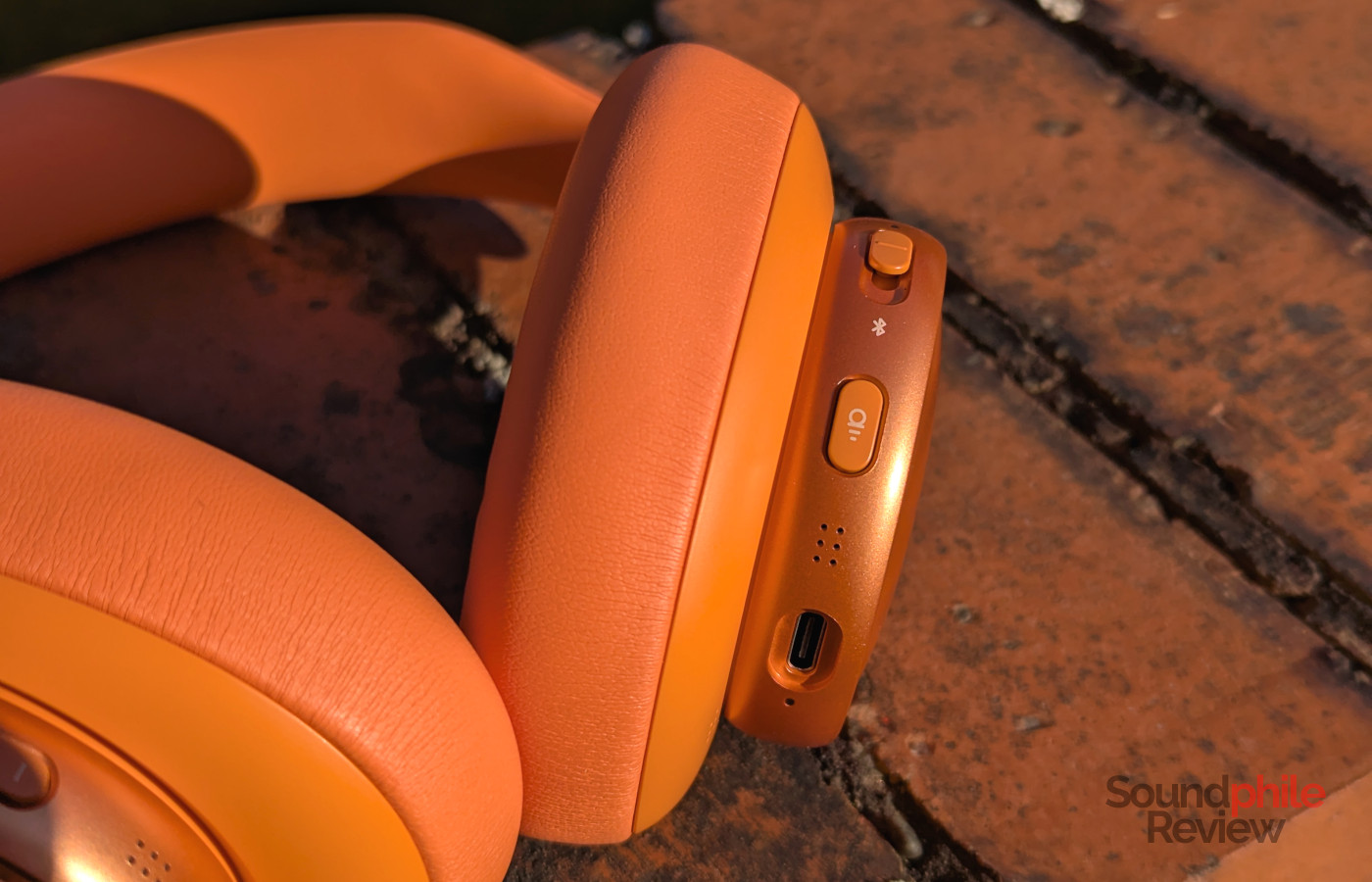
Noise cancellation works quite well with low-frequency sounds, which are often the most prevalent and the most annoying when you’re travelling on trains and aeroplanes. In fact, it removes most of that noise leaving you with just a whisper, which is quite impressive considering these are mid-range headphones. As there is minimal passive isolation, however, the effect of ANC is somewhat reduced in terms of perceived effectiveness, as lots of other noises come through (e.g. people’s voices, the higher-frequency component of a jet engine, etc). This means that you will still need to raise the volume to counteract the noise.
The controls are very intuitive and they can also be customised using the companion app (more on that in the next section); the touch controls on the earcup on the right hand side are very responsive and, as they’re only of the “tap” type (no gestures), they’re also responsive and never miss a beat.
Battery life is practically eternal. The company claims 80 hours without ANC and 50 hours with ANC, which is very very long – so much so that I haven’t been able to see the end of it, so the official estimates seem to be realistic. One thing to note is that although the power switch is physical, the headphones will enter a standby mode when they’re not being used. This prevents the headphones from discharging completely if you forget them powered on (which, I can personally attest, happens quite often).
Software
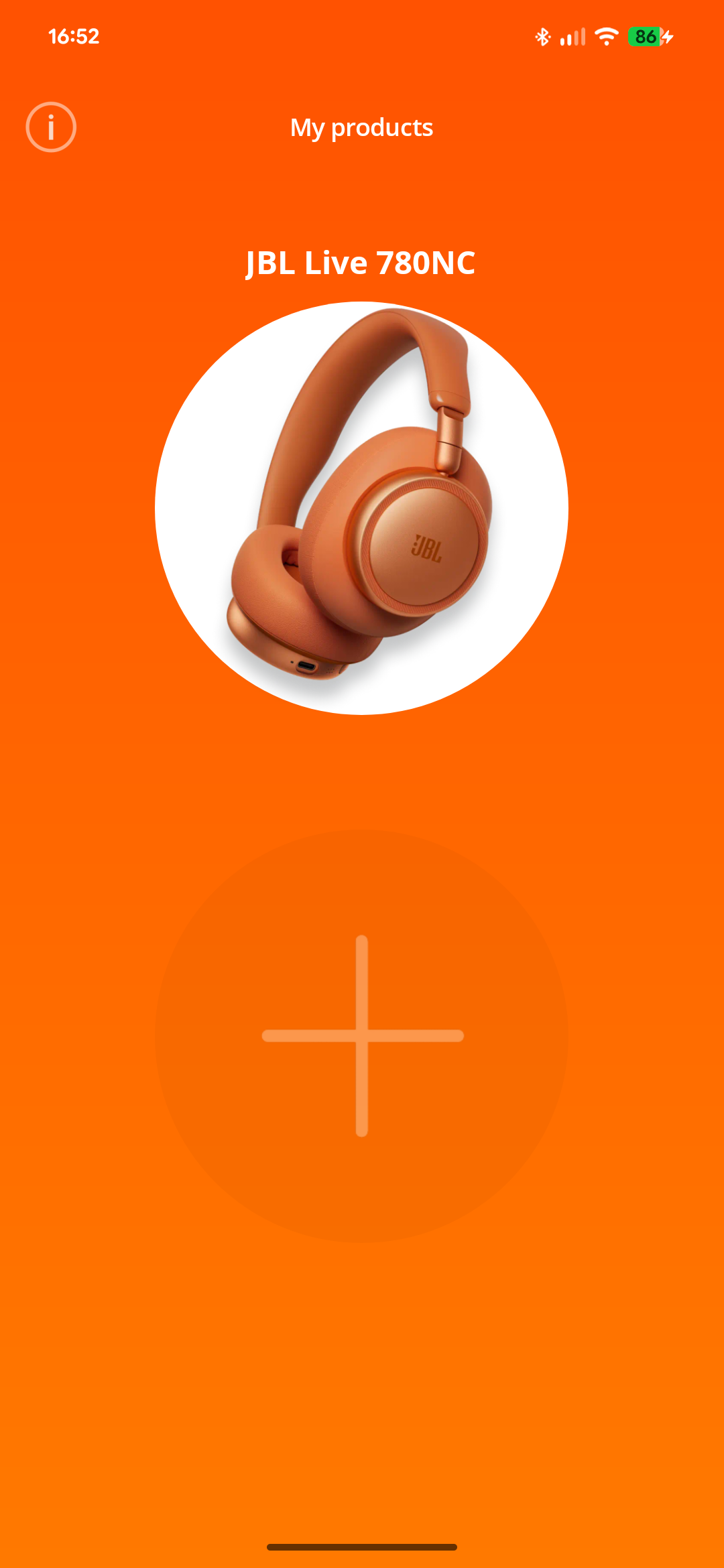
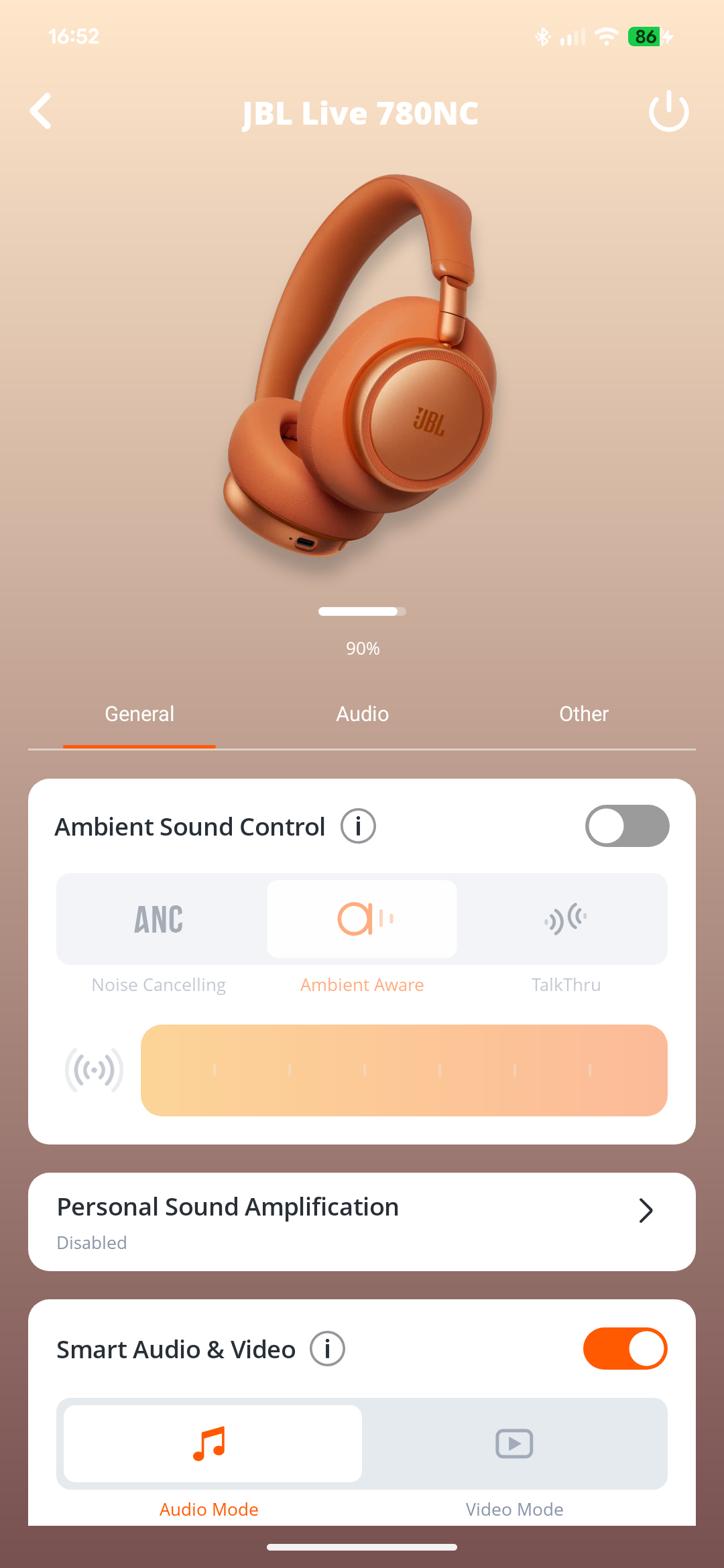
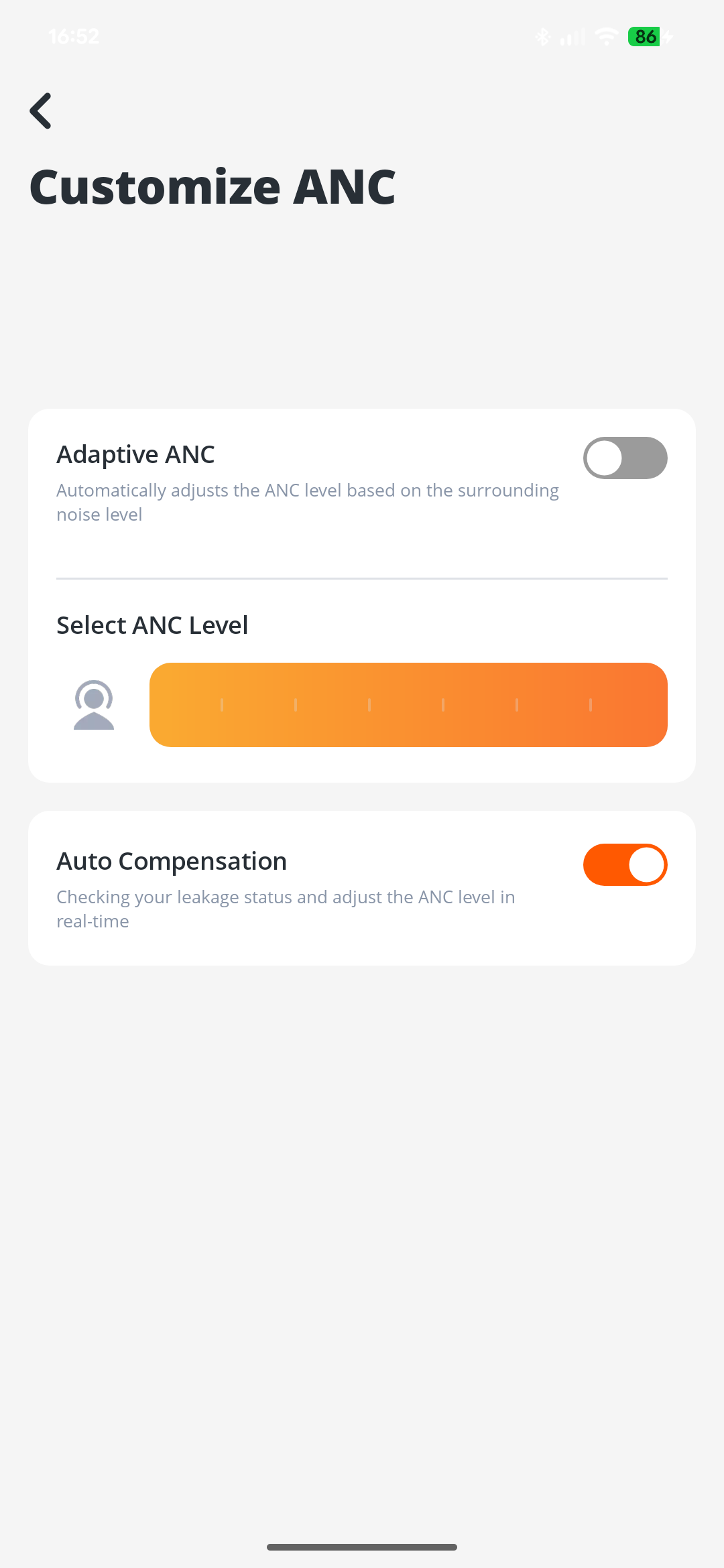
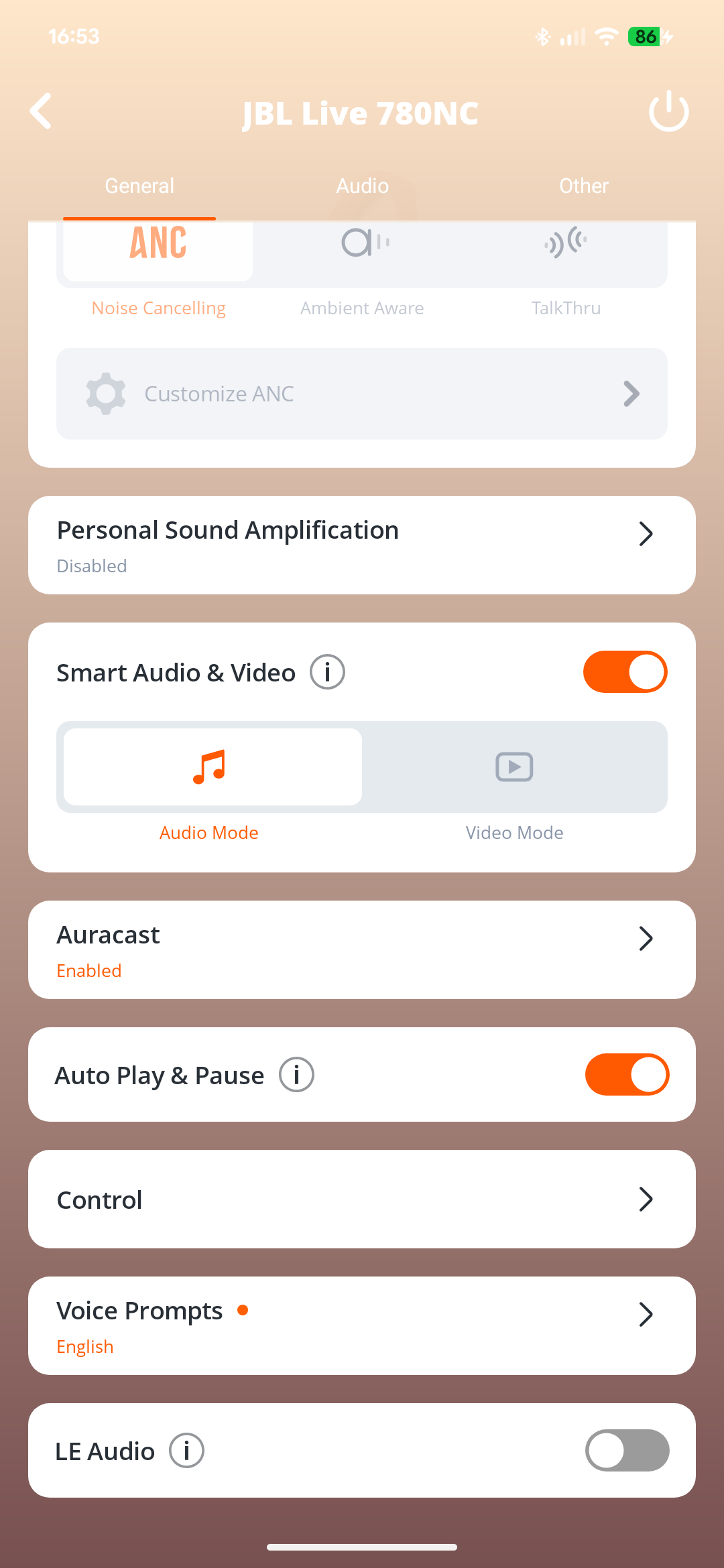
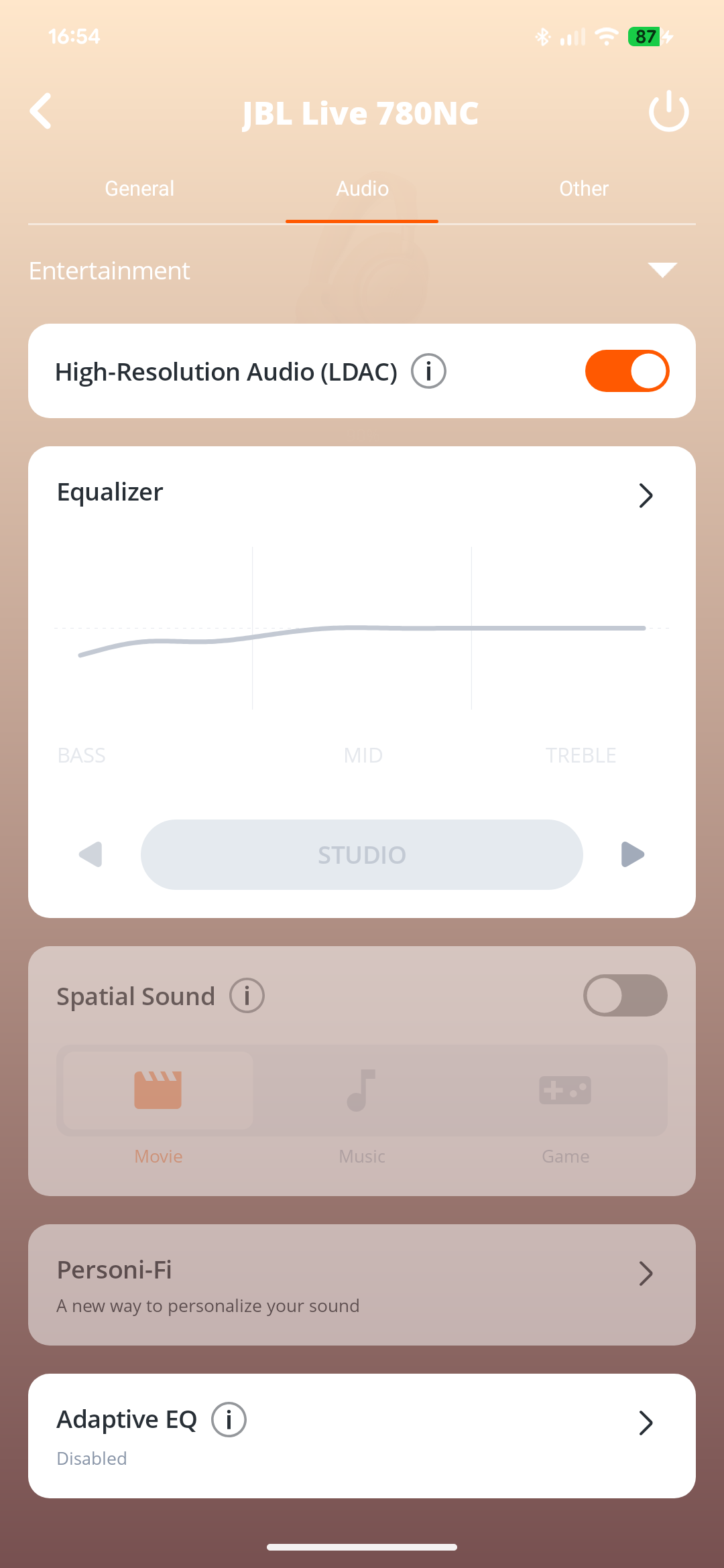
The JBL Live 780NC can be customised by using the JBL Headphones application, available for both Android and iOS. This allows you to customise the headphones with a huge amount of settings and controls. Virtually every single element of the headphones can be altered. The settings are so many that listing them all would be too long! Among them:
- ANC can be tuned to your preference, in terms of strength as well as adaptiveness. Interestingly, there is a setting to compensate for leaks, which is useful if you wear glasses;
- Personal Sound Amplification is a bit like the classic “ambient mode” which plays back sounds from the outside, but it does so at a volume you manage – useful if you want just a little bit of outside sounds;
- Smart Audio & Video optimises for audio quality and latency respectively;
- you can enable LDAC or low-latency audio (one excludes the other);
- there are six equalisation presets: studio (which reduces bass and makes the frequency response more or less flat), bass (as if you need more…), club (which boosts highs mildly), extreme bass (believe it or not), vocal (which reduces bass and treble and boosts midrange) and jazz (which, for some reason, boosts bass and lower midrange, reduces the central area of midrange and heavily boosts highs)
- Spatial Sound creates the illusion of a bigger soundstage by tweaking the frequency response, with three presets: movie, music and gaming (you need to disable LDAC in order to use this);
- Personi-Fi allows you to customise the tuning based on your hearing and pinna shape, but unfortunately there is a known bug which prevents it from working on Android so that I could not test this;
- Adaptive EQ allows the headphones to adapt the frequency response to low-volume listening as well as to compensate for leakage (again, useful if you wear glasses);
- Sound Level Optimiser makes volume during calls more level, avoiding extremes;
- VoiceAware allows you to hear your own voice during calls;
- Relax Mode plays relaxing sounds like waves, the chirp of grasshoppers at night, the crackling of fire, birds singing in a forest, and water in a stream;
- a setting for auto power off allows you to set the power off timer to half an hour, one hour or two hours if the device is unused.
Two things need to be said about the JBL application. The first is that it has a clear, clean interface which puts everything you need right at your fingertips, with clear explanations and very easily discoverability. The second is that it provides a massive amount of settings and possible customisation, with very thoughtful things like leakage compensation which you very rarely see. Excluding the Personi-fi feature which doesn’t reliably work on Android, the app is one of the best-made I’ve seen in the audio world and JBL deserves every credit for it.
Sound & Specs
I tested the JBL Live 780NC with a few devices, including my Google Pixel 7 Pro smartphone and a Hidizs AP80 PRO MAX.
JBL Live 780NC |
| Frequency response | 10 – 40,000 Hz |
| Impedance | 32 Ω |
| Sensitivity | 98 dB |
| Bluetooth version | 5.4 |
| Codecs | SBC, AAC, LDAC |
There is a constant whine-like sound whenever music is playing on the Live 780NC. This is only really audible in a silent environment and if you play music at a low volume, but it is definitely present and it is very fatiguing.
Spatiality is not the Live 780NC’s forte, as soundstage is cramped and imaging is limited. To be more specific, there isn’t much width nor much depth: it definitely feels like you have two drivers strapped a few millimetres from your ears. Imaging is very limited, too, as everything seems to be more or less in the same space – which is your cranium. The leftmost or rightmost position is very close to the centre one, which means there isn’t much space to play with. Instrument separation is unexpectedly good, and tracks with a good level of complexity see it represented well, although those with several instruments all playing at once will push the limits of the headphones.
JBL is known for its bass-heavy tuning and the Live 780NC are another example of this. They offer very powerful bass that stands in front of everything else, although it never gets overbearing. What’s really surprising is the depth that bass reaches: although it is most present in the mid-bass area, it reaches sub-bass territory while maintaining good presence, which is remarkable. This makes bass varied and adds layering and complexity, as an example in a track like Massive Attack’s Risingson where the bass line is not just a single note but something that has a depth and dimension to it. In terms of detail, bass delivers a good amount, although it is also a measure of the driver’s limits as it struggles a bit delivering fine details in more layered tracks.
Midrange is overall well executed and it is very well balanced, never sounding distant nor “in your face”. There is, however, one exception to this: there is a slight bump in the 2 kHz region which gives more presence to voices and some instruments, but which, together with the whining, ends up being a bit fatiguing over the long term. Overall, however, I’m positively impressed by how well-tuned the mids are as it’s really hard to find any fault in them in terms of pure frequency response, as they’re quite flat. Details are well presented and quite abundant; transients are interestingly fast, although not physical.
Treble is balanced enough and it sits in just the right spot compared to bass and midrange. There’s a little caveat to this: there is a couple of peaks, one around 6 kHz and one around 12 kHz, which are felt quite strongly and which sometimes make treble a bit more aggressive than it should be. This is not always apparent, however, and most of the time treble sounds well balanced and enjoyable even to treble-sensitive people. On the other hand, there are also some troughs that take some energy and presence away: the shimmer of cymbals is more muted than it should be. In terms of detail, JBL has again done a good job with a good level of detail being present, although – once again – with some limits that are apparent once the track becomes more crowded.
Final Thoughts
The JBL Live 780NC are crowd pleasers. They’re the equivalent of comfort food for the audio world (risotto alla milanese, in my case). That’s what you’d expect from headphones tuned for the mainstream market and for the widest audience possible. In may ways, however, they hit a great sweet spot as they deliver on both functionality (and there are lots) and sound signature, especially once you use the app to tame the bass section. The companion app is one of the best-made in the market as it’s super easy to use and yet gives you a whole load of settings. This comes on top of Bluetooth 6.0, Auracast, LDAC and good noise cancellation.
I find the frequency response to be a real surprise, as it is definitely coloured, but not overdone like you frequently see in the mainstream audio market – I’m looking at you, Sony 1000X THE COLLEXION. The fact that it takes two minutes to install JBL’s app and apply a standard EQ preset (so no guesswork involved!) and have a much more balanced tuning only makes the Live 780NC more likeable.
Should you buy the JBL Live 780NC? Well, it depends. Very interestingly, they are far cheaper in Europe than they are in the US: here in the UK they cost ~£170, so ~$220 including taxes. At that price they’re not a bargain, but they’re definitely one of the better headphones you can currently buy in the mainstream market. At $250 plus taxes, though, they become slightly less interesting as there is stiff competition coming from both sides. Even then, however, I feel like recommending them is easy – especially if you find them on sale.