
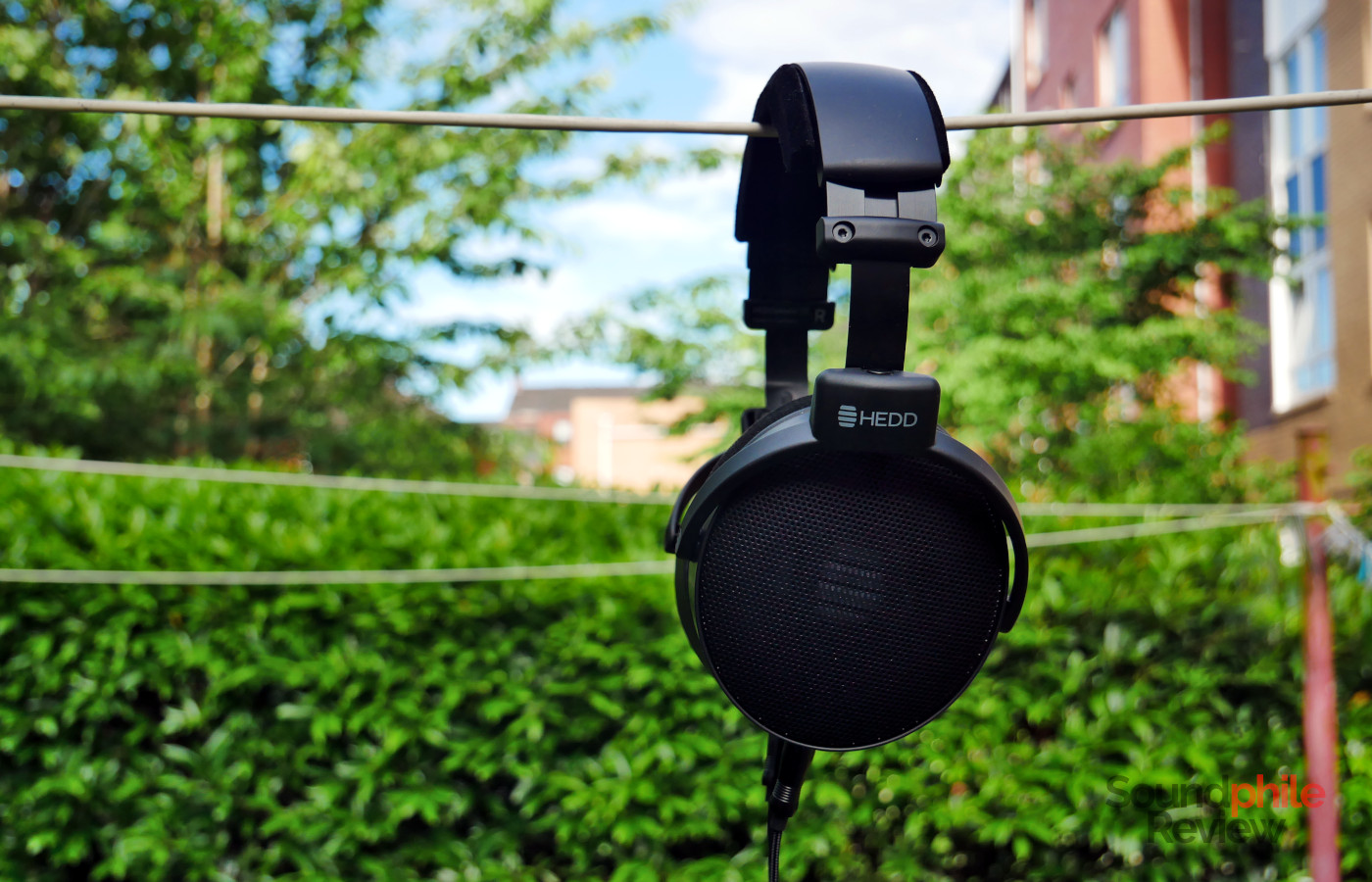
HEDD is a German brand based in Berlin that built its fame on AMT drivers, first in speakers and then in headphones. The company has now branched off into traditional dynamic headphones with the HEDD HEDDphones D1 (love a good pun!), but with a twist: the driver is made with thin-ply carbon fibre, which is made of layers of carbon fibres which are significantly thinner than usual, making it more lightweight while still preserving the high rigidity that carbon fibre is known for. This makes it, at least in theory, an ideal material for manufacturing drivers. And after trying out the HEDDphone D1, I can confidently say that HEDD was spot on.
Disclaimer: I received a free sample from HEDD’s UK distributor, KS Distribution. The HEDDphone D1 retails for £599 in the UK and $799 in the US. Additional information on the official product page.
TL;DR: recap
| Pros |
Cons |
| + Superlative sound
+ Amazing technicalities + Incredible detail + Very comfortable earpads + Overall well-built |
– Terribly uncomfortable headband
– Poor headband padding construction |
Rating: 8.8/10
Packaging & Accessories
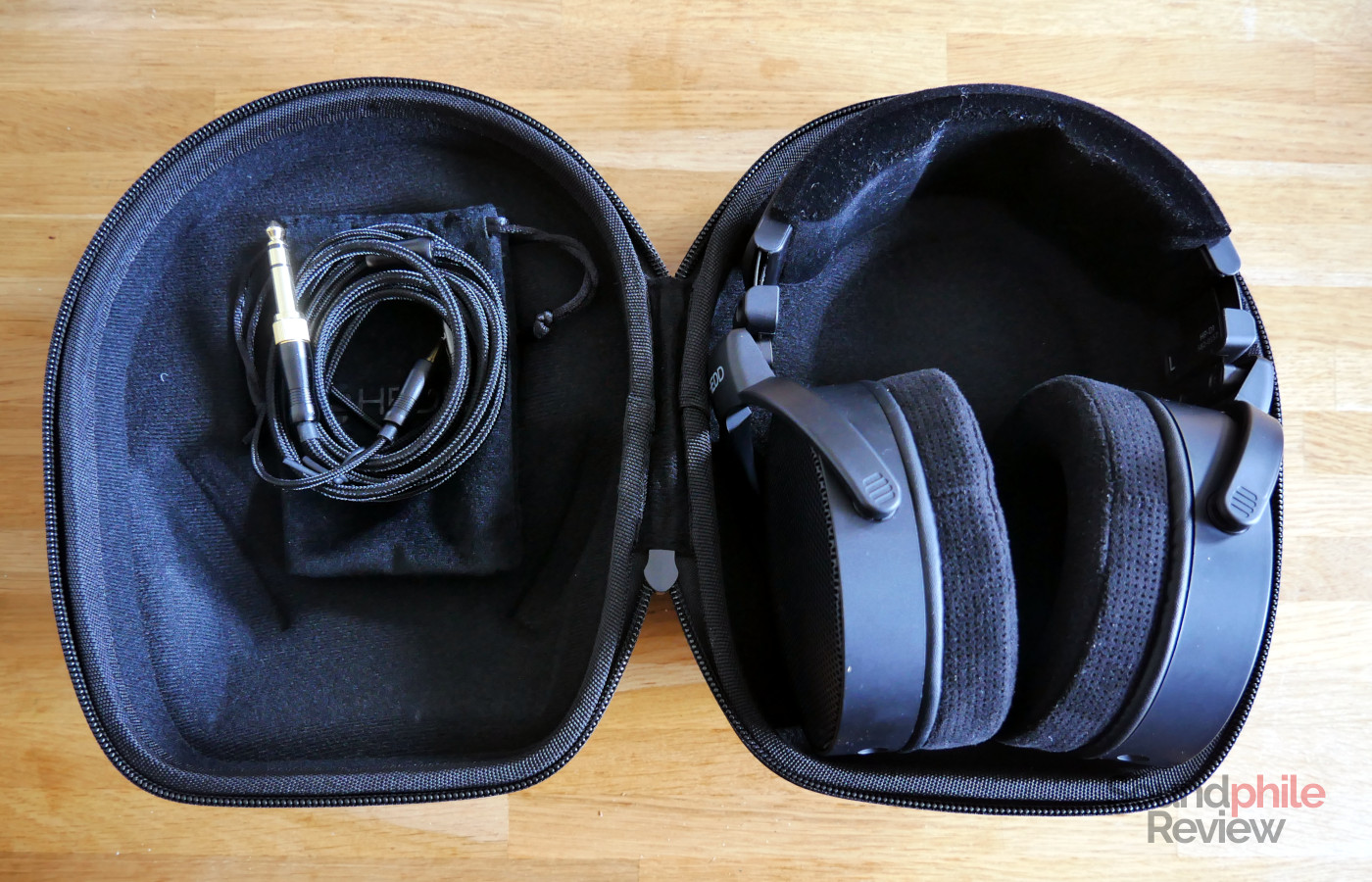
The HEDD HEDDphone D1 come in a double heavy cardboard box which ensures that the headphones won’t be damaged during transport. Inside the box we can find a hard case, which contains the headphones and the cable, as well as a manual. The cable comes with its own drawstring pouch as well as a screw-on 3.5 mm to 6.3 mm adaptor.
Design & Comfort
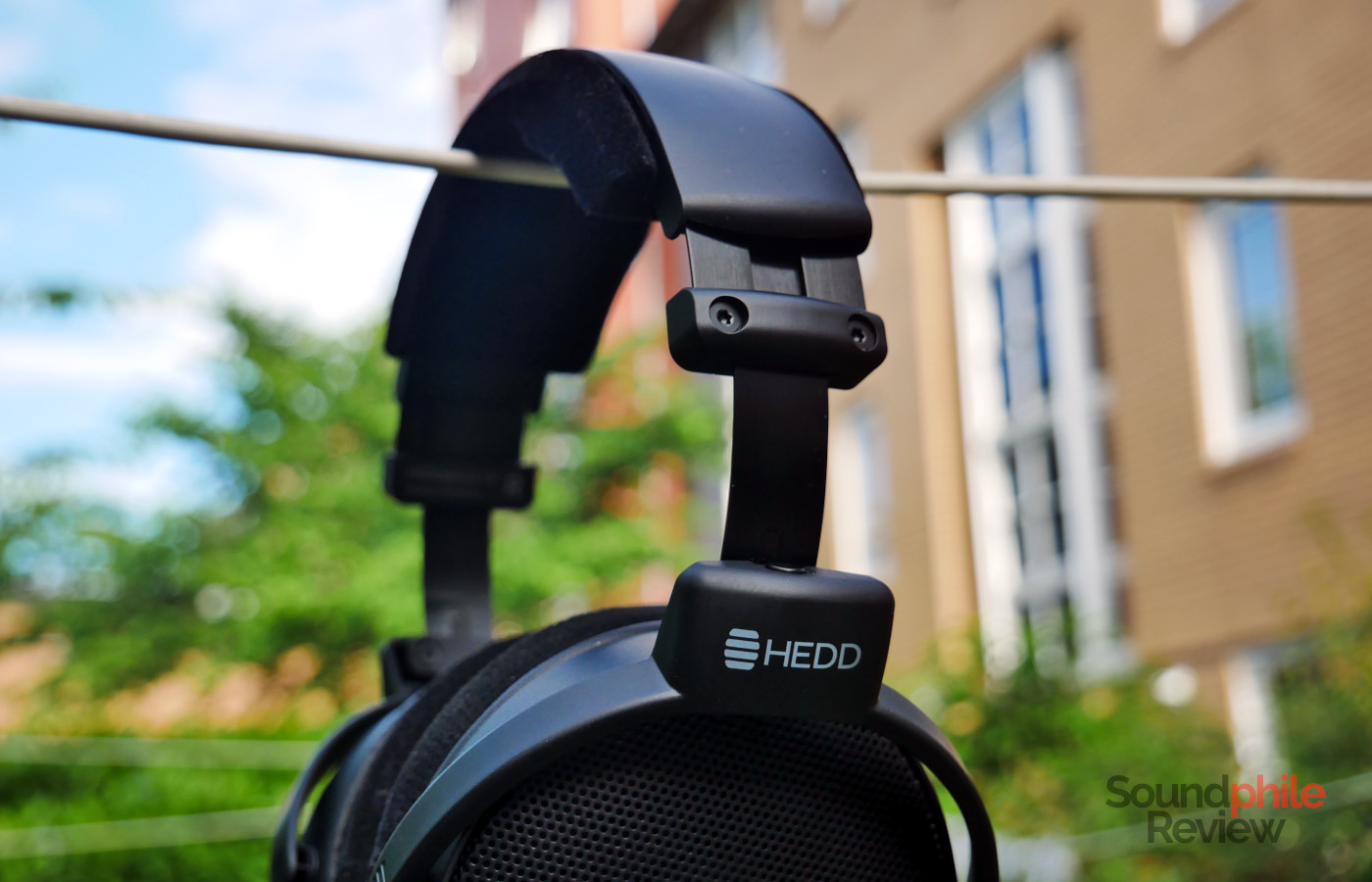
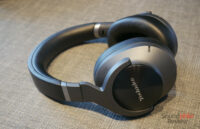
The HEDD HEDDphone D1 are the epitome of “studio headphones”. They have a simple, no-frills design which prioritises functionality and simplicity. The headband is probably the single element that best showcases this: it is made of metal and plastic, and there are visible screws holding it together. This is a design that communicates strength and robustness and that makes its functional components a part of the aesthetics.
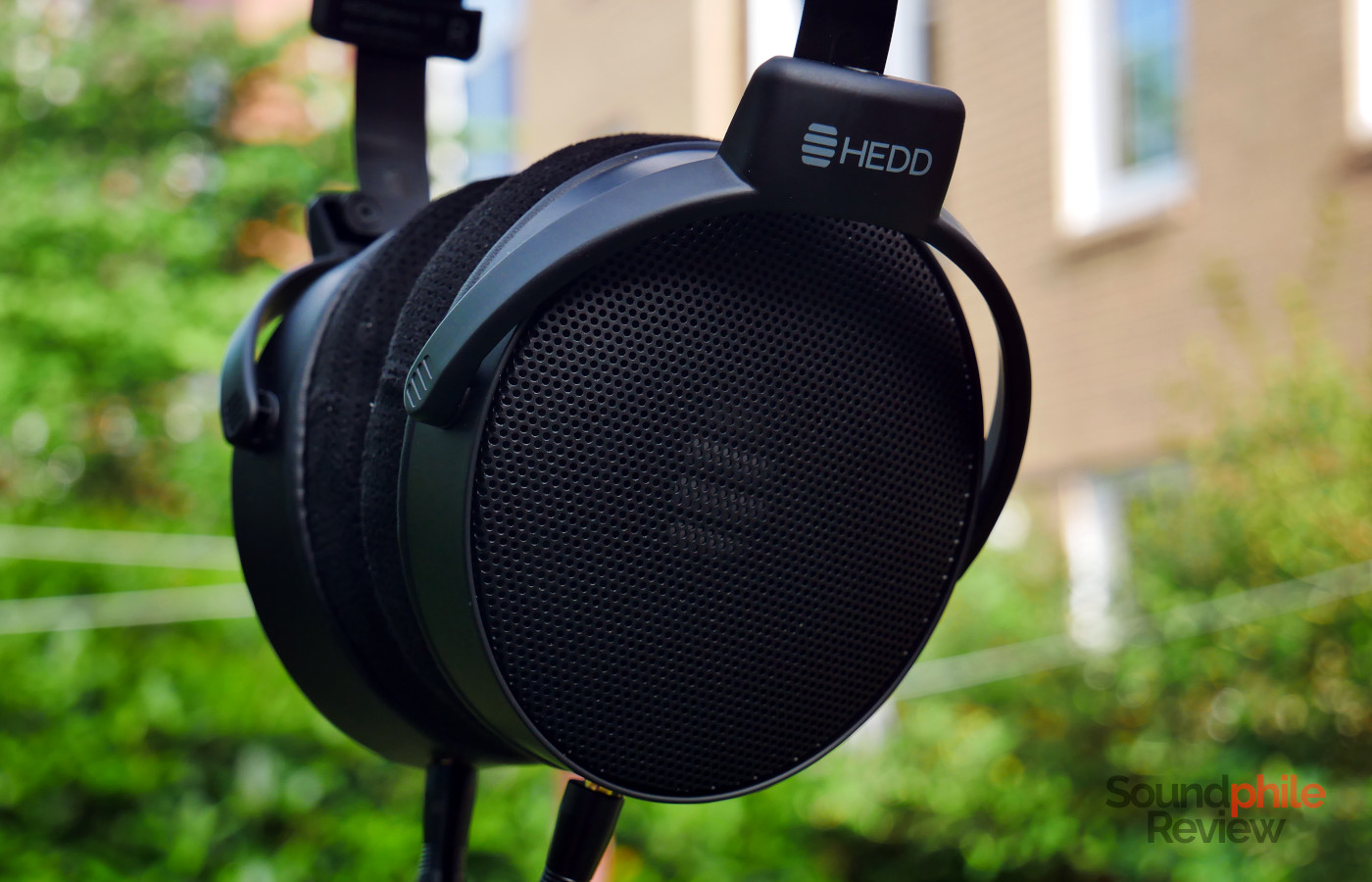
Everything is made of sturdy matte black plastic, except for the metal grille in front of the drivers and the headband, which is made of a combination of metal and plastic. The fact that everything is black and matte, with only the HEDD logo interrupting this, makes the HEDDphone D1 quite “serious”, as in the best tradition of studio headphones like those by Sennheiser, AKG or Beyerdynamic. This is not to say that the HEDDphone D1 don’t look modern, as hey actually have a sort of modern minimalism that sets them apart.
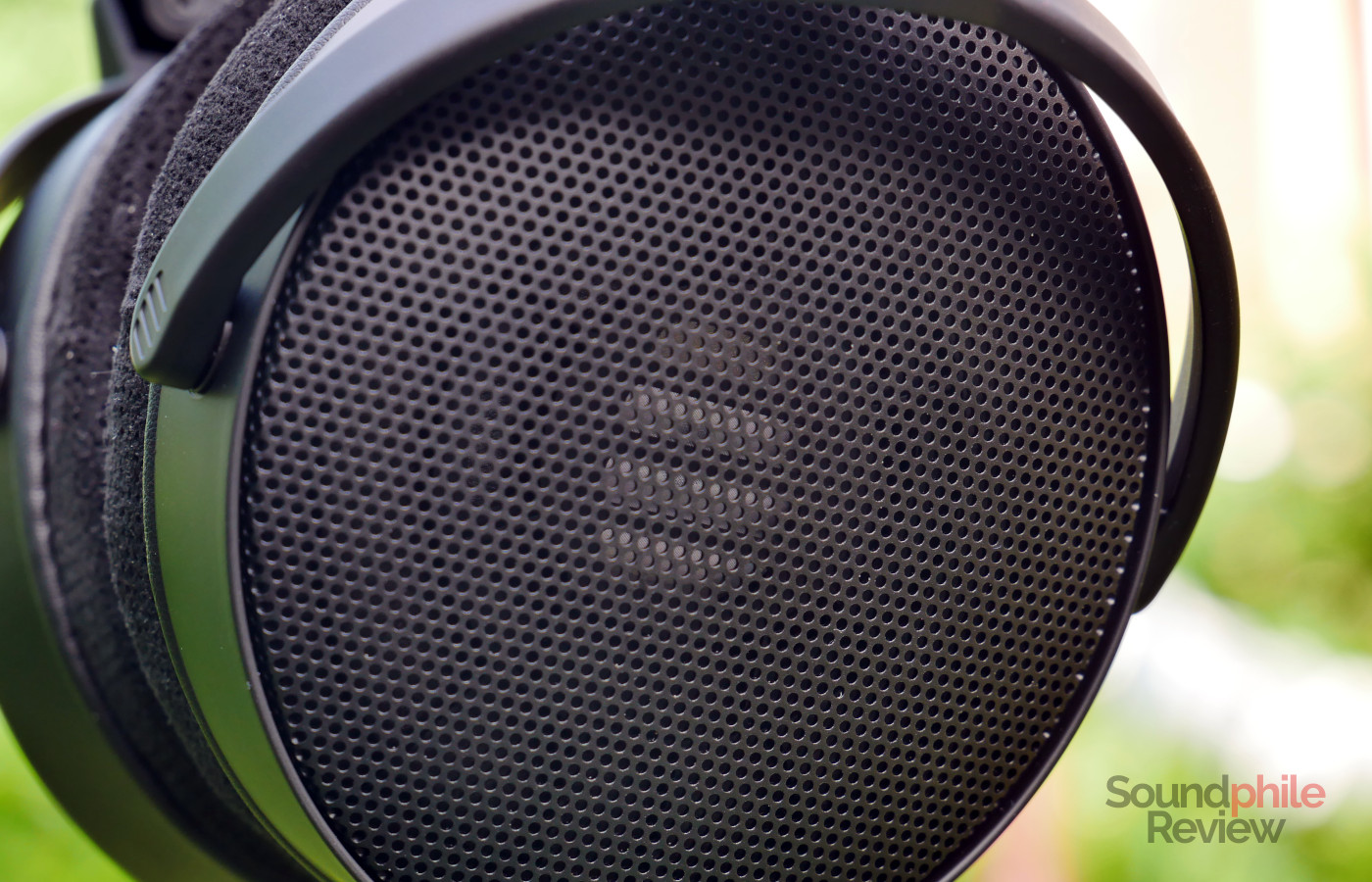
An interesting bit of design that HEDD has managed to sneak in as a sort of Easter egg is that the driver looks like their traditional AMT drivers from the outside. It also reprises the HEDD logo, which again is shaped after their AMT drivers. While not functionally significant, it’s a nice design touch.
The gimbals allow the cups to rotate both horizontally and vertically, so that you can adjust the headphones the way you prefer them. The same goes for the headband, which can be adjusted in discrete steps (which, however, are not marked).
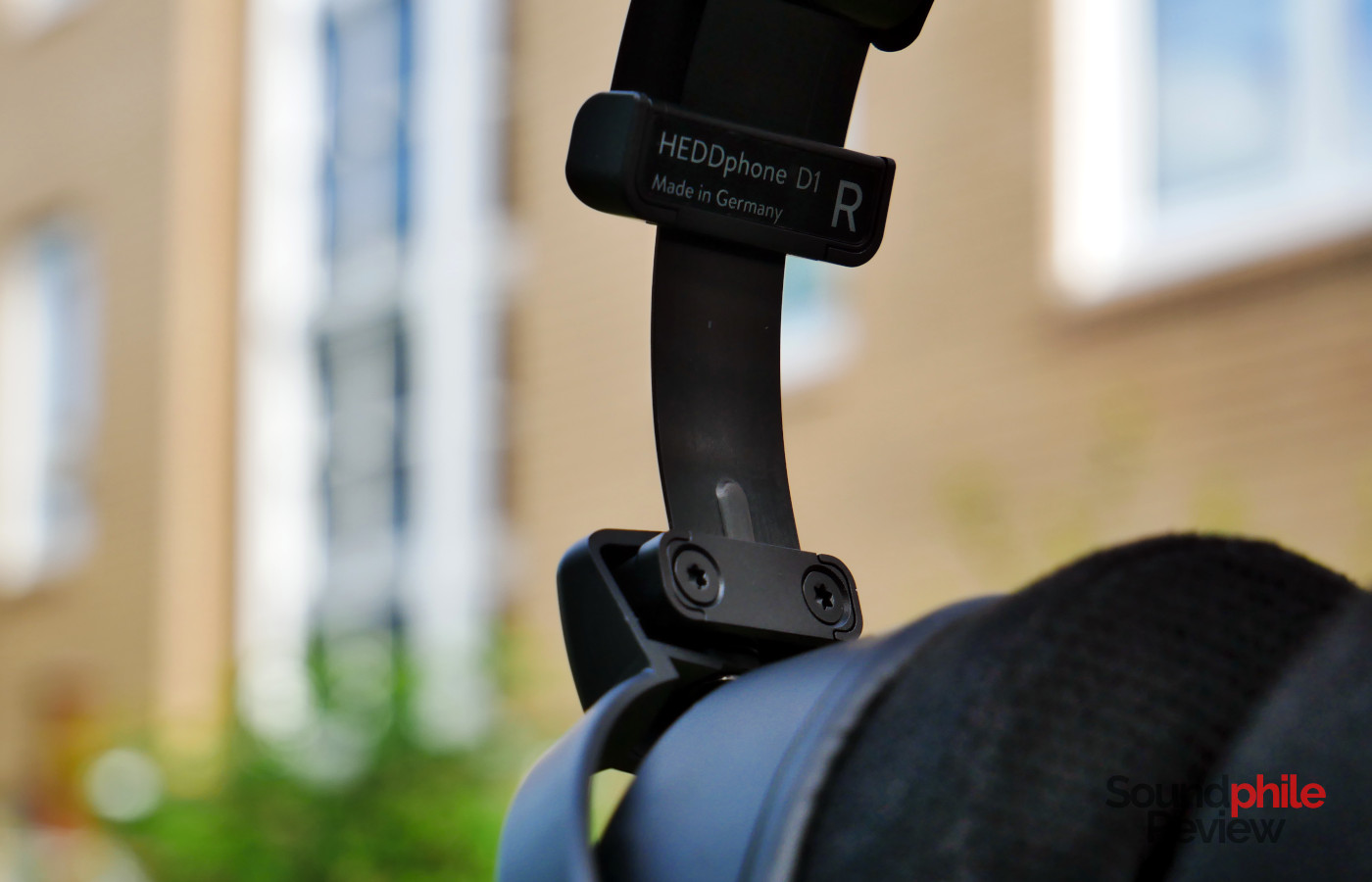
Build quality is generally great, as the headphones are made with sturdy materials and are well-assembled. The plastic used looks and feels very solid and durable, and metal is used skilfully so that it lends strength to the assembly without adding too much weight. Everything is built to be easily serviceable, like studio equipment often is: both the earpads and the headband padding are mounted on plastic mounts which can be very easily taken off as they’re just clipped to the main body.
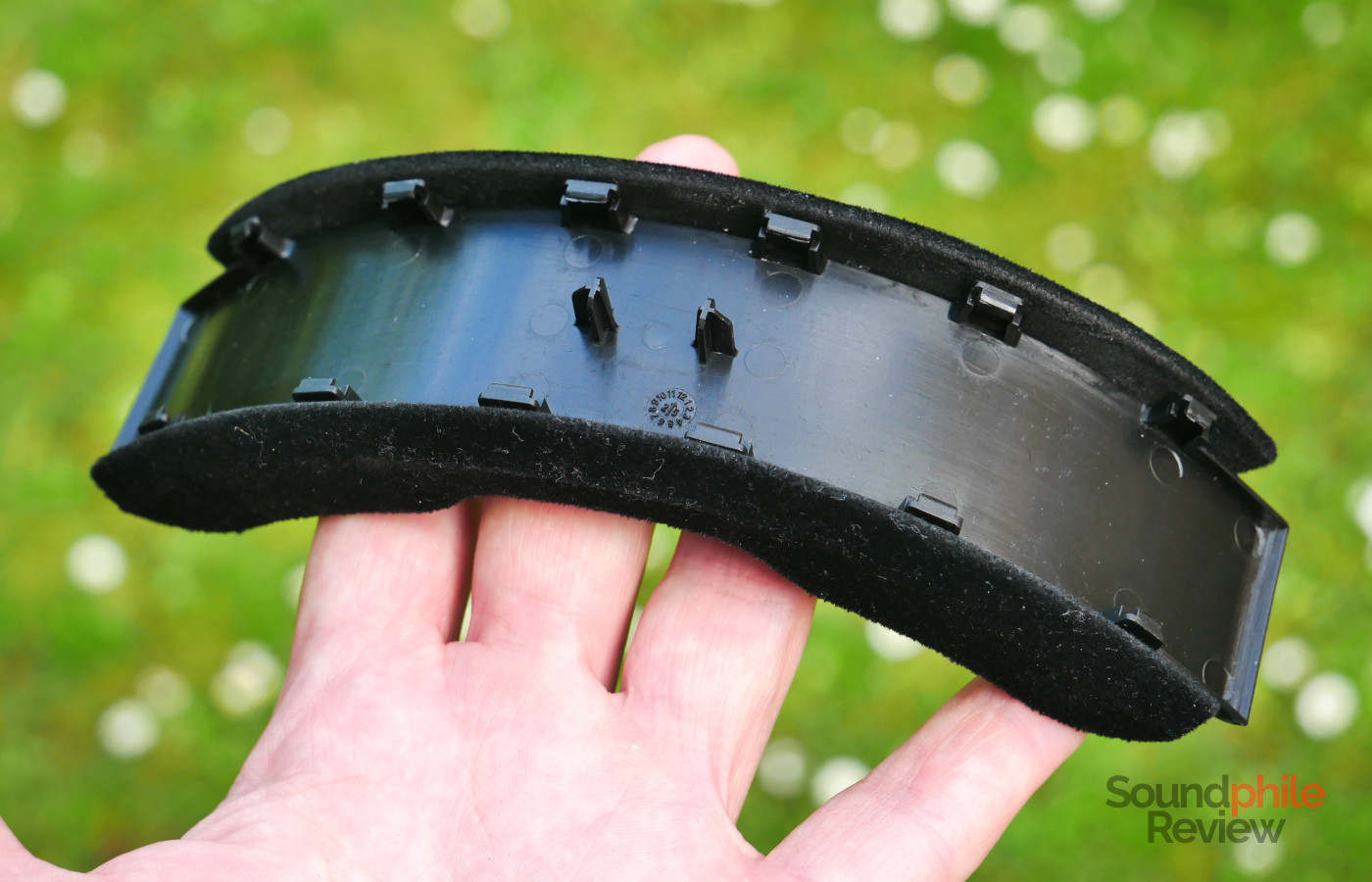
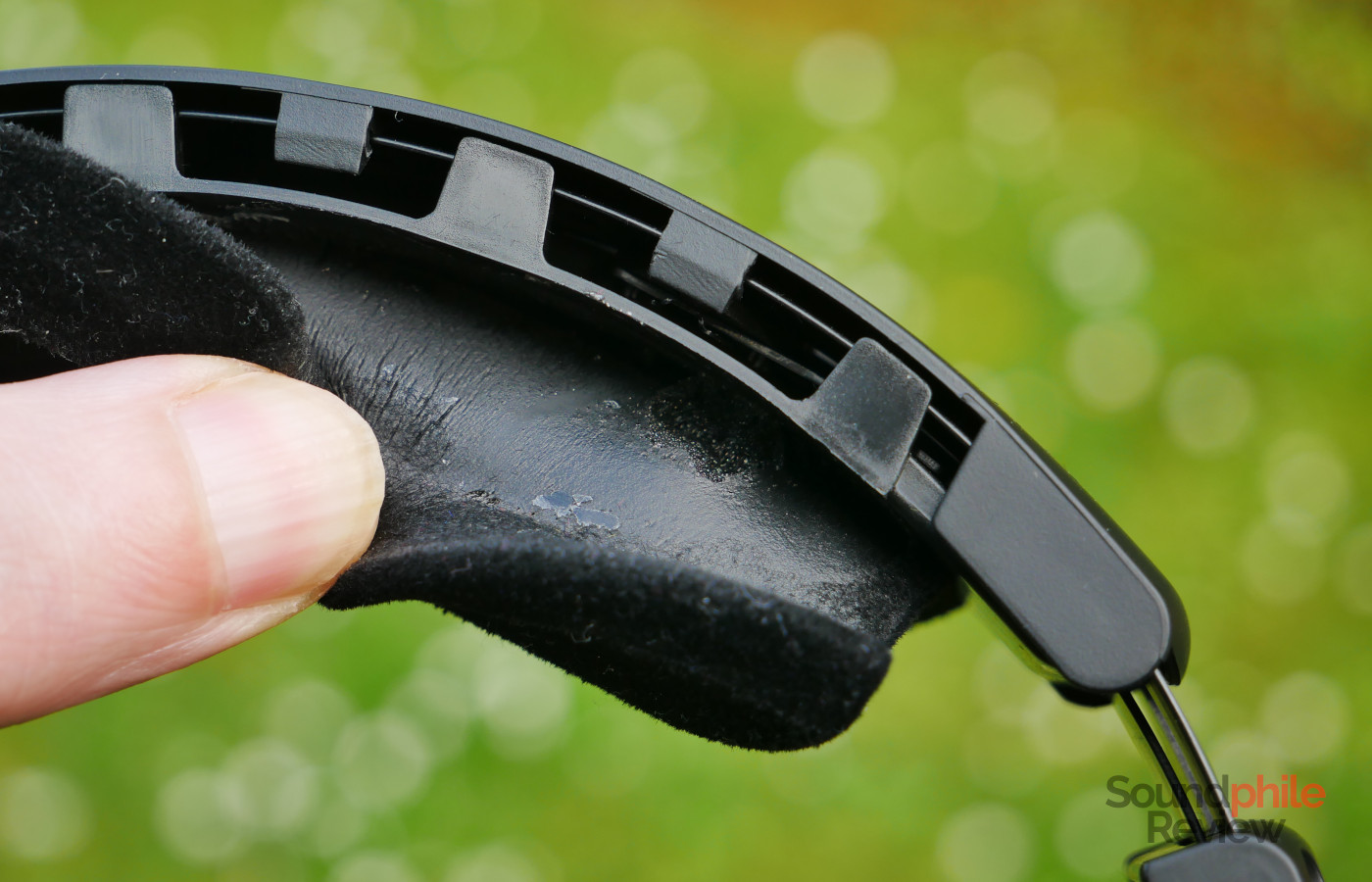
The one element that stands out, however, is the headband padding. It is, in fact, just glued to its mount and it comes off very easily: you just need to poke at the edge, which is open, to reveal the side of the headband assembly. The foam very easily comes off and tears, as it is only held in place by glue on the bottom and doesn’t have anything to fix it to the side. This design makes it relatively easy to service the headphones in case you need to replace the headband but, to be quite blunt, the way this was implemented is not acceptable on headphones costing nearly a grand (in dollars, or more than half a grand in pounds) because it makes damaging the headphones by accident all too easy.
On top of this, the HEDD D1 could definitely see some improvement in the comfort section exactly due to the headband padding. While the earpads are quite soft and feel like a soft pillow on the side of your face, thanks to the breathable fabric they’re covered with, the headband’s padding is made of foam covered in velour which is very hard and does not conform to your head at all. There is a depression in the centre to allow you to hang the headphones to a holder without damaging the padding, but this, combined with the hardness of the foam, makes it so that there are two ridges digging into your scalp. My listening sessions become very fatiguing after about 15 minutes. The one trick I’ve found is that putting a sock between the headband and my head helps, although I feel like this shouldn’t be needed. Another thing to note is that the gimbals are built in such a way that they will pull your hair out if you happen to have relatively long hair.
Lateral pressure is small, which means that you won’t feel fatigue from that (and the softness of the padding would probably prevent it anyway), but it also means that the headphones will move if you move your head and will fall off if you look down.
As the HEDD D1 are open-back headphones, they offer no passive isolation whatsoever and, conversely, will leak sound outside, so they are not ideal in noisy environments or in places where you could disturb others (e.g. a library or an office).
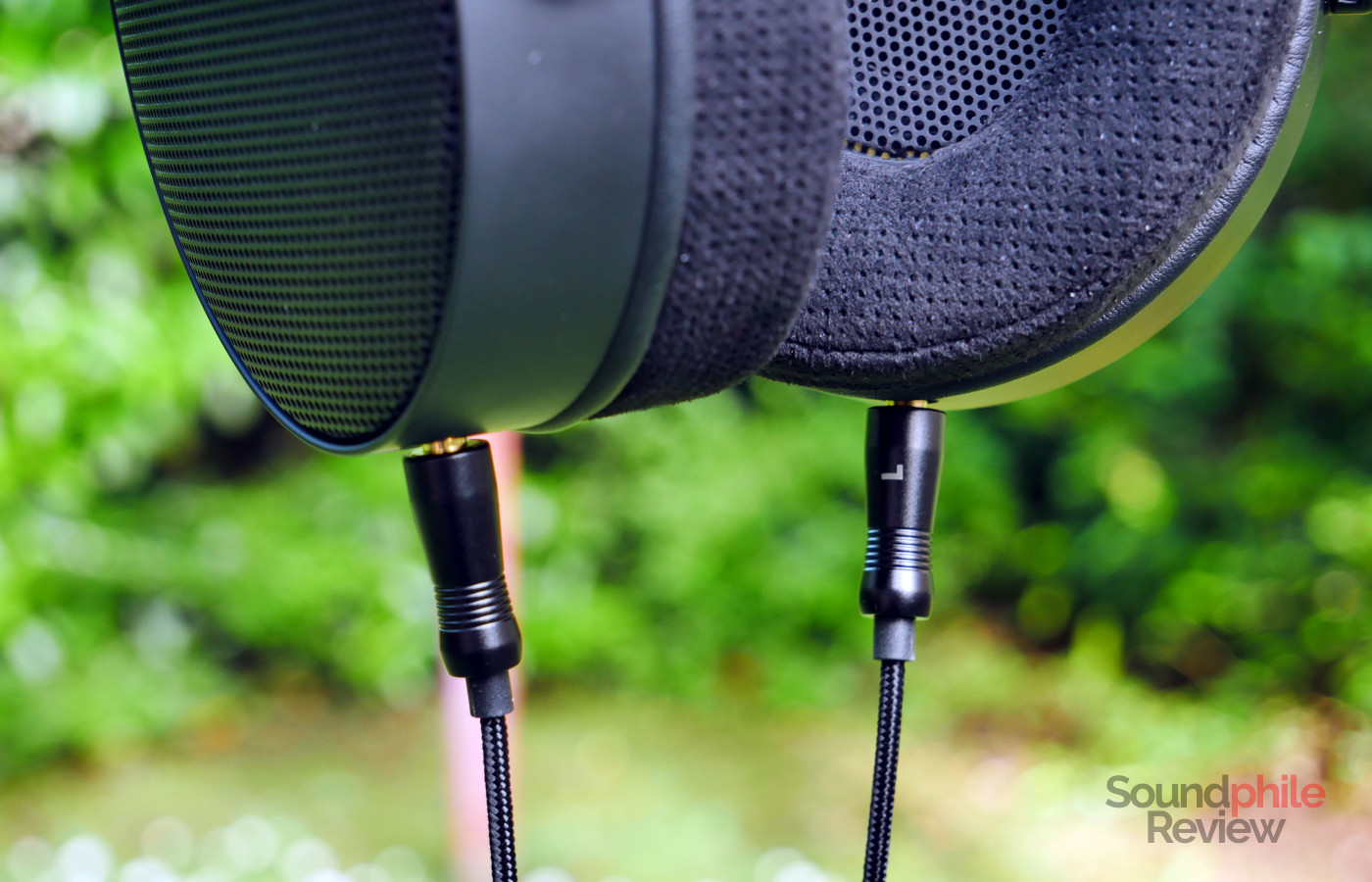
The cable is covered in fabric and has metal casings for all the various bits (the jack connectors and the Y-split). At both ends there are 3.5 mm jacks, and on the side you plug into your source there is a screw thread which allows you to use the 6.3 mm adaptor. The cable is very long, at about 2.5 m, which allows for a lot of flexibility (e.g. being able to use the headphones on your sofa while the amplifier is in your hi-fi stack). An optional balanced cable is available, though it costs half as much as the headphones themselves (£264 in the UK).
Sound & Specs
I tested the HEDD HEDDphone D1 with various sources, including an SMSL DO400, a SoundAware MDAT3, and a Hidizs AP80 PRO MAX.
HEDD HEDDphone D1 |
| Frequency response | 5 – 40,000 Hz |
| Impedance | 32 Ω |
| Sensitivity | 100 dB |
At just 32 Ω of impedance and 100 dB of sensitivity, the HEDD D1 are very easy to drive and can be used with virtually anything out there with a jack output. You won’t need a specialised, powerful amplifier for these headphones to shine as they require very little power.
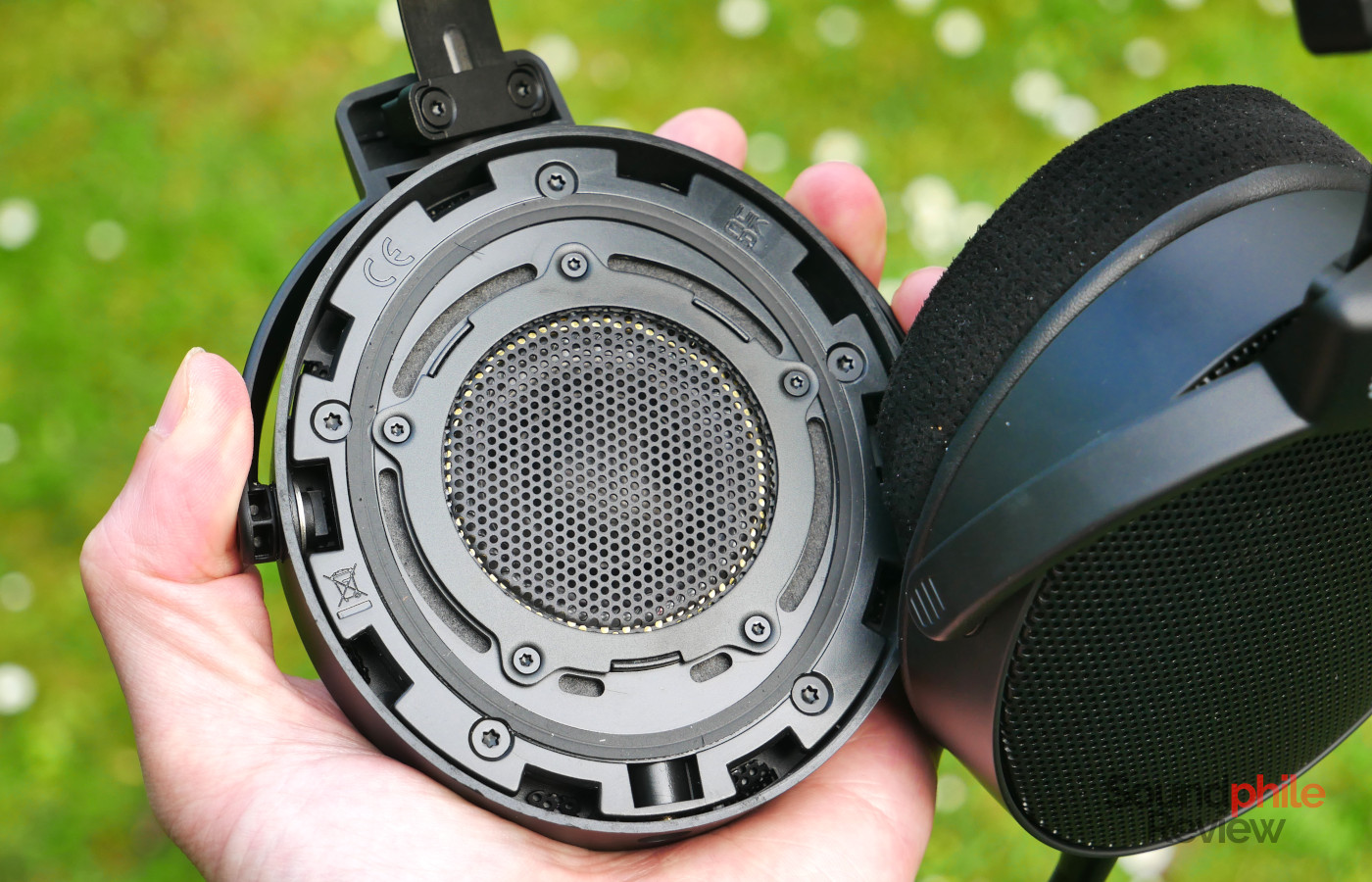
The HEDD HEDDphone D1 straddles the line of neutrality, with a little added emphasis on bass as well as between upper midrange and middle treble, which however does not alter the overall presentation too significantly. This seems to be thanks to HEDD’s thin-ply carbon fibre diaphragm: the material’s rigidity and light weight really seem to make a difference.
Soundstage is relatively wide, as expected from open-back headphones; it often sounds like you’re in a mid-sized room, with the instruments close to you and the sound expanding across the space. It is not a super wide (nor deep, as there is only a hint of depth) presentation, but it is a convincing one. Imaging is both precise and accurate: it accurately reconstructs the stage, using the full left-right spectrum and with a great centre image, and it precisely positions instruments on it, giving them a clearly-placed position. This also happens in crowded and layered tracks with multiple instruments competing for the focus, as instrument separation is excellent.
Bass is slightly more abundant than in an ideally perfectly neutral signature and this lends a bit more warmth to the sound – but these are not bass-boosted and I would still define them as “neutral”. The bass section is impressively smooth, as it goes down to 20 Hz with ease and without any peaks or troughs; there is some additional emphasis on the mid-bass area, around 80 Hz, but it’s small and it never becomes overpowering. Bass often feels like it’s right where it should be: at the fore when needed, acting as the foundation otherwise. What’s really impressive however is not just this smoothness, but also (and especially) the level of detail: it is superlative and it stays so even in heavily layered tracks. You can often feel the vibration of bass strings (as an example, in Snarky Puppy’s The Curtain) – and I write “feel” because there is also excellent physicality. Transients just feel snappy and immediate, so much so that you find yourself tapping your feet without even realising.
Midrange is carefully balanced to sound as natural as possible and this care shows in the lower and middle regions, which often sound like the instruments are right there in the room with you. There is, however, some additional emphasis on the upper region, which makes some instruments like trumpets and violins more present in the mix. You can also hear it with electric guitars, too (see the intro to The Clearing by Snarky Puppy). Overall, HEDD has struck a very good balance which sees some brightness added into the mix without subverting the sound. The one thing that really strikes me here, once again, is how incredibly easy the HEDD D1 make it to hear small details. In The Clearing, the guitar picking around the 1:00 mark is so crisp and clear that it’s almost unbelievable – and, most amazingly, it stays so even when the other instruments come into the scene and relegate it to the background. Congas and other percussions in that same track sound vivid and realistic, as a clear example of how well these headphones manage transients.
Treble shows some emphasis in waves: first around the 6 kHz area, then around the 8 kHz mark with a heavier emphasis, before then quickly falling off a cliff. It’s exactly these two areas which make treble more prominent in the mix – and sometimes a bit aggressive, too, depending on the track. Treble is, in fact, the only area which I find less than ideal, and the one that probably will divide opinions on these headphones. Cymbals do often come to the fore, even when they shouldn’t, which can become fatiguing if your music has a lot of them in it. On the positive side, the level of detail is just as great as for the rest of the signature, and there is plenty of micro-details emerging very clearly from the mix even with heavily layered tracks.
Final Thoughts
I’m not going to mince words here: the HEDD HEDDphone D1 are amazing headphones. They sound way better than what their price alone (at least here in Europe) would lead you to believe, as they compete effortlessly with much more expensive models. They’re a real surprise, and a very positive one. The thin-ply carbon driver makes a real difference and puts the HEDD D1 right under the spotlight among the most interesting headphones out there under $1,000. These are headphones that make very few compromises and, when they do, they make the right compromises, so that they’re neutral while still having personality, they’re analytical without being boring, they’re spacious without introducing too many compromises in the frequency response.
There are only two blemishes: one is the headband padding, which is not at the same level of the rest by either comfort or build quality; the other is treble, which is sometimes a bit too energetic and becomes aggressive. Both things can be (relatively) easily corrected.
Overall, I am happy to give the HEDD HEDDphone D1 my full recommendation as a great headphone model that will offer you 99.9% of what the vast majority of people need, while also not breaking the bank in the process. These are basically the Sennheiser HD650, but better. And what’s not to like about that?

I’m interested in SoundAware MDAT3.
Do you have plans to discuss it?
Yes, a review will come, though the sample I got seems to have issues so I am waiting for a new one to be delivered.