There is no denying that Bluetooth is very convenient and that applies not just to earphones, but to stereo speaker systems, too. DACs and amplifier increasingly feature Bluetooth to add convenience – and that’s exactly why the Fosi Audio BT20A Max features Bluetooth on top of classic wired interfaces. This very compact stereo amplifier can be used with any source (DACs, CD players, network streamers, etc) as well as on its own through its integrated Bluetooth module, adding a lot of convenience to the form factor.
Disclaimer: I received a unit gratis from Fosi Audio to write this review. The BT20A Max retails for $279. Additional info on Fosi’s website.
TL;DR: recap
| Pros |
Cons |
| + Compact
+ Large power output + Neutral sound signature + Bluetooth connectivity with lots of codecs + Loads of features |
– Runs quite warm even when idle
– Always-on fan – Slightly fuzzy treble |
Rating: 8.5/10
Packaging & Accessories
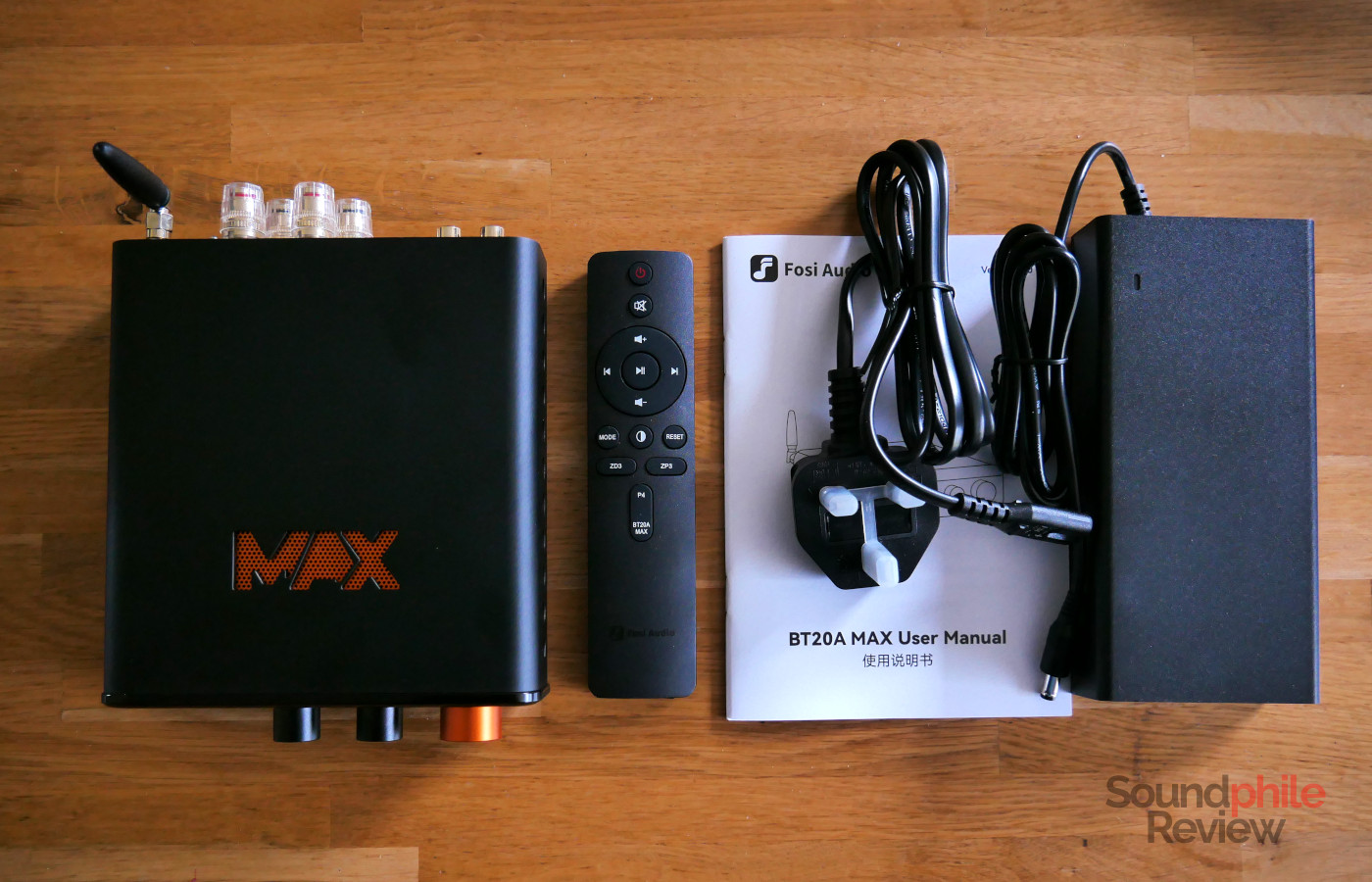
Inside the packaging of the Fosi Audio BT20A Max you can find the amplifier itself, its power supply, a remote and a manual. The amp comes with three power supply options: a 32 V / 5 A one (160 W), a 48 V / 5A (240 W) version and another 48 V / 5A made with GaN (gallium nitride) transistors, which is smaller and more efficient than traditional silicon-based PSUs. The 240 W PSU will set you back $20 more than the 160 W one; the GaN one will need an additional $20 on top of that.
Design & Build
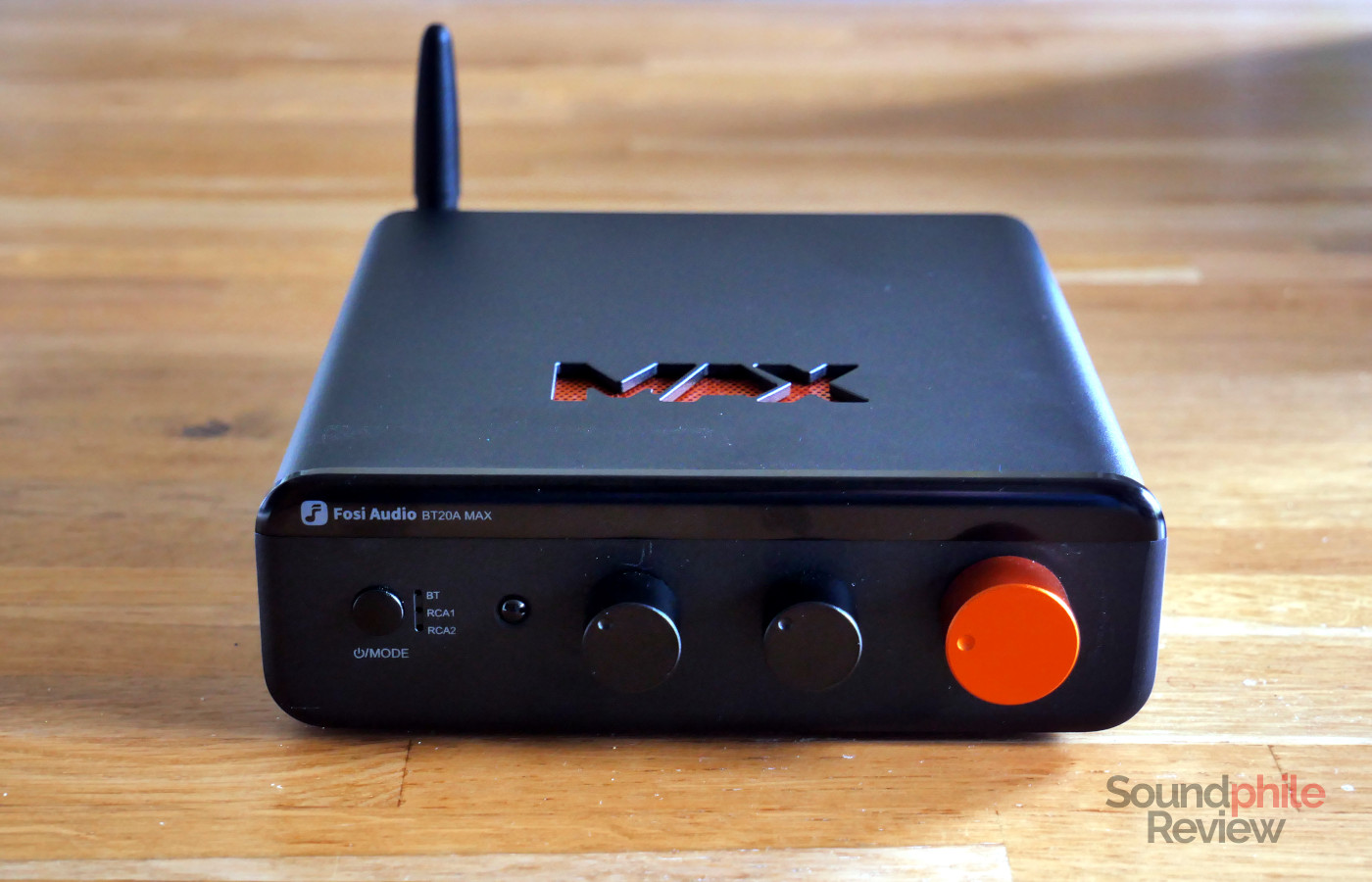
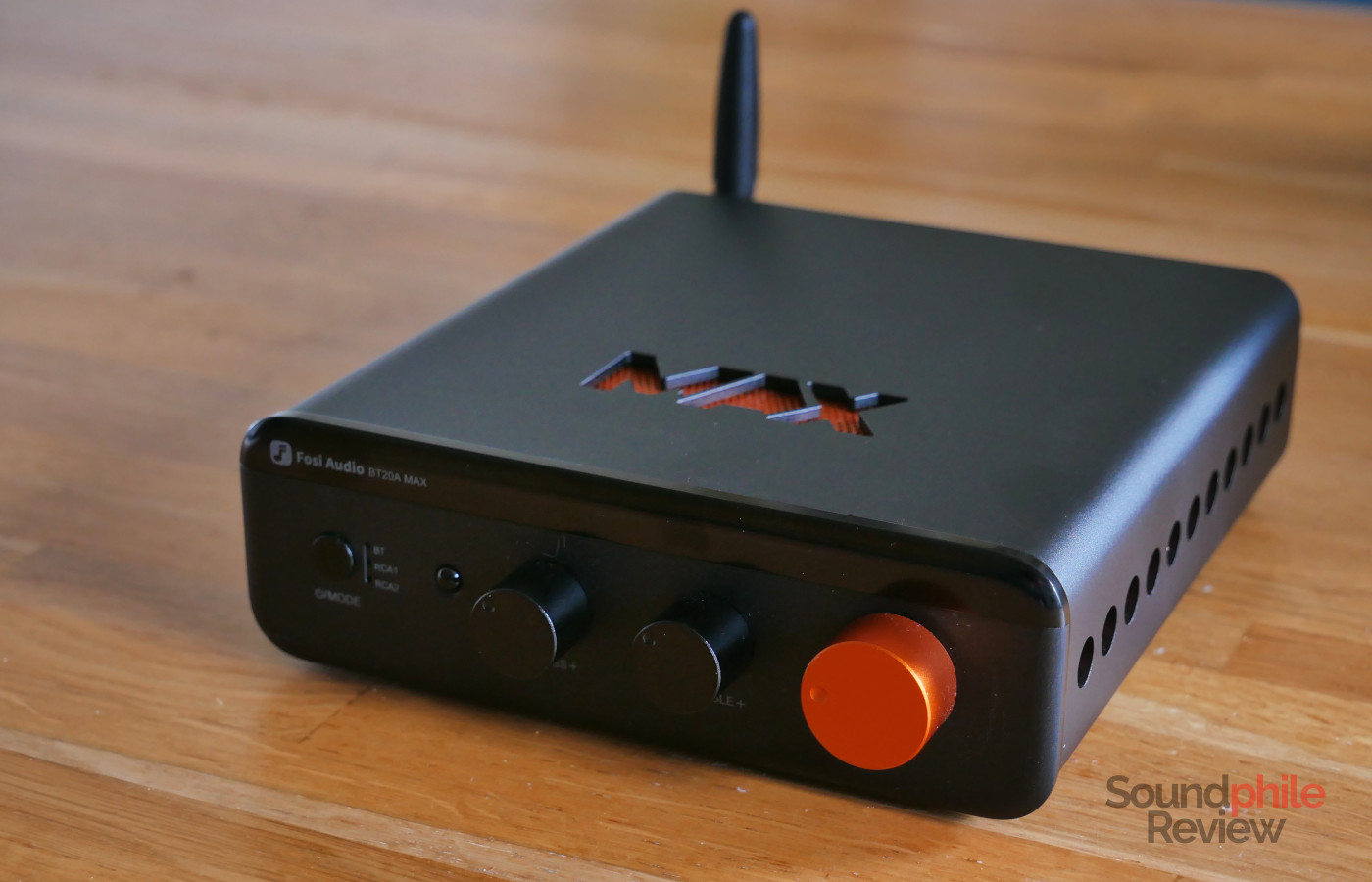
The Fosi Audio BT20A Max signals a departure from the usual design language adopted by Fosi, with a smaller and more rounded chassis and especially with a two-part and two-tone front which features a glossy plastic band on top. It has a more playful character than previous models by the company, while still keeping things elegant.
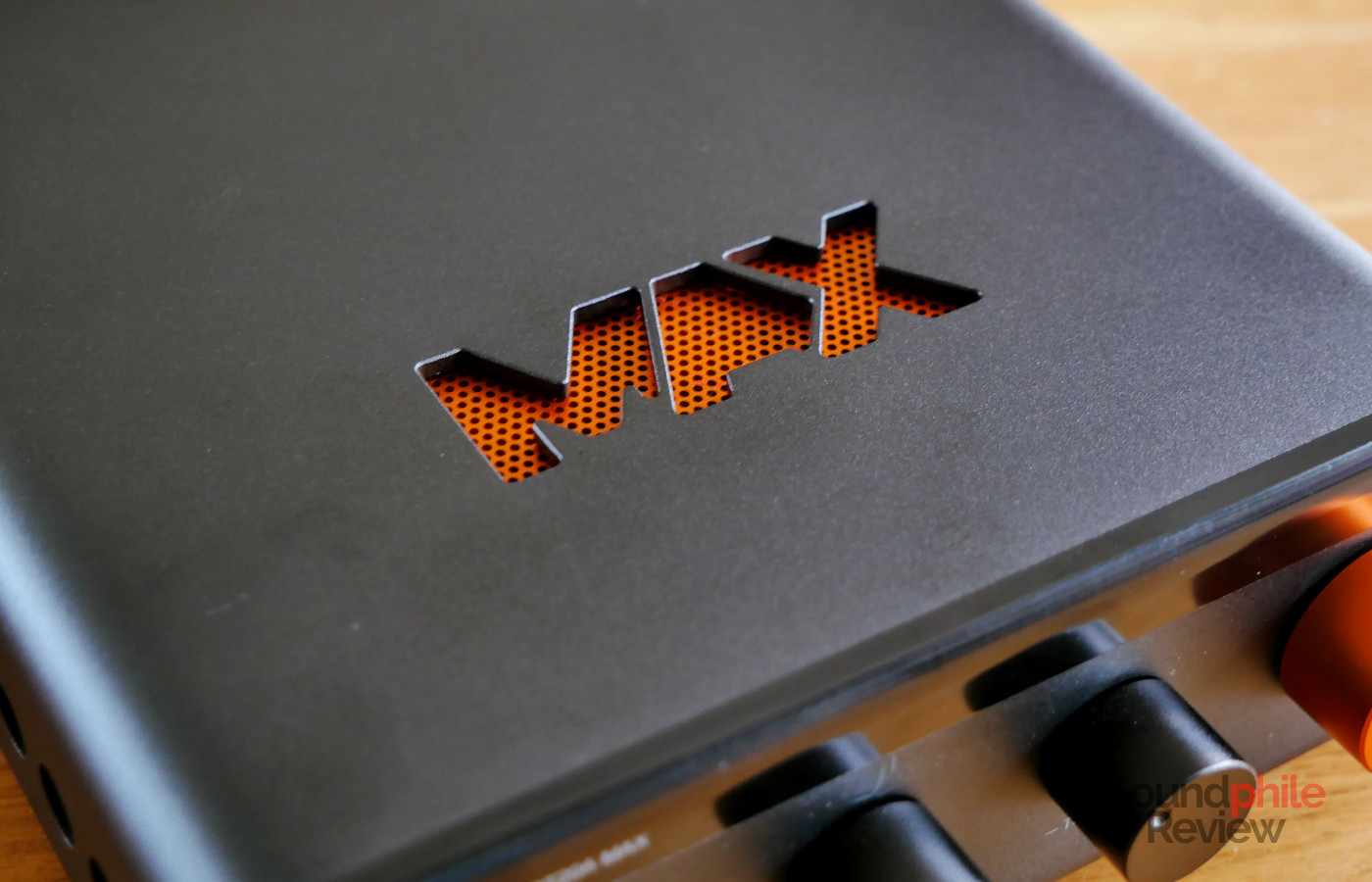
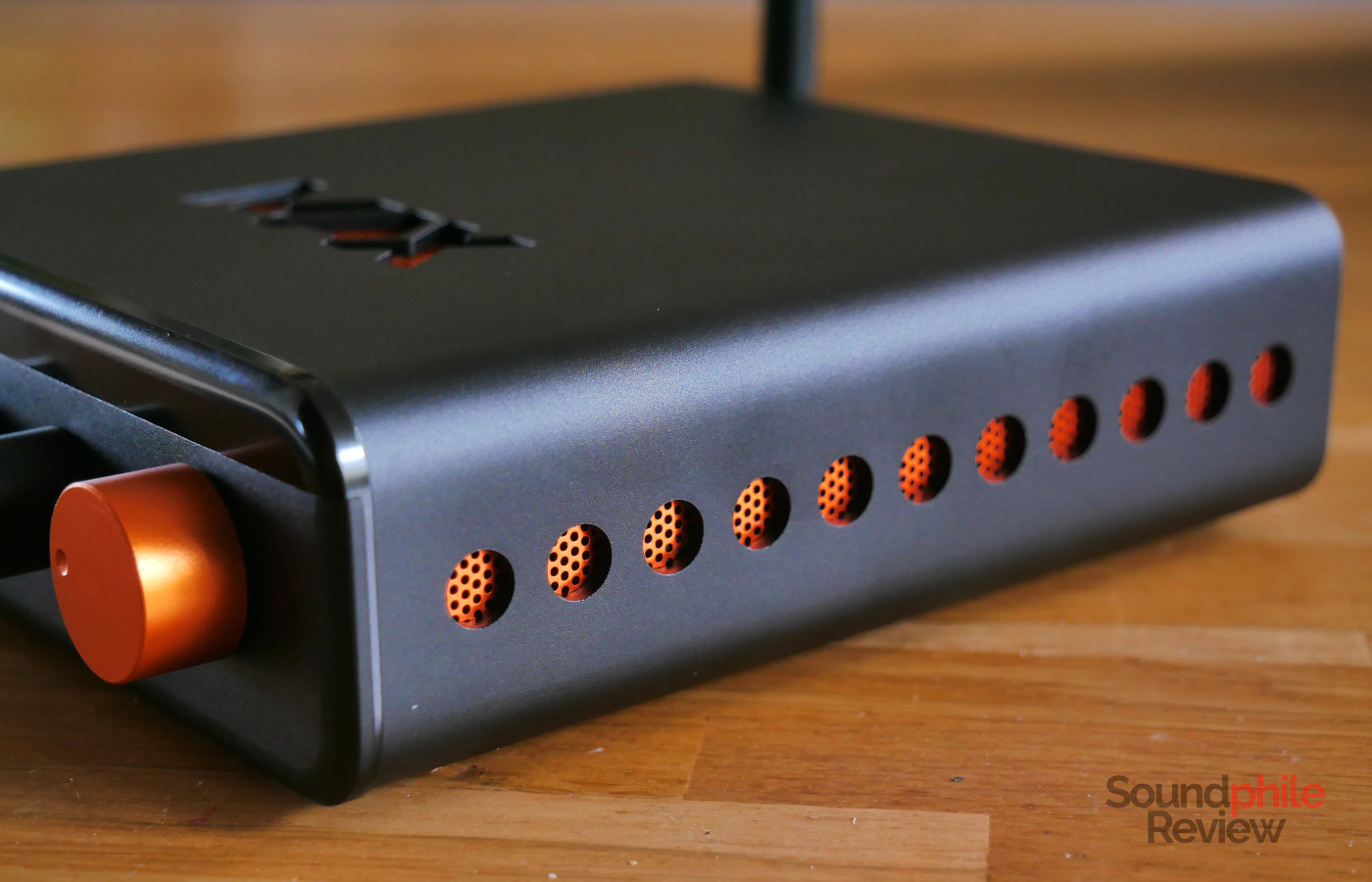
The sides have lots of holes with a protective grille in the company’s signature orange showing through, and there is a large hole on the top as well, shaped like the word “MAX” written in capitals. Under this hole there’s an always-active fan to help dissipate the heat and keep temperatures inside the case low. The fan is relatively silent, but it is still audible from less than 1 m away in a silent environment. I personally don’t find it that noticeable when sitting on my sofa at ~1.2 m, except when it’s dead silent, as it is covered by music even at the lowest volume; I would not use the BT20A Max for a near-field system, however.
It should also be noted that the amplifier becomes quite warm despite the fan and even when sitting idle. This could be due to two things: one is that Fosi decided to use a smaller case than other similar amplifiers like the ZA3, thereby increasing the thermal density of the system due to the smaller heat sink; the other is that some circuitry is always on and consuming power, even when the amp is doing nothing. It is also possible that we have a combination of those two elements. A slightly larger case with a bigger heat sink would probably have led to lower temperatures and therefore better longevity of the unit.
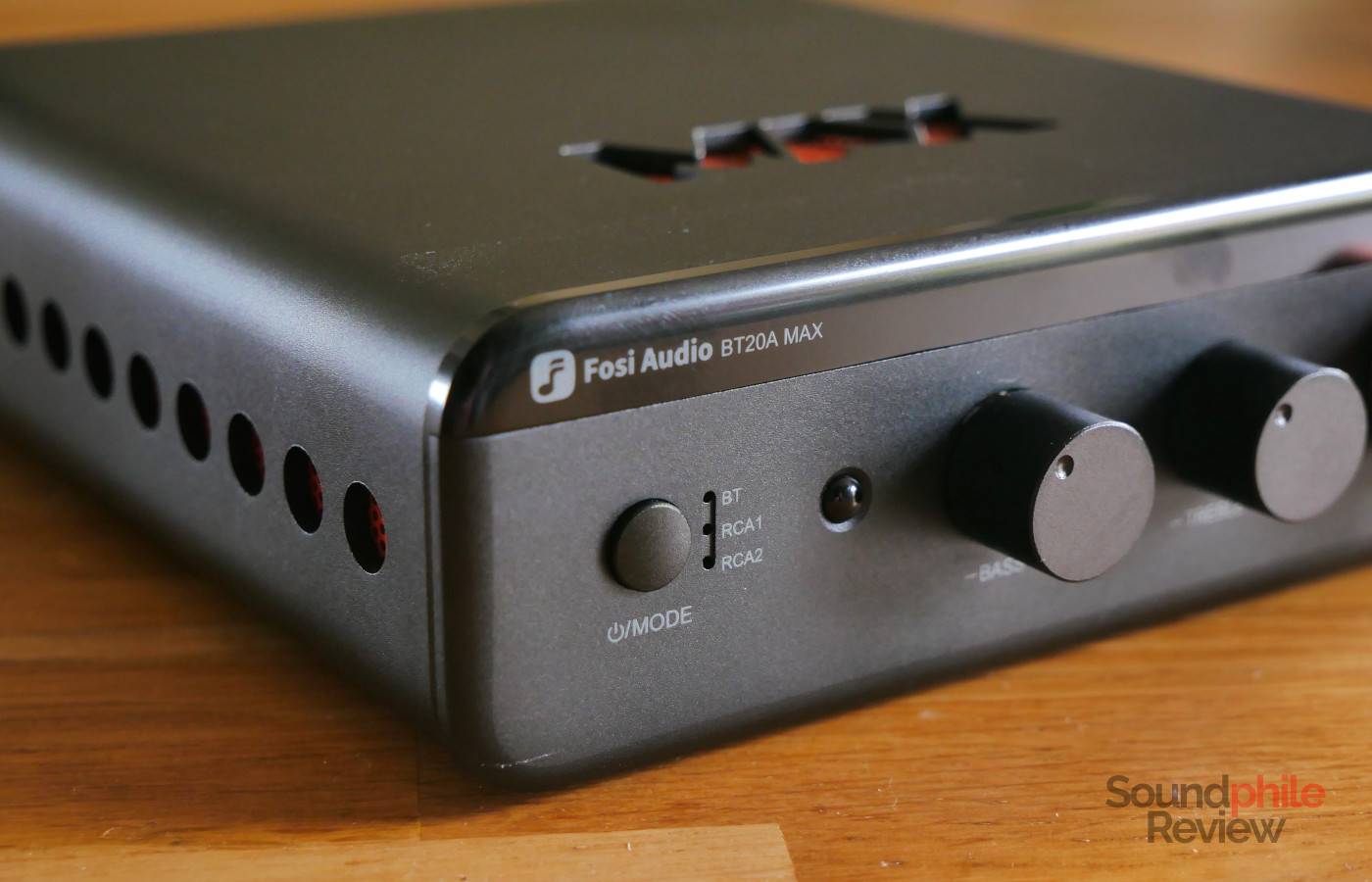
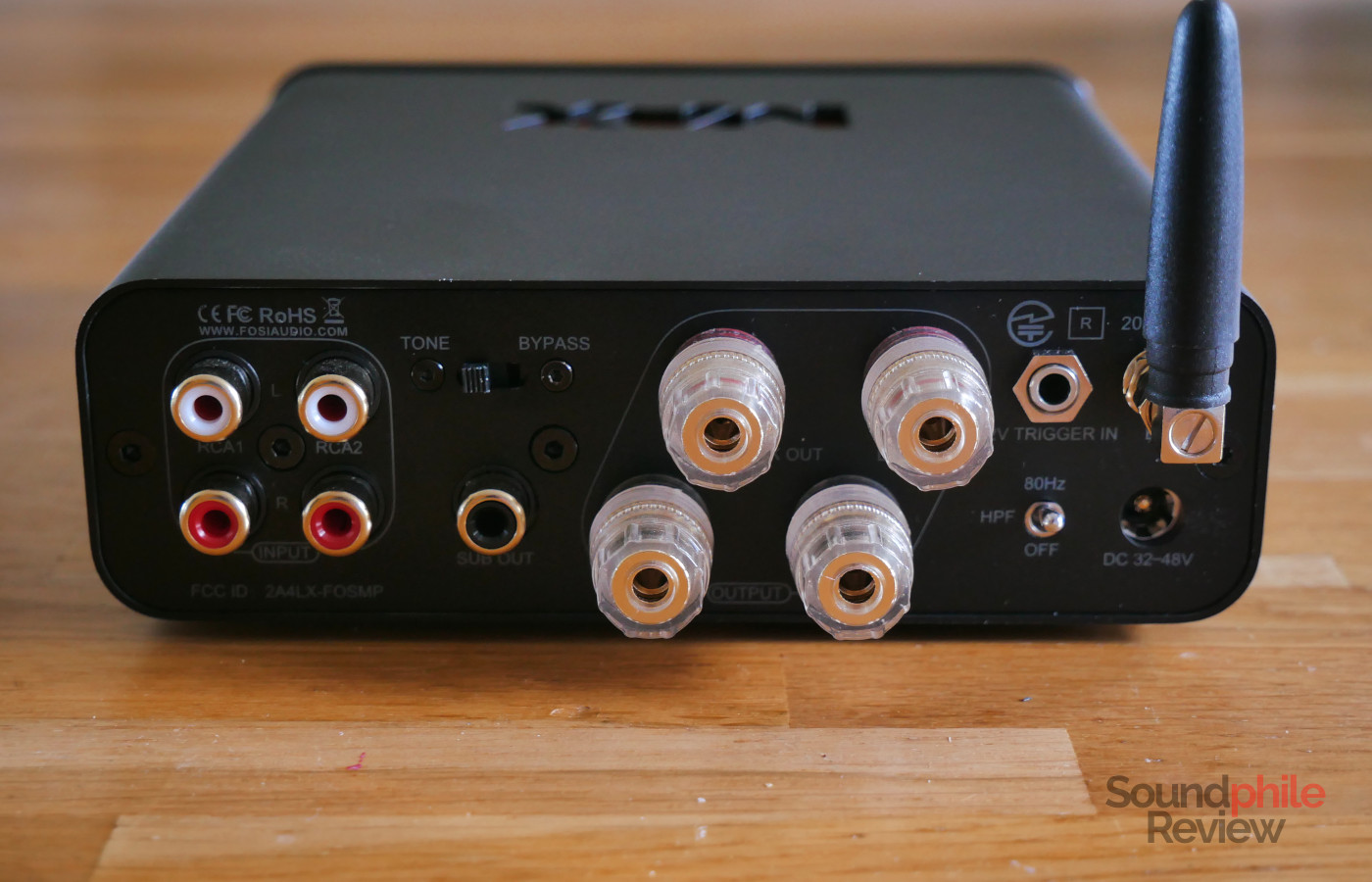
The front of the BT20A Max hosts the power button (which also acts as an input selector), a set of status LEDs to indicate which input is active, an IR sensor for the remote, two knobs to adjust bass and treble, as well as the volume knob. It’s very clean and simple, with the volume knob in orange. The back is busier and hosts two sets of stereo RCA connectors so you can connect the BT20A Max to two different sources, a physical switch to enable or disable the equaliser knobs, an RCA subwoofer output, the speaker outputs (compatible with both banana plugs and bare wire), a switch for the high-pass filter, the Bluetooth antenna, a 12 V trigger input via a 3.5 mm jack, and the power connector.
Build quality is excellent, like all products by Fosi Audio. The BT20A Max looks and feels like a premium product, also thanks to the smooth and polished metal build.
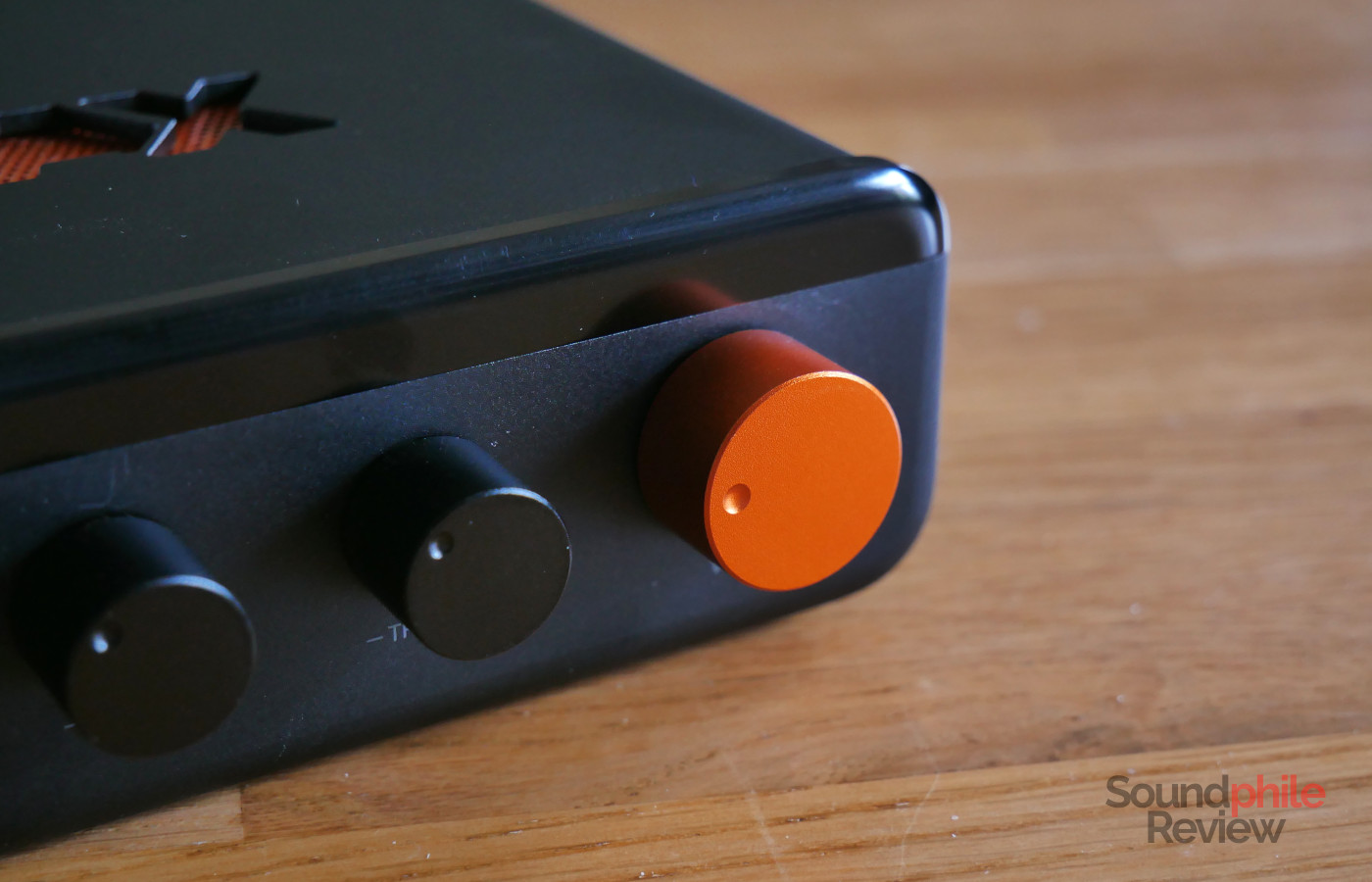
The volume knob is motorised, so it moves automatically when you adjust the volume using the remote. It is the first time I personally see this in a small amplifier in the sub-$500 price range. You can still turn it yourself, and it is buttery smooth. It also has a nice weight to it when you do which allows for precise adjustments. There is a relatively small imbalance zone between the starting position (7 o’clock) and 8 o’clock. The two EQ knobs have a “notch” in the neutral position, so that you can feel where it is when turning them.
Features & Specs
The defining feature of the BT20A Max is its Bluetooth connectivity. The amplifier is compatible with the Bluetooth 6.0 standard and offers the SBC, AAC, aptX, aptX HD, aptX Adaptive, aptX Lossless and LDAC codecs. The connection is very stable and remains stable and without hiccups even when moving the source across my (admittedly very small) flat.
The double RCA inputs give you more flexibility in terms of managing multiple sources, like a DAC and a CD player at the same time. The high-pass filter allows you to cut off the lower frequencies (below 80 Hz) so that they are left to the subwoofer when you connect one.
Fosi Audio BT20A Max |
| Input | RCA, Bluetooth |
| Suitable speaker impedance | 2 – 8 Ω |
| Maximum output power | 300 W p.c. (declared, @ 4 Ω) |
| Frequency response | 20 – 20,000 Hz (±0.5 dB) |
| THD+N (@1 kHz) | < 0.003% |
| SNR | > 112 dB |
| Crosstalk | N/A |
Contrary to all the other amplifiers by Fosi Audio that I’ve tested, the official specs for the BT20A Max say that the amp eschews the Texas Instruments TPA3255 to adopt a different chip called the TPA3225. The interesting thing is that there is no sign anywhere of this chip actually existing: TI’s website does not provide any information on it. Looking elsewhere in the product page, the company mentions the TPA3255 as being the actual chip being used, accompanied by NE5532 op-amps.
Fosi highlights their use of the PFFB technology: the acronym stands for “post-filter feedback” and is a technology developed by Texas Instruments and integrated in the TPA3255 amplifier chip used by Fosi on the BT20A Max. It offers better gain with lower noise and distortion, and it is why the BT20A Max offers better SNR and THD+N than the ZA3.
The digital stage is managed by a Qualcomm QCC3095 Bluetooth chip, capable of managing 24-bit, 96-kHz content, while the DAC is a Cirrus Logic CS4398, which is an older chip from the early 2010s which still offers good performance.
Contrary to many amplifiers, even those equipped with Bluetooth, the Fosi Audio BT20A Max sports a remote through which you can control it remotely. The remote is a universal one made for most Fosi Audio devices and has dedicated buttons for the ZD3, the ZP3, the P4 and the BT20A Max. It features button for power, mute, volume up and down, play/pause, next and previous track, mode (to switch between Bluetooth, RCA 1 and RCA 2), a brightness button and a “reset” button which don’t do anything on the BT20A Max.
Sound
I have tested the Fosi Audio BT20A Max both using its Bluetooth connectivity (with a laptop and a Google Pixel 7 Pro) and connecting it to a Fosi Audio ZH3, in both cases driving a pair of ELAC DBR62 speakers.
When the EQ is disabled, the BT20A Max sounds entirely neutral and no different than the many other amplifiers based on the TPA3255 chip that I’ve heard. There are, however, some considerations to make regarding how it delivers that sound. I find that the BT20A Max has a somewhat “analogue” sound, in the sense that it tends to deliver slightly loose bass which lingers on for longer and therefore sounds more abundant, and it tends to sound less detailed than other alternatives. Some finer elements, especially in the treble region, seem a bit fuzzy to me, which contributes to that analogue feeling. We’re not talking about major differences here, but rather small accents which emerge when listening to well-known tracks.
The two EQ knobs allow you to adjust bass and treble, and you can really go wild here. Turning the bass knob up all the way makes my DBR62 absolute bass monsters, although sound becomes muddied and clumped at that point. In small doses, however, it is something that adds fun and makes tracks like The Prodigy’s Smack My Bitch Up a lot heavier-hitting. Conversely, I find that the treble adjustment can take away a bit of that treble fatigue which I often experience lately, making things mellower. It is an EQ system which works very well and allows you to tune your speakers in a very easy way. A small dose goes a long way, however, and I find that you don’t need to move the knobs too much to get a significant effect.
Final Thoughts
The Fosi Audio BT20A Max is Fosi’s most expensive amplifier to date. While it uses the same chip as the other devices by the company, the difference in price appears to be justified by the addition of Bluetooth as well as by the usage of PFFB technology, which significantly reduces distortion and noise. It is a very versatile amplifier, thanks to its neutral sound signature, and it is made even more versatile by the addition of the two EQ knobs which allow you to alter the sound of your setup in a purely analogue fashion. It also comes with a remote and a motorised volume knob, which is a rarity in amplifiers of this size and price.
The only drawbacks of the BT20A Max concern the heat the amplifier produces: despite having an integrated fan, the amp always draws enough power to get quite warm, even when completely idle; that fan is not entirely silent, either, which makes the BT20A Max unsuitable for near-field setups. All in all, however, I feel like Fosi has done a great job here and that this is a great little amplifier which achieves a fantastic balance of convenience and sound quality.