Wireless microphones have traditionally been either the hand held type, which are normally associated with singers and presenters, or those worn on you like lavaliers and those with an ear hook. Dynamic podcasting microphones have so far been wired. The Maono PD200W is the first one to cut the cord while keeping functionality intact – and, in fact, offering more.
Disclaimer: I received a unit through Maono’S UK PR agency. The PD200W retails for $129. Additional information on the product page.
TL;DR: recap
| Pros |
Cons |
| +Well-built
+ First wireless podcasting microphone! + Varied connectivity options + Can be connected to camera as well + Lots of built-in features + PC and mobile apps |
– ANC feature removes noise, but creates distortion
– AI ANC is only available on Windows or macOS – Limited range – The status ring reacts quite slowly |
Rating: 7.8/10
Packaging & Accessories
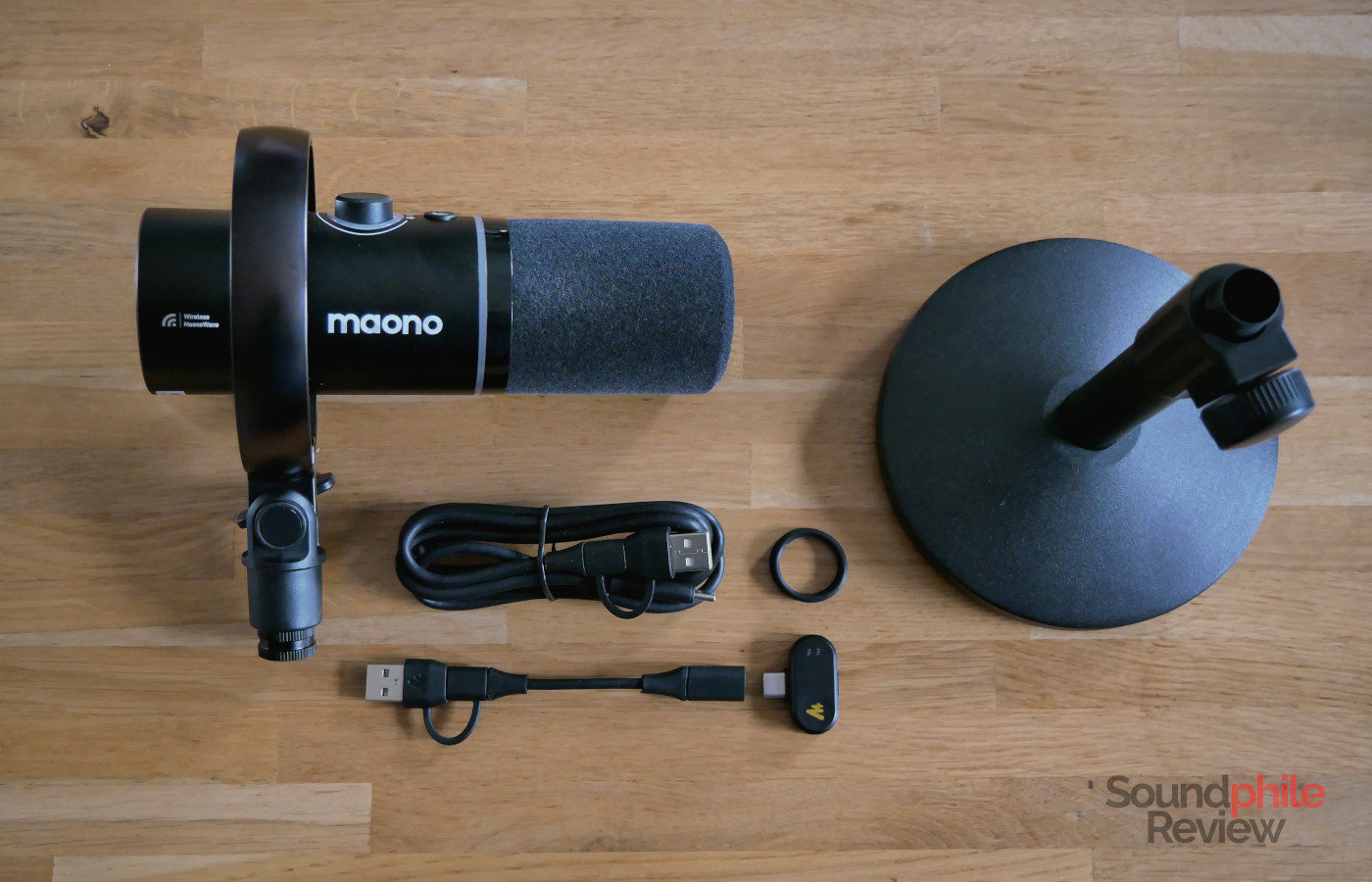
The packaging includes the microphone with its own shock mount, as well as a desk mount with a telescopic arm, a USB to USB-C cable, a wireless receiver with a (male) USB-C connector, a cable with a USB-C port, a USB-C connector with a built-in USB-A adapter, two spare elastic bands for the shock mount and a manual.
Design & Build
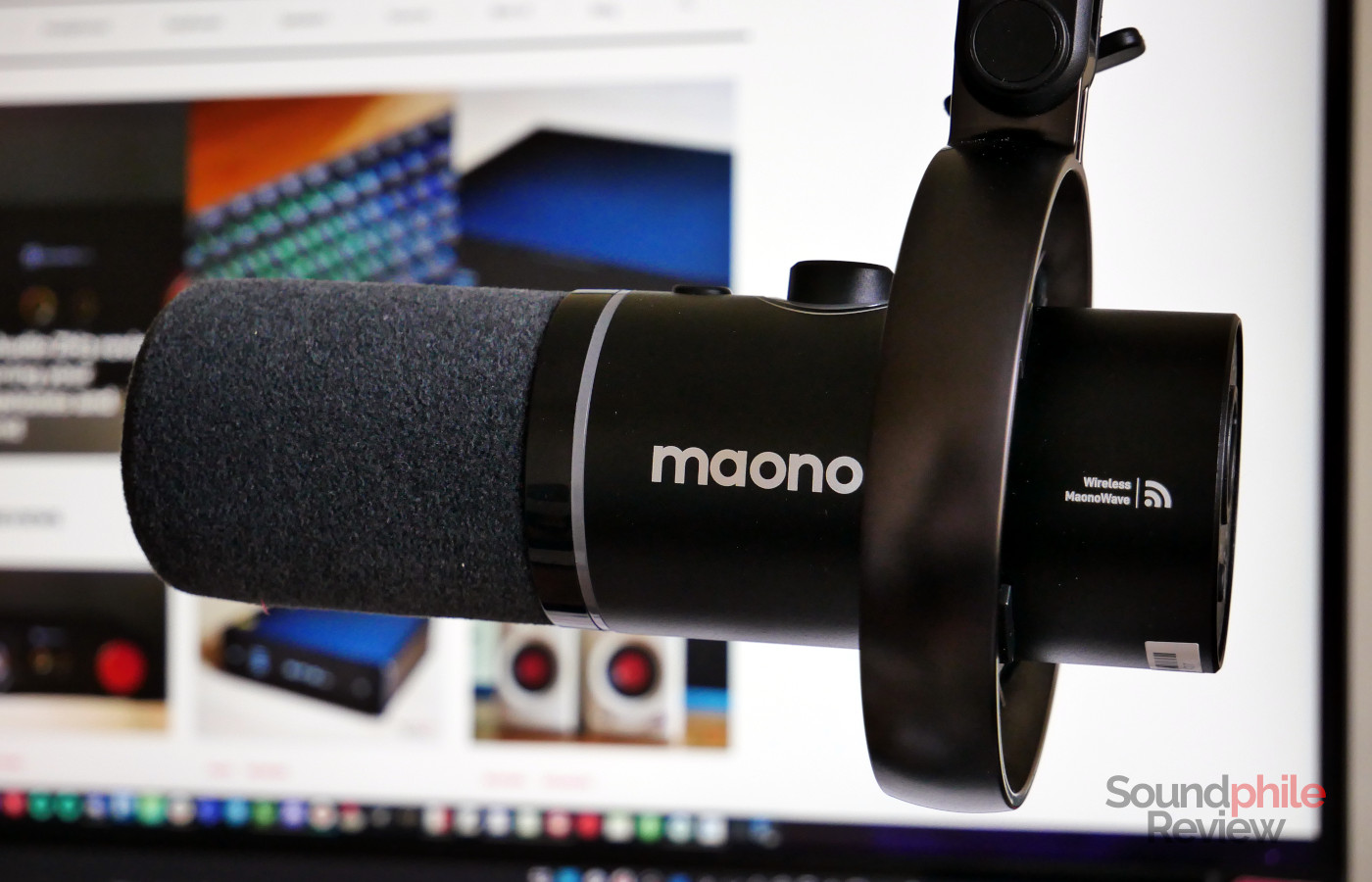
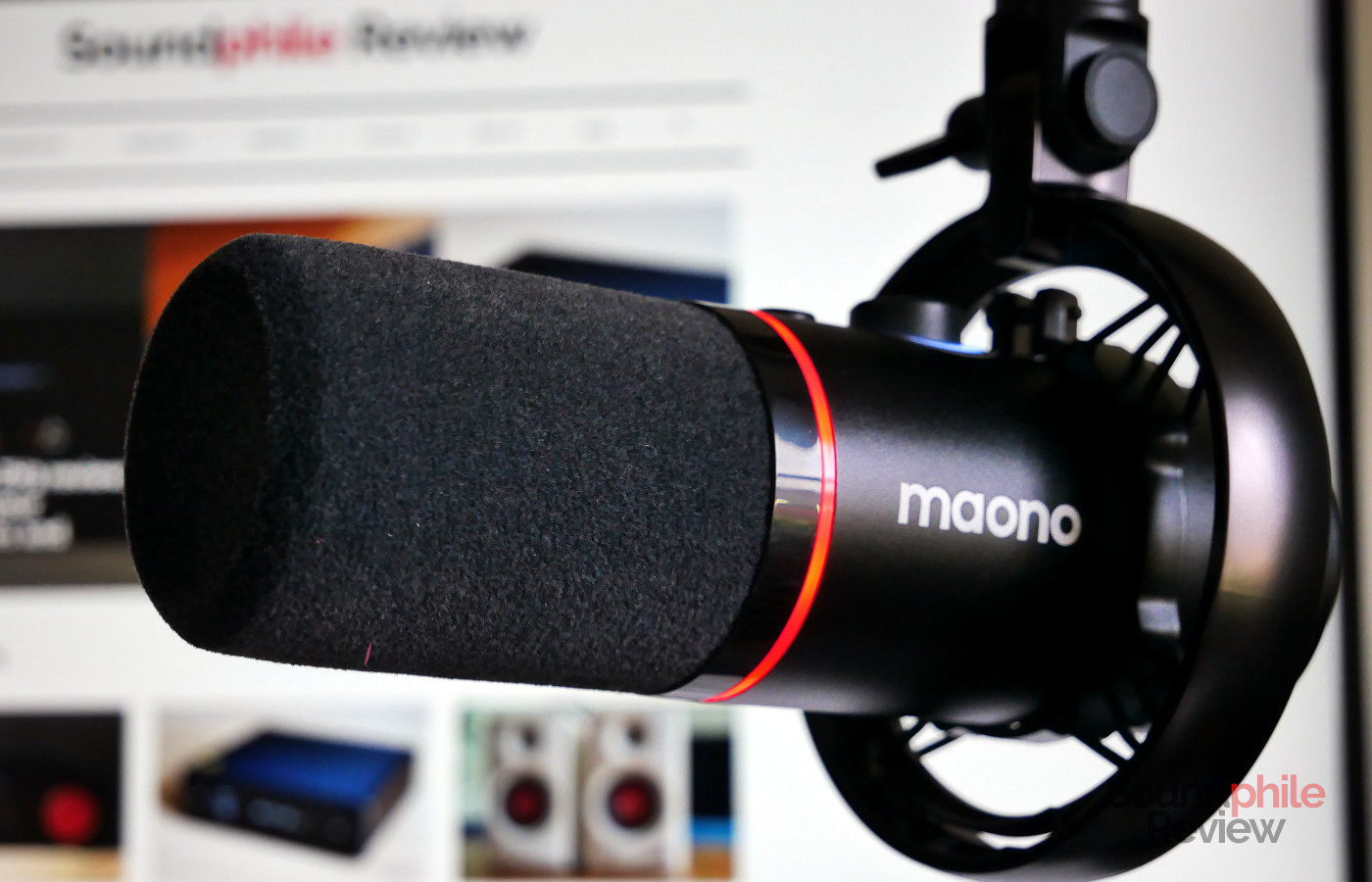
In terms of pure design, you can’t really tell from a glance that the Maono PD200W is a wireless microphone: it looks like most other podcasting microphones, complete with XLR and USB-C connectors on the back. The only indication is the power button, which sits right next to the 3.5 mm jack used for connecting headphones for monitoring. Otherwise, the PD200W looks like a generic professional studio microphone.
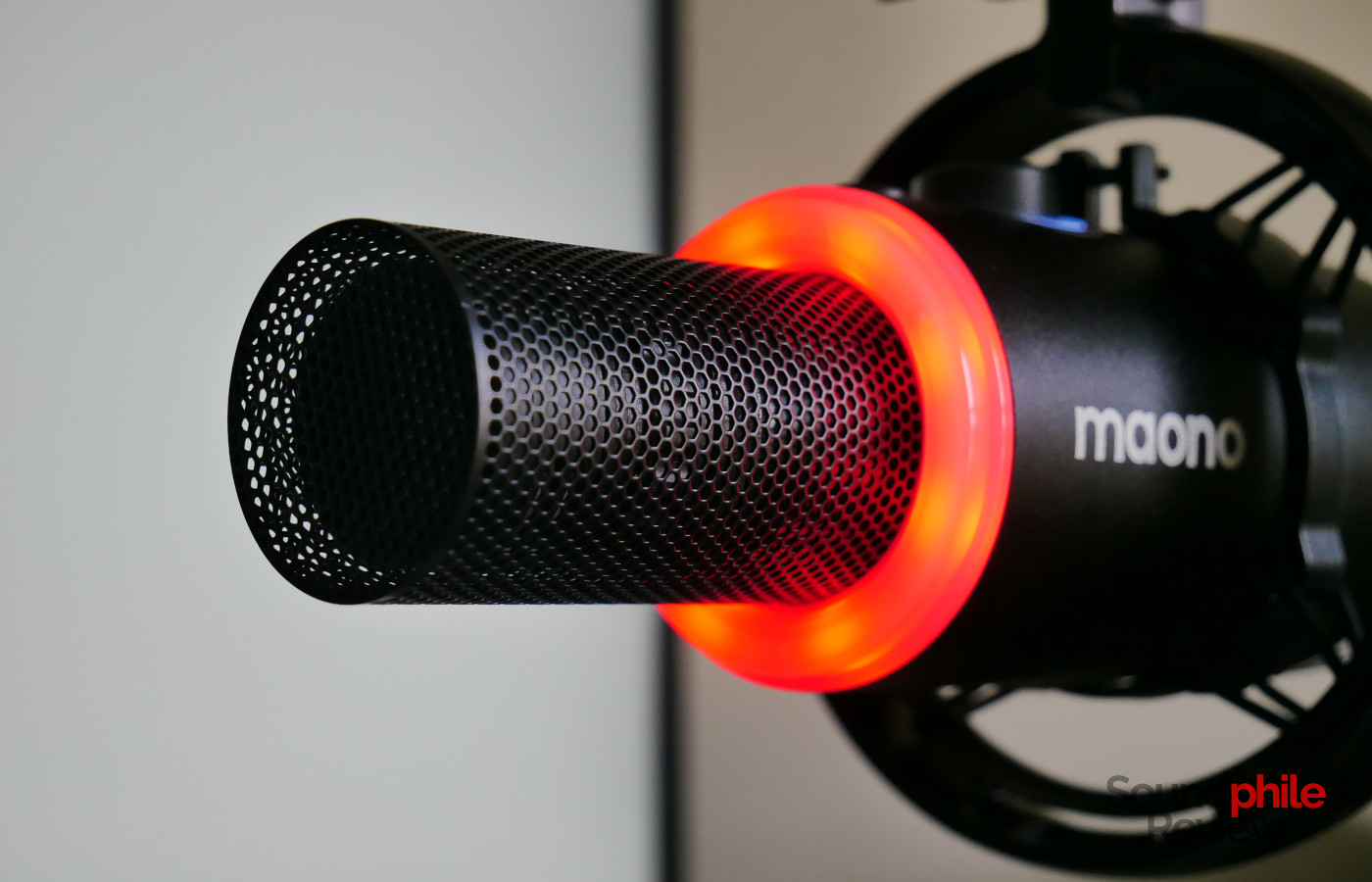
The neutral grey pop filter is easily removable; at its base there is a plastic ring, which sits against a transparent ring which lights up with RGB lighting. Under the pop filter there is a metal cage protecting the capsule.
The body of the microphone is made of aluminium painted black with a smooth finish. Overall, the PD200W looks very understated and, thanks to this, it would feel at home anywhere – be it a studio, a streamer’s desk, or an office.
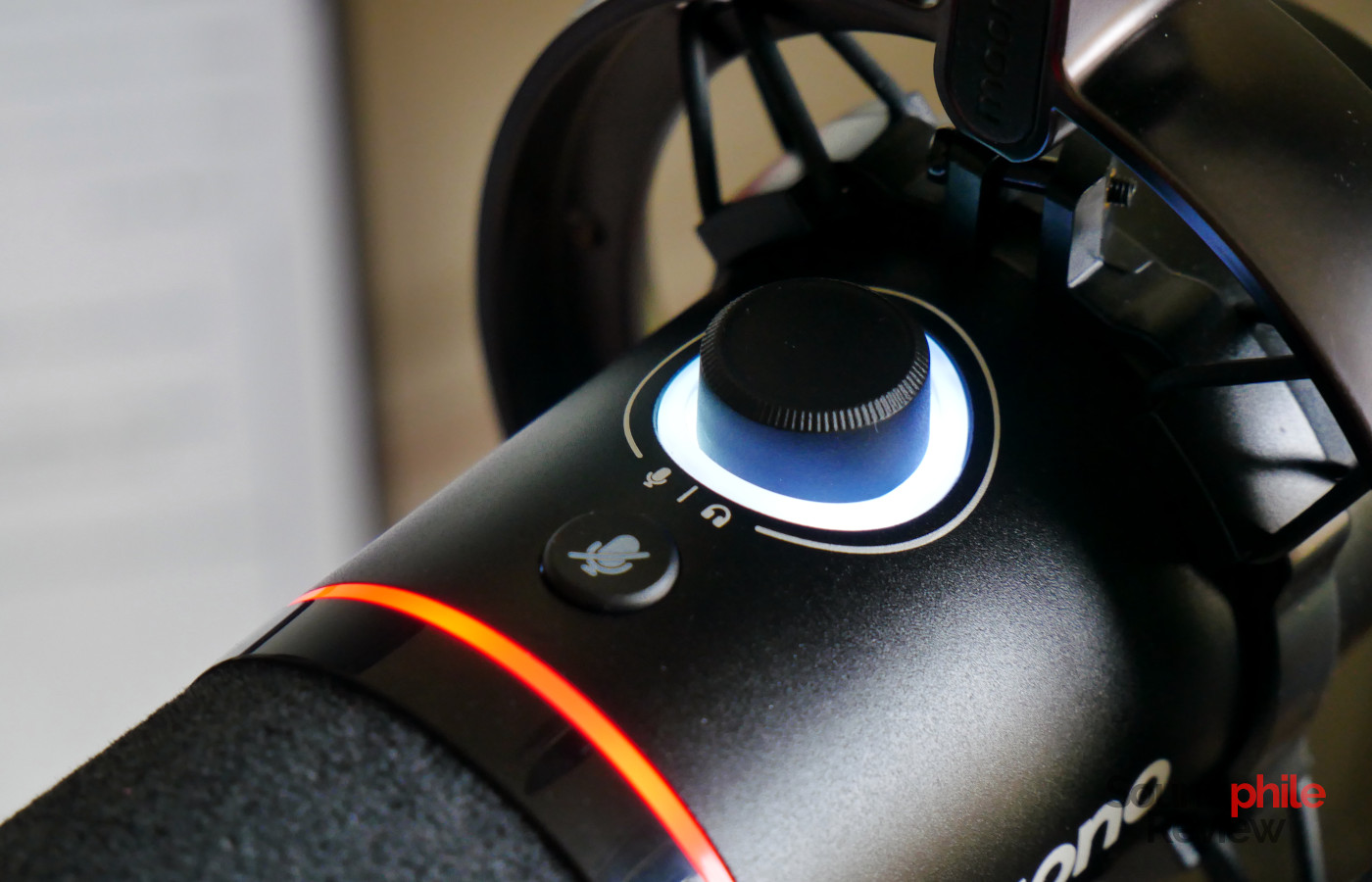
There is a “mute” button on top, next to a free-spinning stepped digital wheel which is used to adjust both the volume and the noise cancelling feature. Around this wheel there is another light-up ring, which is used to indicate the status of the microphone – things like the volume or the charging level. The ring flashes twice once you reach the minimum or the maximum. One thing to note is that this ring reacts quite slowly, so it will flash with a delay of a couple of seconds; a faster response would have been ideal to allow the user to adjust things with better precision.
Specs & Features
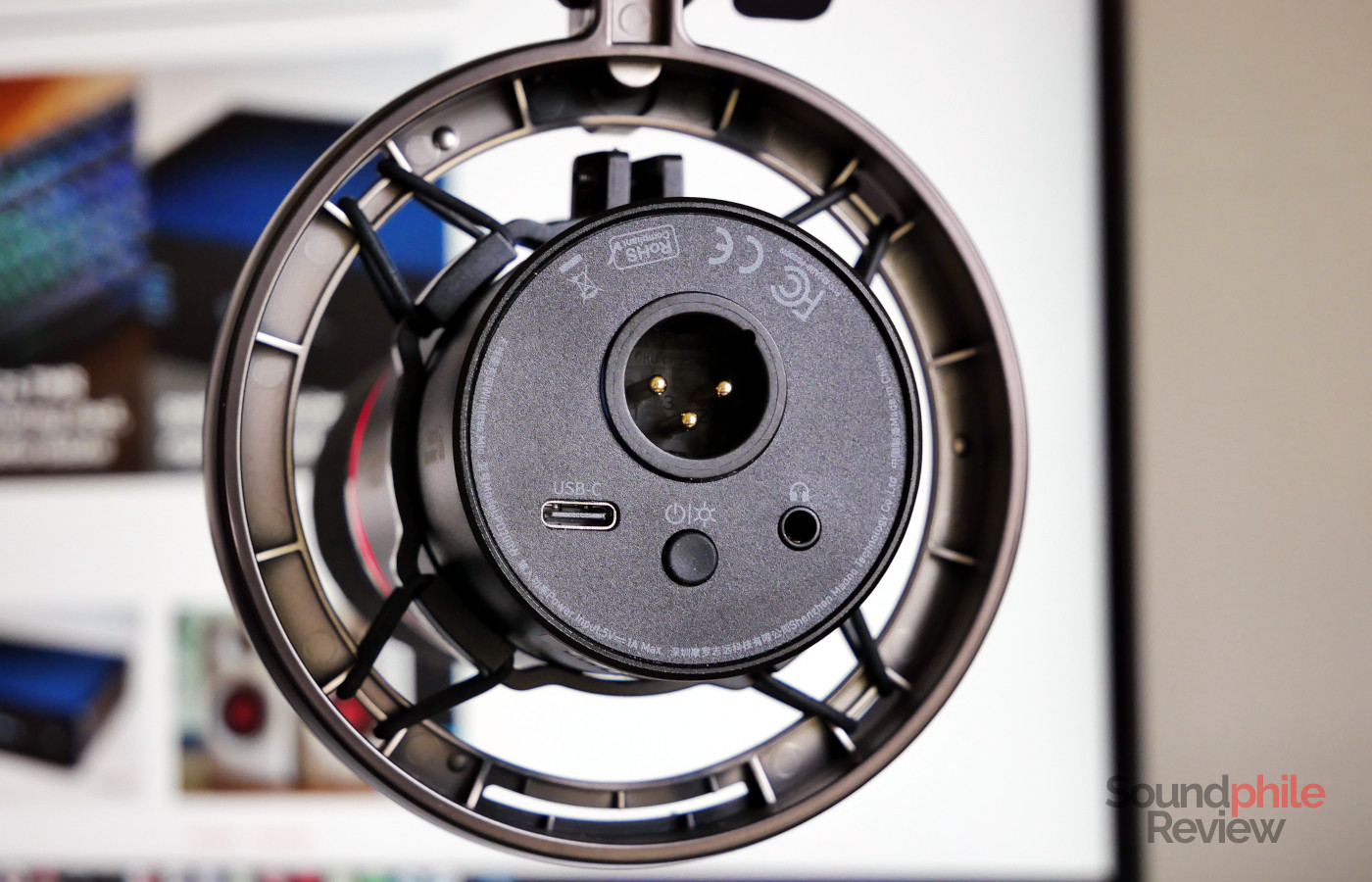
Maono provides a bit data on the microphone through their website and a bit through the manual. They say that it has a 30 mm capsule which offers a cardioid pattern (which is included in the manual, but curiously not on the website), an SNR of 82 dB and a maximum SPL of 128 dB. The frequency response graph they provide in the manual makes it clear that this is a podcasting microphone which is best suited to recording voices and therefore it is not recommended for e.g. musical instruments, as the sensitivity goes progressively up (however relatively slightly) above 1 kHz.
Maono boasts a range of 50 metres in a line of sight situation; when testing the microphone inside a flat, a single wall and about 4 metres of distance in between the microphone and the computer it was connected to was enough to make the microphone disconnect. I would therefore say that the wireless capability is useful only in those situations where you can keep a line of sight.
The Maono PD200W sports a 2,600 mAh battery which is enough to power the microphone for 60 hours with RGB off or 38 hours with RGB on; in my experience it lasts about half that much with RGB turned on and ANC dialled to the maximum level. Maono says that when you charge the microphone, the light around the volume wheel turns off once the charging is complete; in reality, it turns green.
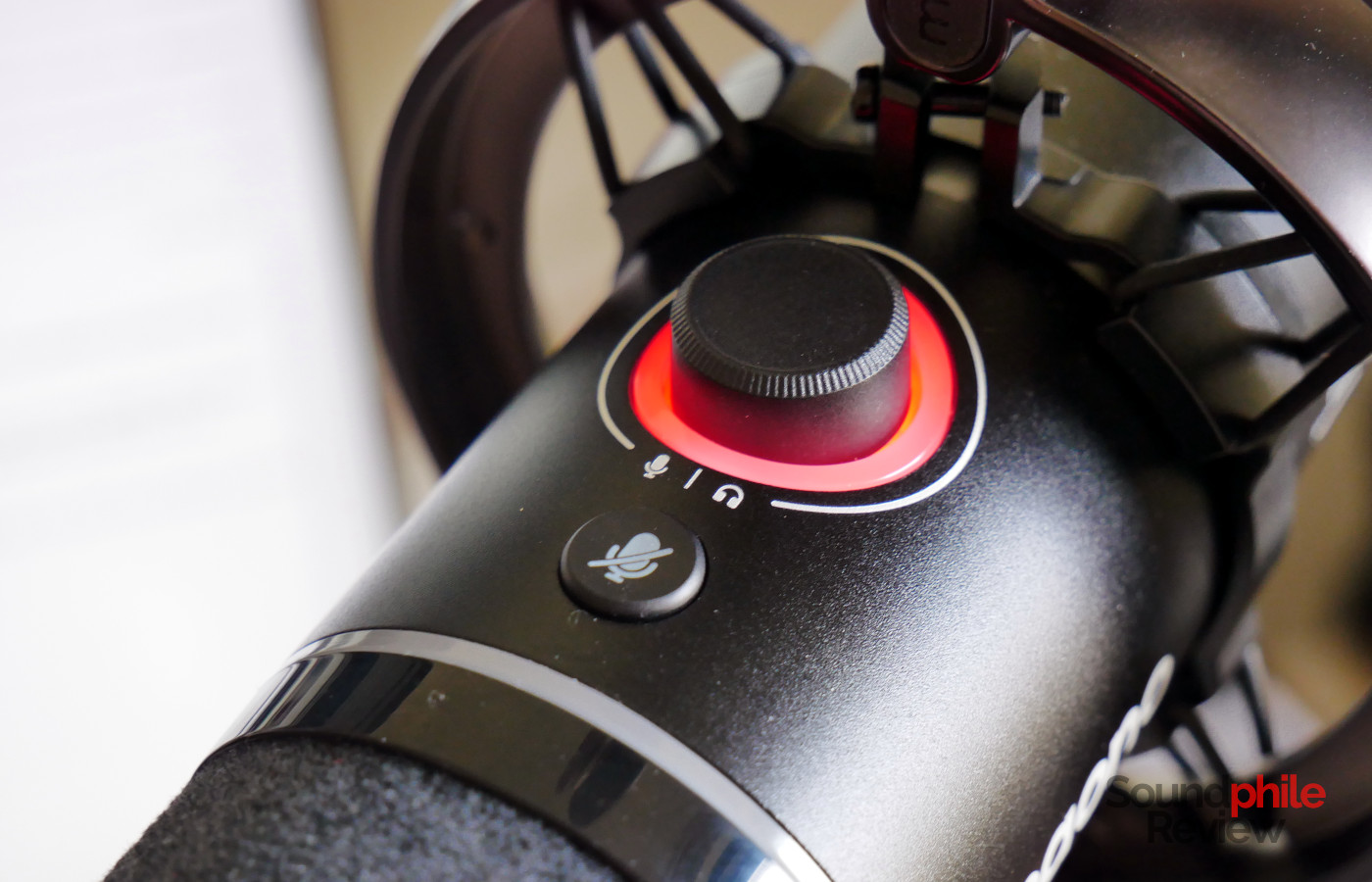
The ring light flashes and then turns off when the microphone is muted, while the ring light around the volume knob turns red. This is enough to give you a visual clue about the state of the microphone, although it is not super visible (and I have, in fact, struggled understanding why people couldn’t hear me on multiple occasions, before figuring out that I had muted the microphone!).
The PD200W is supported out of the box on all major operating systems, including Linux (and therefore the Steam Deck) and Android.
Maono PD200W |
| Microphone type | Dynamic |
| Polar pattern | Cardioid |
| Frequency response | 50 – 16,000 Hz |
| Connections | USB (24 bit, 44.1 – 48 kHz), XLR, wireless |
| Maximum SPL | 128 dB |
| SNR | 82 dB |
| Sensitivity | – 7 dBFS (USB) – 53 dBFS (XLR) |
The Maono PD200W supports USB, XLR and wireless connections. An interesting bit is the fact that it supports all of them at the same time: you could theoretically connect the microphone to your phone using the wireless receiver, to a desktop computer using the XLR cable towards an audio interface like the RØDECASTER Pro II, and then the USB-C to a laptop and have them all work at the same time. I figure this could be useful for streaming or in cases in which you want to make sure that you are actually recording everything and you have multiple copies. Although this might seem obvious, it should be noted that the noise cancellation and mute button only work when using the microphone with the USB and wireless connections, and they will not work if you use it just with the XLR connection. As this is a dynamic microphone, it does not require phantom power.
Speaking of wireless connection, a very interesting option with the PD200W is using an alternative wireless receiver which is compatible with cameras, as it has a 3.5 mm jack output rather than a USB-C connector. This makes it possible to record videos using the microphone directly through your camera, without the need to record audio and video separately and then reconcile them afterwards in the editing process.
Maono does not provide any information on headphone compatibility for the headphone output; I tested the headphone output with low-impedance earphones and it worked really well, with plenty of power available.
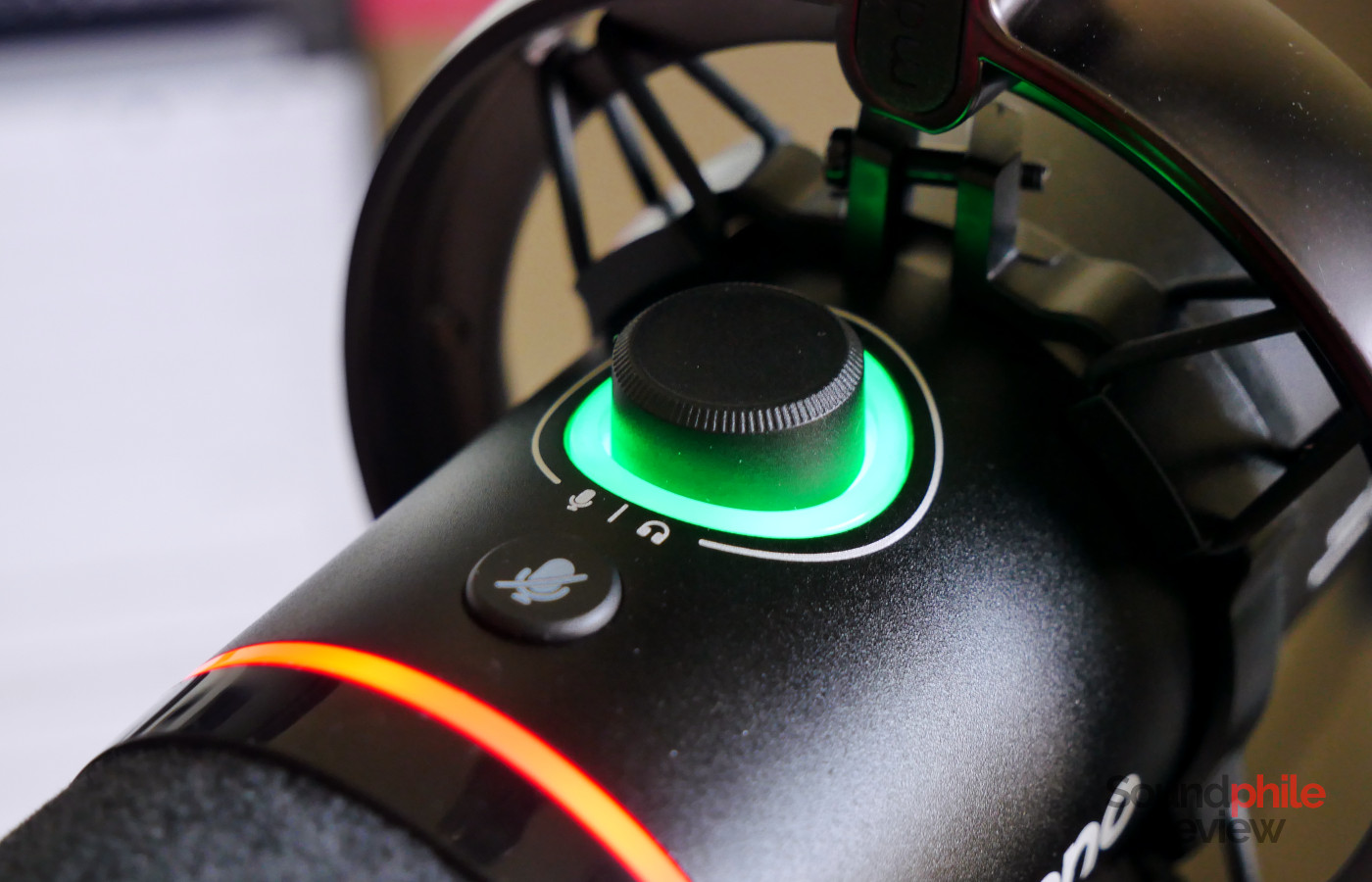
Like many advanced USB microphones, the PD200W offers a noise cancelling feature; it can be adjusted using the volume knob: you long-press it to switch between the volume of the headphone output and the intensity of the noise cancellation. The ANC feature is useful, as it does reduce unwanted sounds significantly. However, it is limited in the amount of noise it removes, so it won’t magically remove almost everything like it happens with other microphones (e.g. the Fifine K688). To test the feature, I used the microphone to record an interview in a café and the noise from the other people talking was reduced to the point that I could clearly hear the other person, but it was still evident in the recording; this is because the cardioid pattern still picks up a lot of sounds from the sides. In order to get the best ANC, you should use the Maono Link application, which is however only available for Windows and macOS – if you, like me, use Linux, or if you’d like to connect the microphone to your phone or camera, you are out of luck.
Sound
The Maono PD200W offers very good sound quality overall. Its cardioid pattern allows it to pick up sounds more strongly from the front and to reject those from the back, which typically acts as a passive noise reducer.
The climb in the upper midrange is audible: sibilants and plosives are more emphasised than the rest, despite using the pop filter and speaking from a distance of about 30 cm, as you can hear from the test recording above. My voice sounds clean and clear, with that sort of broadcasting-style depth that makes it richer, while still sounding like my voice.
The ANC feature works decently well. In order to record the file you can listen to above, I played “Rip & Tear” from the soundtrack for DOOM (2016) on my computer at full blast, so that it was behind the microphone. This recreates a situation where there is strong ambient noise. As you can hear, the ANC feature removes a lot of noise from the background, but it also ends up distorting my voice slightly. Interestingly, this does not happen if there is no (or very low) ambient noise. This distortion is noticeable, however, and makes my voice sound less natural. This makes the feature less useful than it could and would be, as it significantly affects the quality of the recording. Post-processing to remove noise is probably a better option.
Final Thoughts
The Maono PD200W is a competent microphone which offers good sound quality and a lot of convenience thanks to the wireless connection. This is the real distinctive feature that the PD200W brings to the table: the ability to use it with a variety of devices (even at the same time, if you are so inclined) and to employ it without the boundaries imposed by cables. This adds a lot of flexibility and convenience, especially if you would like to use the microphone to record podcasts or interviews while on the go.
The only blemish on an otherwise good product is the noise cancellation feature, which significantly impacts the sound quality of recordings, and the fact that you need to use a computer with Windows or macOS to correct this.
At the MSRP of $129.99, the Maono PD200W is more expensive than its direct competitors, but this is abundantly justified by the wireless capability it offers. I think that the PD200W is worth its full price if you really need the wireless capability, as the competitors offer slightly better sound quality at a lower price. However, the microphone is often on offer: as I am writing this, it is on sale for $84.99 on Maono’s website, which makes it a no-brainer.