There’s a very famous advert in Italy which promotes brushes. It goes like this: a guy is riding his bike in the middle of very intense traffic, with an absolutely gigantic brush on his back – bigger than him, in fact. A policeman stops him and asks him what he’s doing, to which he replies that he needs to paint a big wall and so he needs a big brush. The policemen then says: “to paint a big wall you don’t need a big brush, but a great one” (the lost-in-translation joke here is that “big” and “great” are the same word in Italian). All of this to say that the Edifier MR5 are monitor speakers which follow the same philosophy: they are not big, but they aim to be great, and they do so with a unique design that uses a 5″ woofer (that’s where the “5” in the name comes from, after all) but points it downwards and hides it inside the cabinet. Let’s see how well this works.
Disclaimer: I received a free unit directly from Edifier for the purpose of this review. Edifier sells the MR5 for $349. Additional information on the official website.
TL;DR: recap
| Pros |
Cons |
| + Well-built with a modern design
+ Many connectivity options + Good transient response + Great detail + No hiss! + Excellent value |
– Bass is not as tight as the rest
– Treble is emphasised – Volume level is reset at every power cycle |
Rating: 8/10
Packaging & Accessories
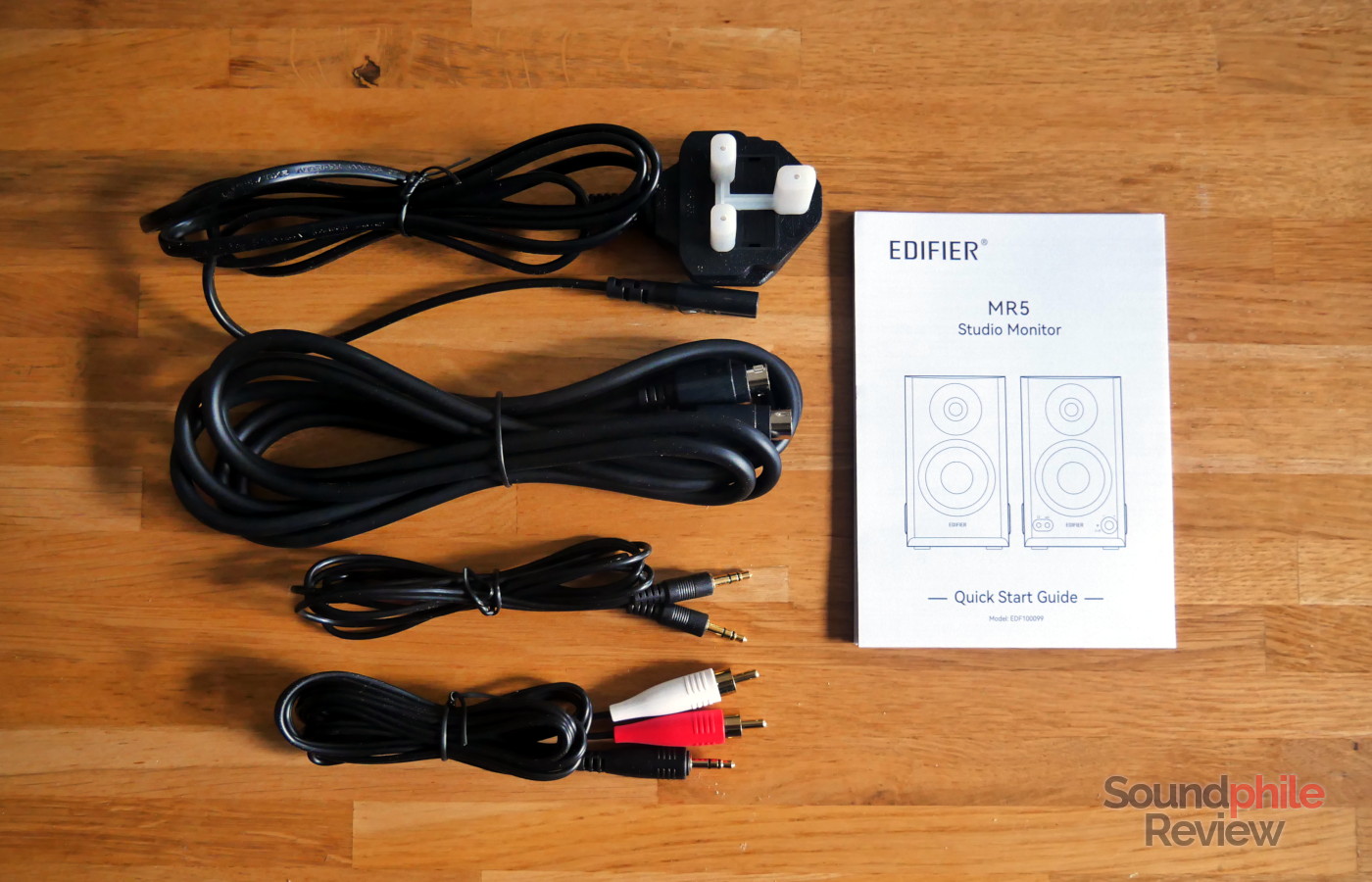
The Edifier MR5 come with the cable to connect the two speakers, a power cable, a 3.5 mm to RCA cable, a 3.5 mm to 3.5 mm cable and a manual.
Design & Build
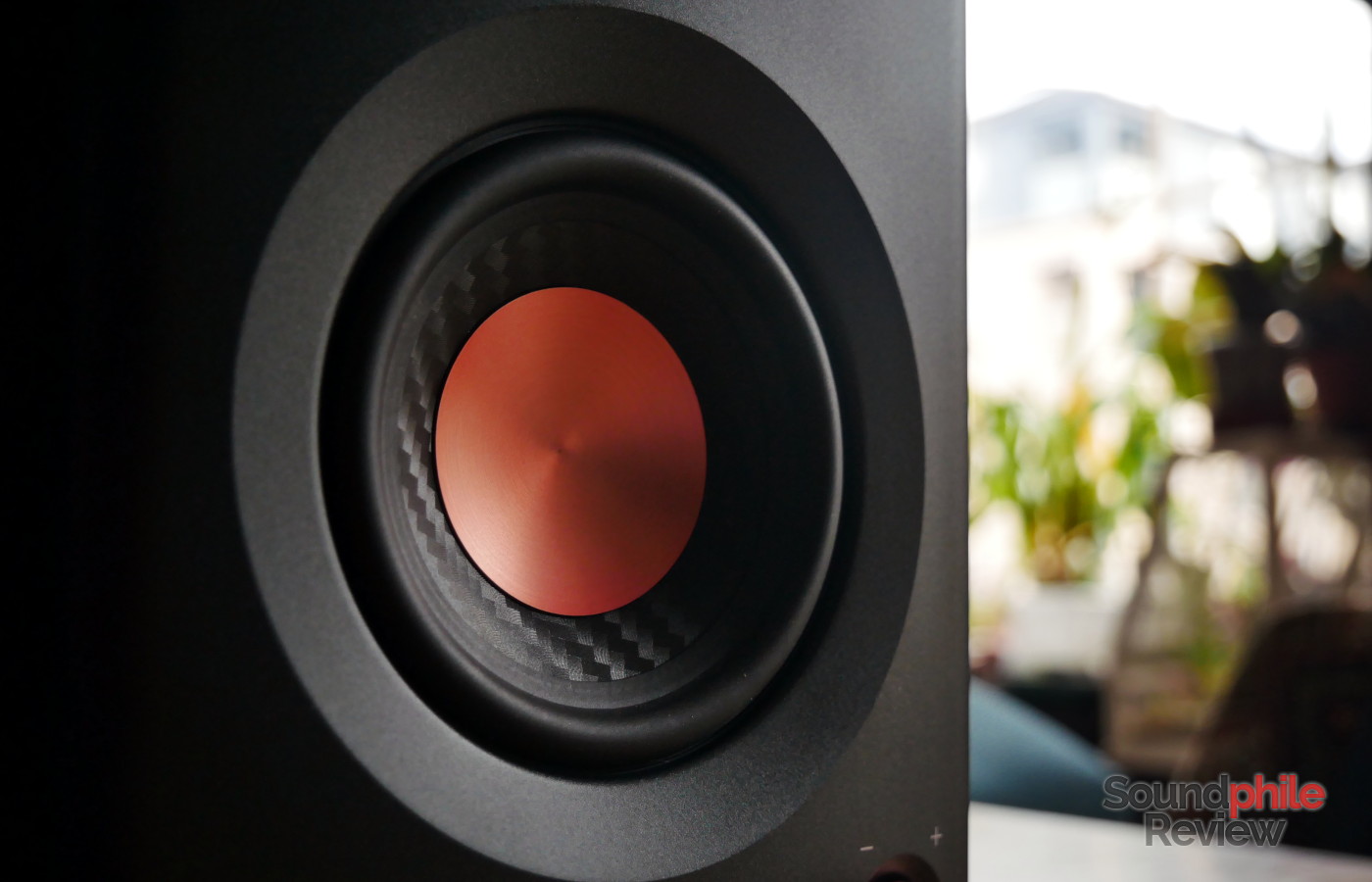
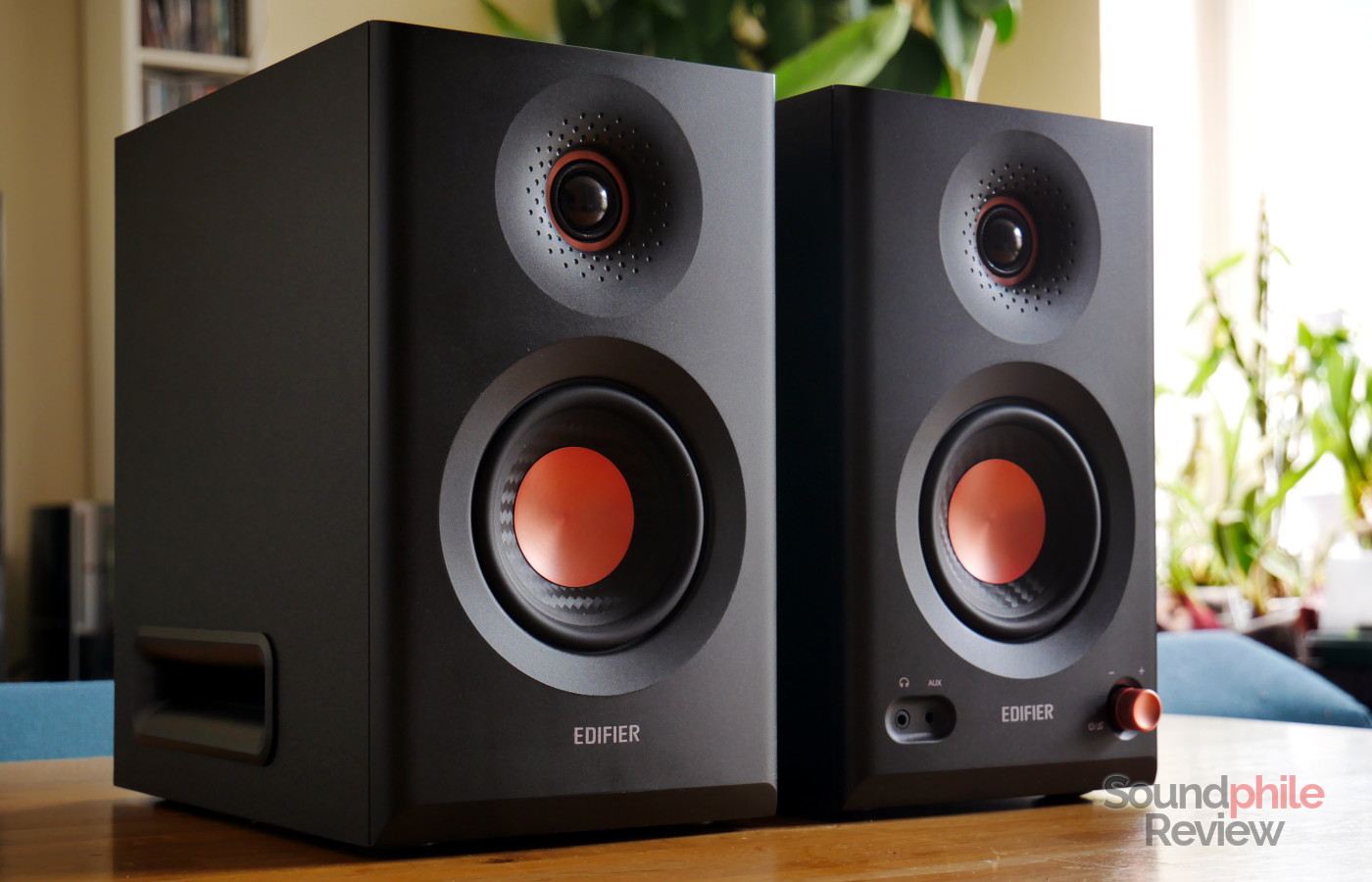
The most striking feature of the Edifier MR5 is that, despite it having a 5-inch woofer, you cannot see it. The speakers appear as just a slightly larger versions than the Edifier MR3, but the front of the cabinet appears exactly the same otherwise: there is a silk dome tweeter on top and a 3.75-inch mid driver under it, with a large coppery-orange dust cap on it. The larger woofer is hidden inside the cabinet and its presence is only hinted at by a horizontal slit on both sides, near the bottom and towards the back: the woofer is in fact firing downwards, a trick which works as it only takes care of bass and leaves the midrange to the 3″ driver. As bass is not (overly) directional, having the driver firing downwards still works.
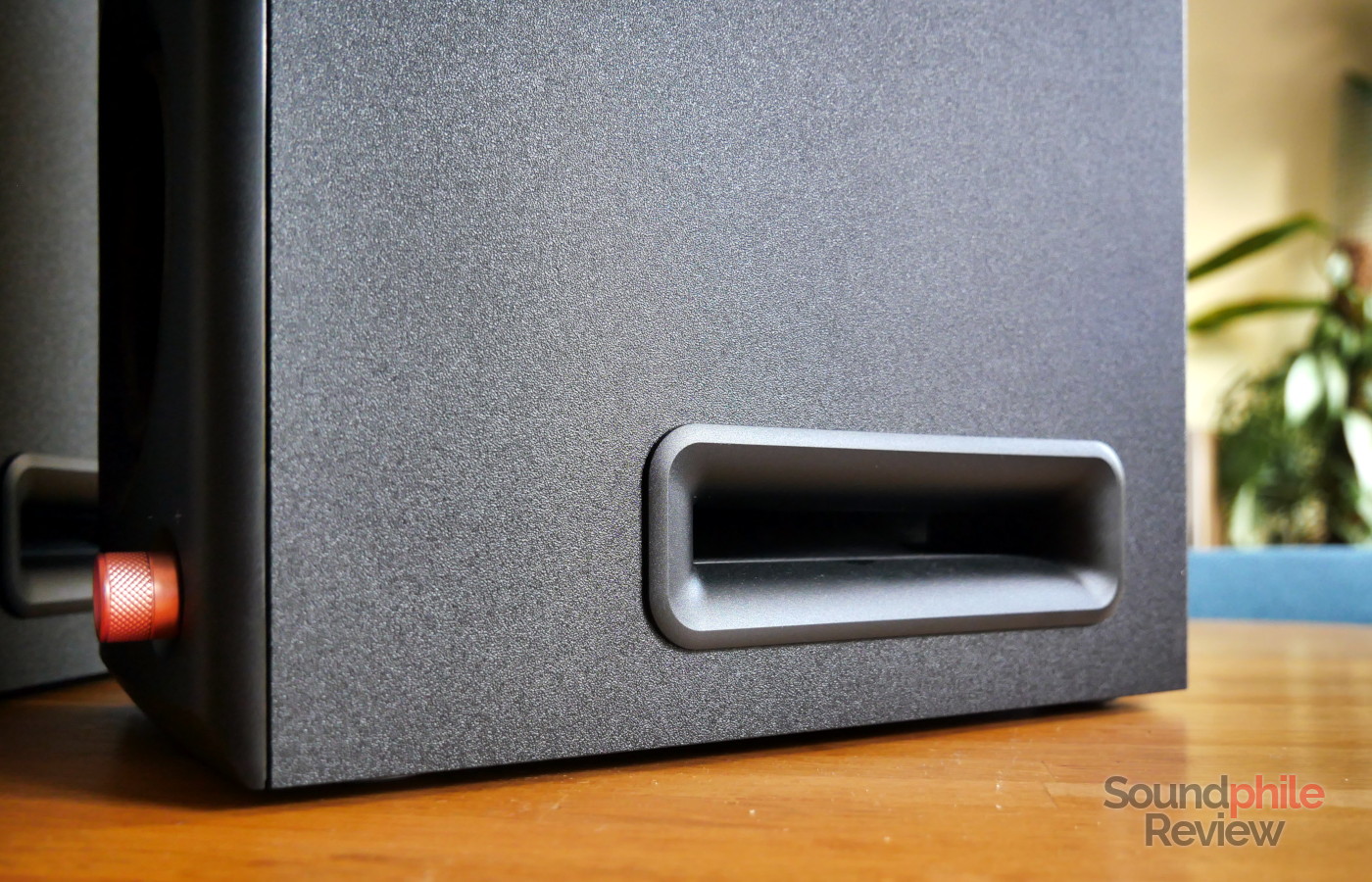
The MR5 are rather elegant and understated: both the cabinet and the drivers are black (though there is a version with white cabinets as well), with copper accents on both the midrange driver and the tweeter. The same copper colour is reprised on the volume knob on the right hand side speaker. Overall, the MR5 are speakers which you could use anywhere, be it on a desk in a studio or in the living room, as they are minimalistic enough to fit in any place.
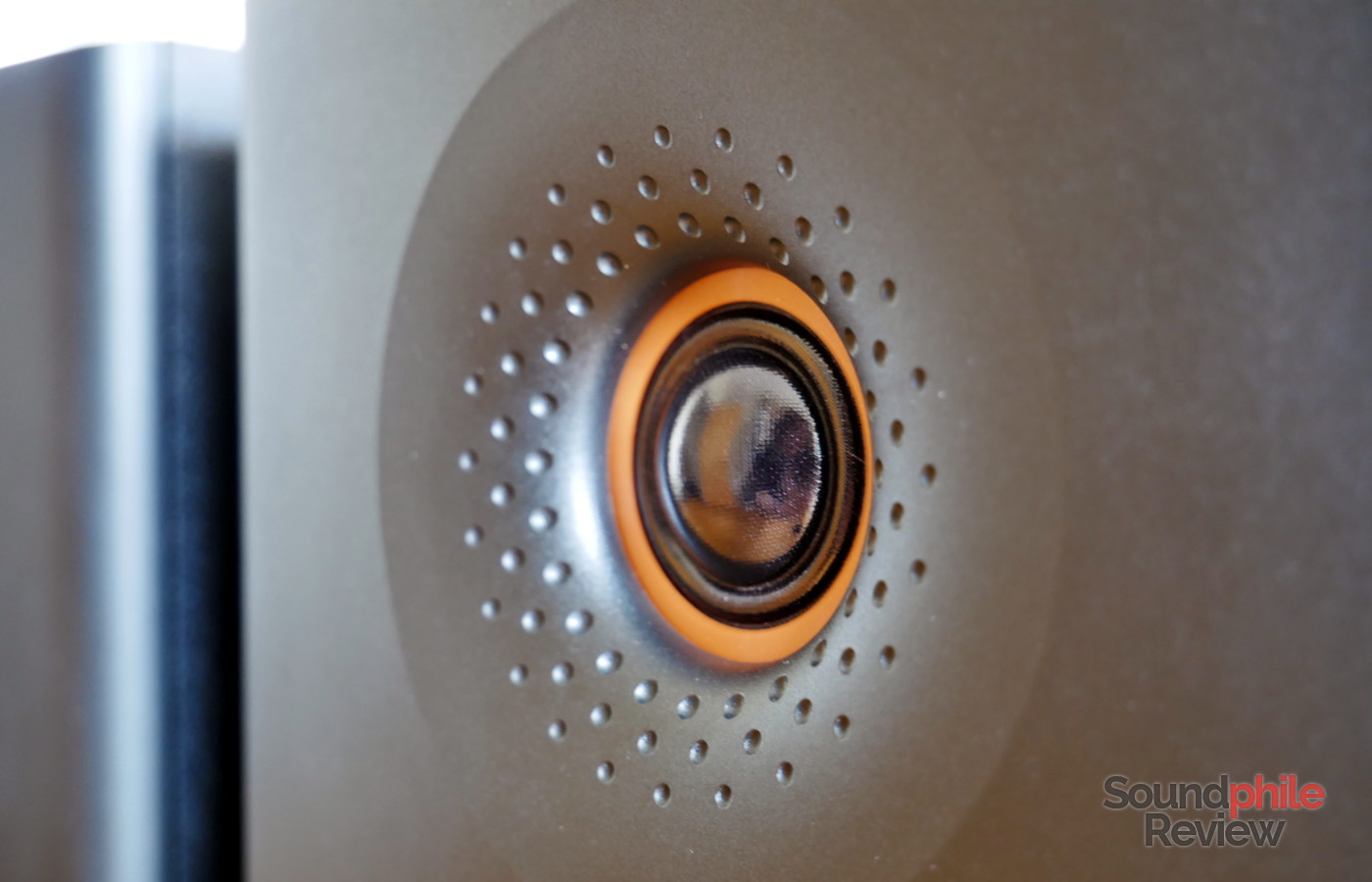
The cabinets are made of MDF, while the front (and the slits) are made of plastic. The front is shaped, according to Edifier, to optimise the performance of the drivers, with special regards to the tweeters which have waveguides around them.
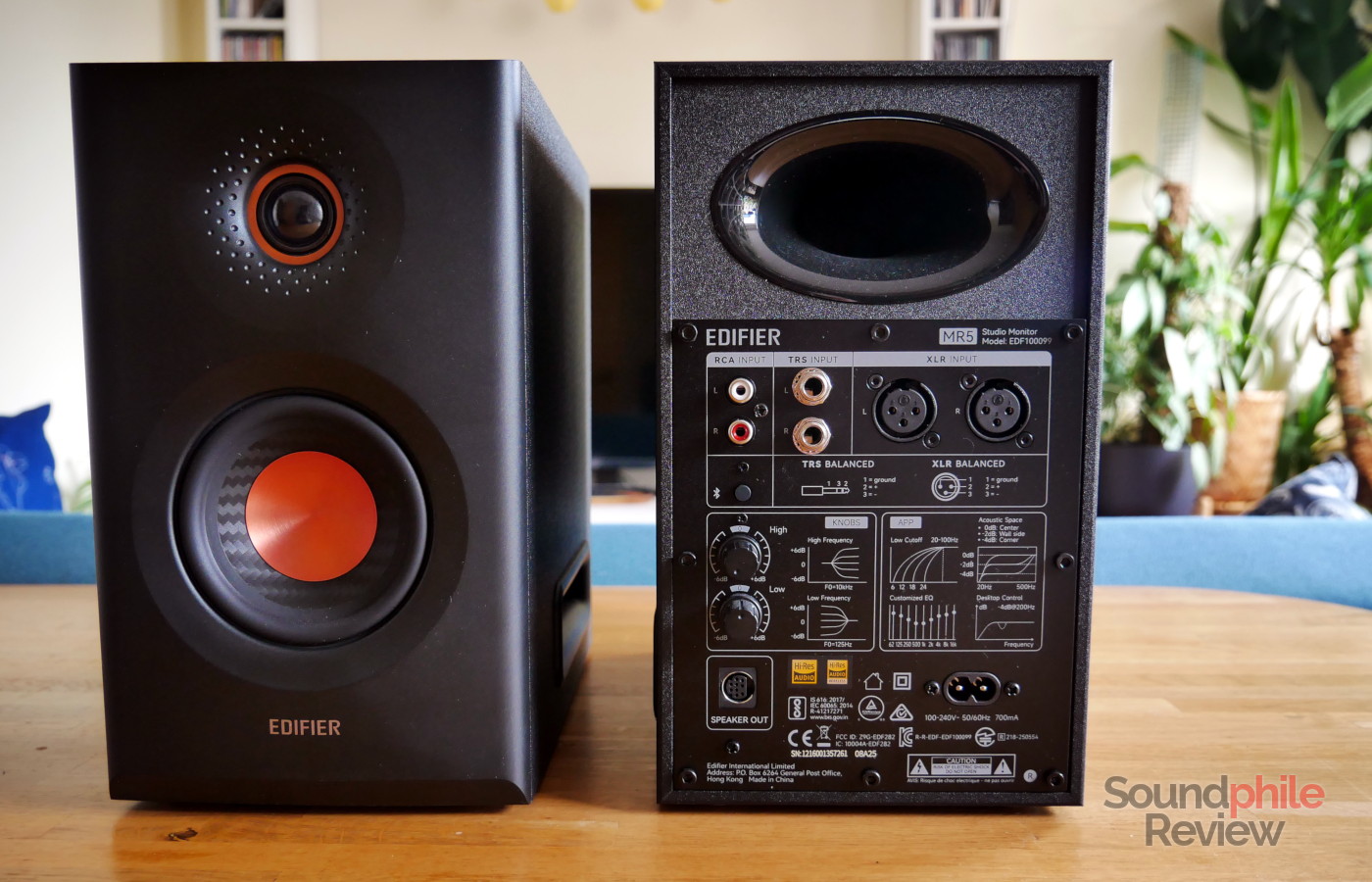
The right hand side speaker is the active one and contains all the electronics; it offers two 3.5 mm jacks (headphones out and aux in) as well as the aforementioned knob and a status LED on the front, whereas the back hosts all the various connectors and switches which include dual RCA, 6.3 mm TRS jack and XLR inputs, a button to initiate Bluetooth pairing, knobs to adjust treble and bass, a port to connect the other speaker, and an 8-figure power cable connector. Overall, the MR5 offer rich connectivity, including the two front-facing jacks which add a lot of convenience and flexibility.
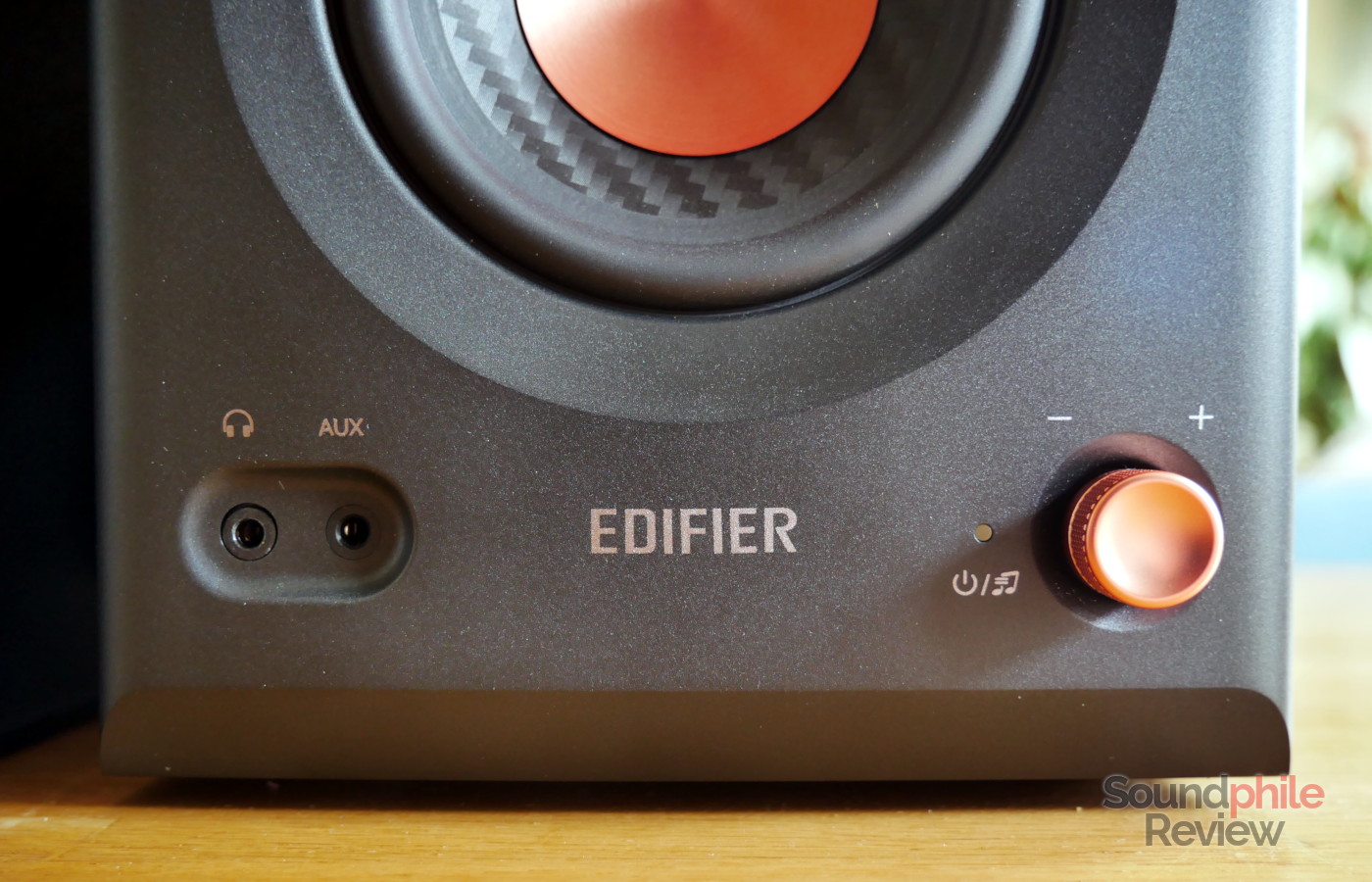
The volume knob is digital, so it spins continuously, and it is stepped, so it clicks whenever you turn it. It also acts as a power button if you push it.
Features & Specs
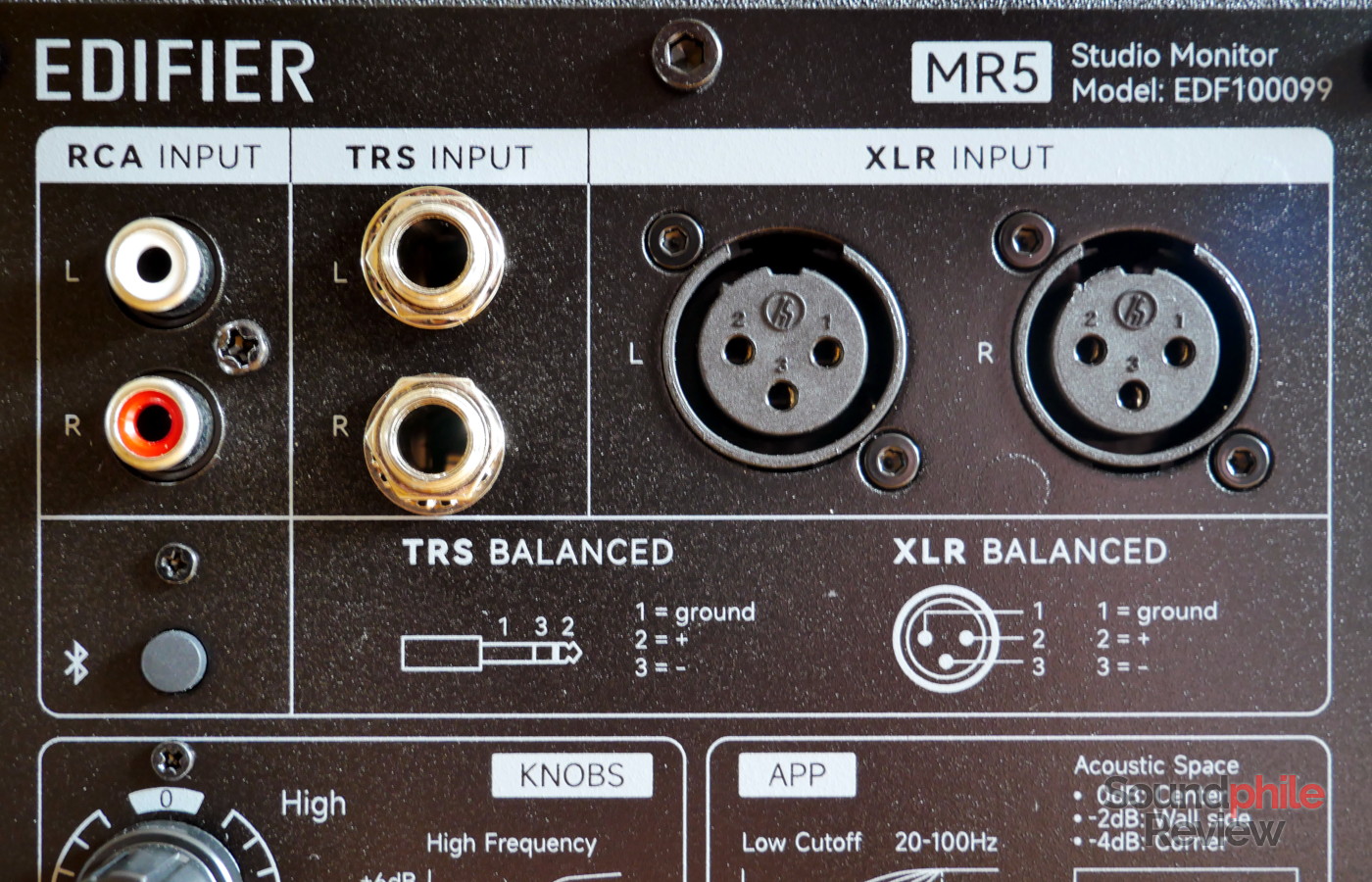
The Edifier MR5 are meant to be used as studio monitors and that is the reason why, contrary to many other active speakers in the consumer space, they also take balanced connections through the 6.3 mm TRS jacks and XLR connectors. They are still compatible with single-ended devices through the RCA connectors. This makes them quite flexible, as you can pair them with a variety of audio interfaces, DACs and other devices, including computers and TVs.
On top of wired connections, the MR5 also support wireless ones through the Bluetooth connection. They support both SBC and LDAC codecs, the latter being the preferred way to reproduce content in high quality.
Edifier MR5 |
| Frequency response | 46 – 40,000 Hz |
| Inputs | RCA, 6.3 mm TRS jack, XLR3 |
| Power output | 10 W p.c. (tweeter) 15 W p.c. (midrange) 30 W p.c. (bass) |
As the MR5 uses three different drivers, Edifier decided to give each its own amplification, and there are therefore three different amplifiers. The advantage to this is that there is theoretically no interference between the different drivers and amplifiers. In total, the MR5 provides 55 W of power per channel, which is more than enough to fill a medium-sized room.
By pressing the volume knob once, the MR5 switches between three modes: monitor (red LED), music (green LED) and customised (white LED). Monitor mode is the flattest, while music mode offers more bass at the expense of some tightness.
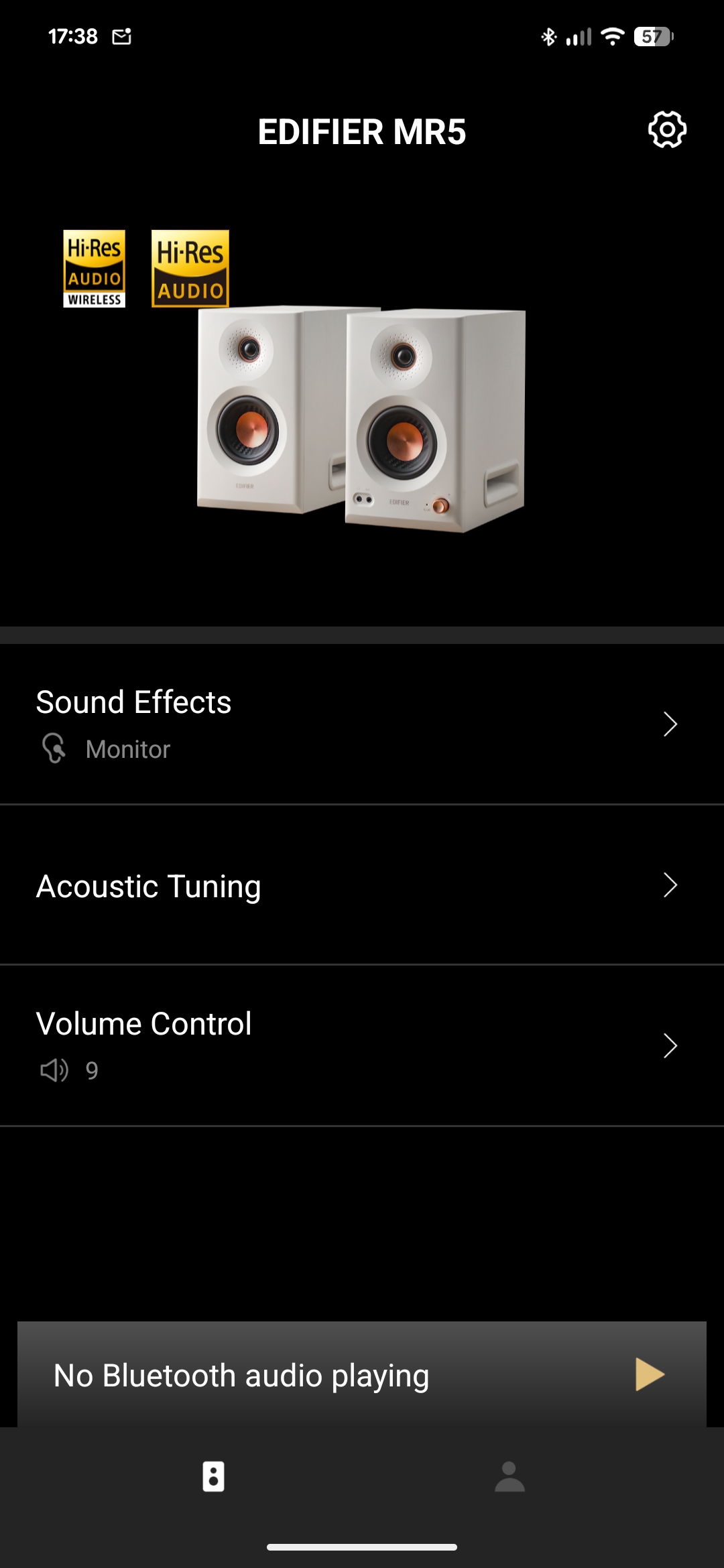
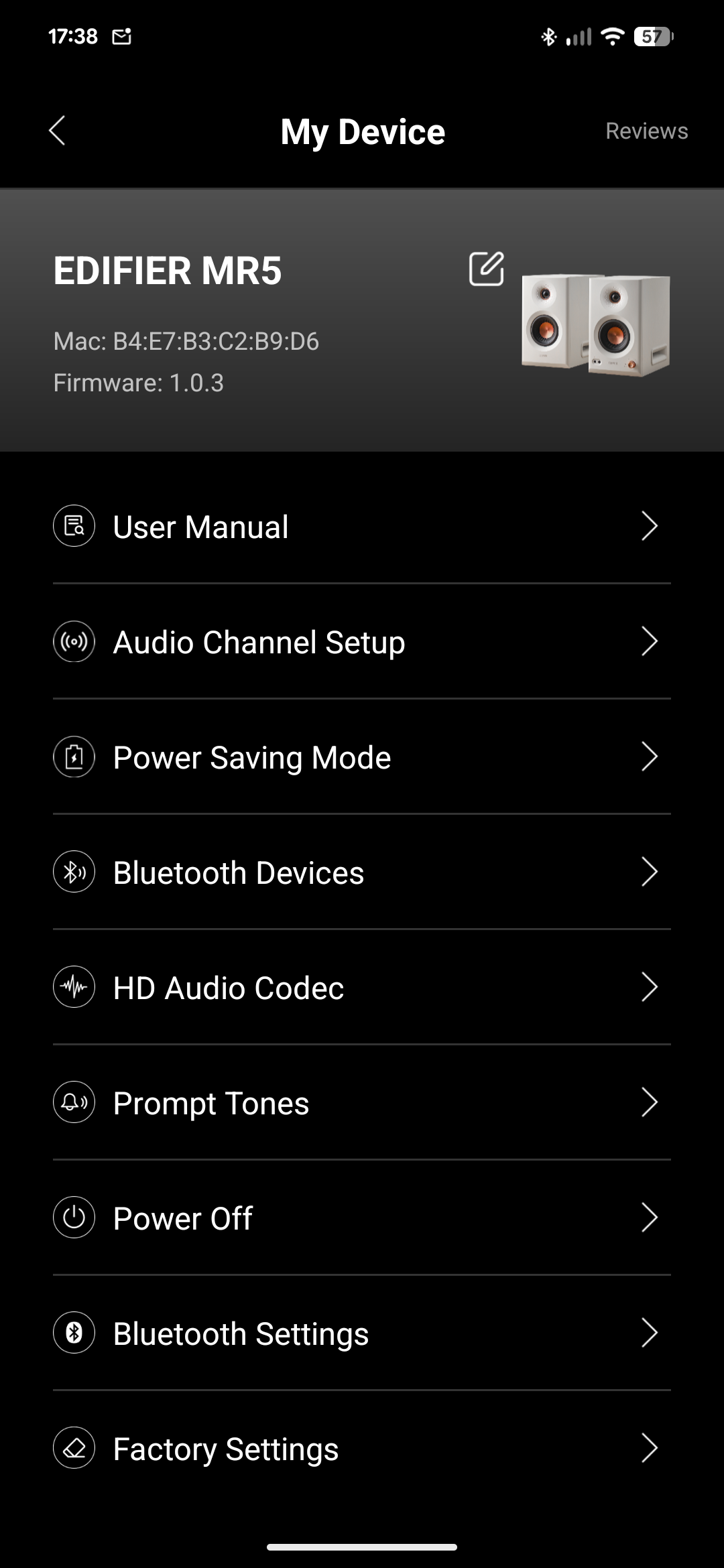
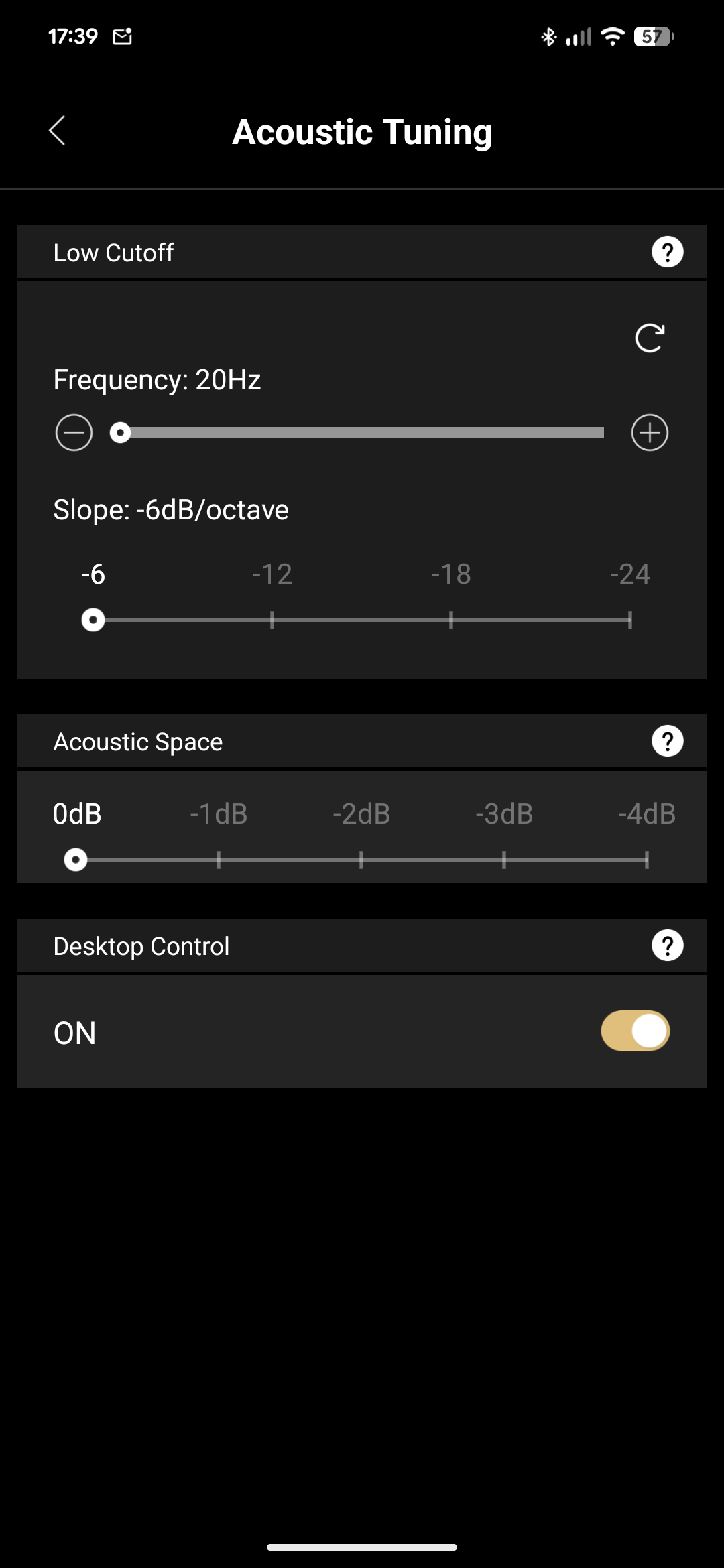
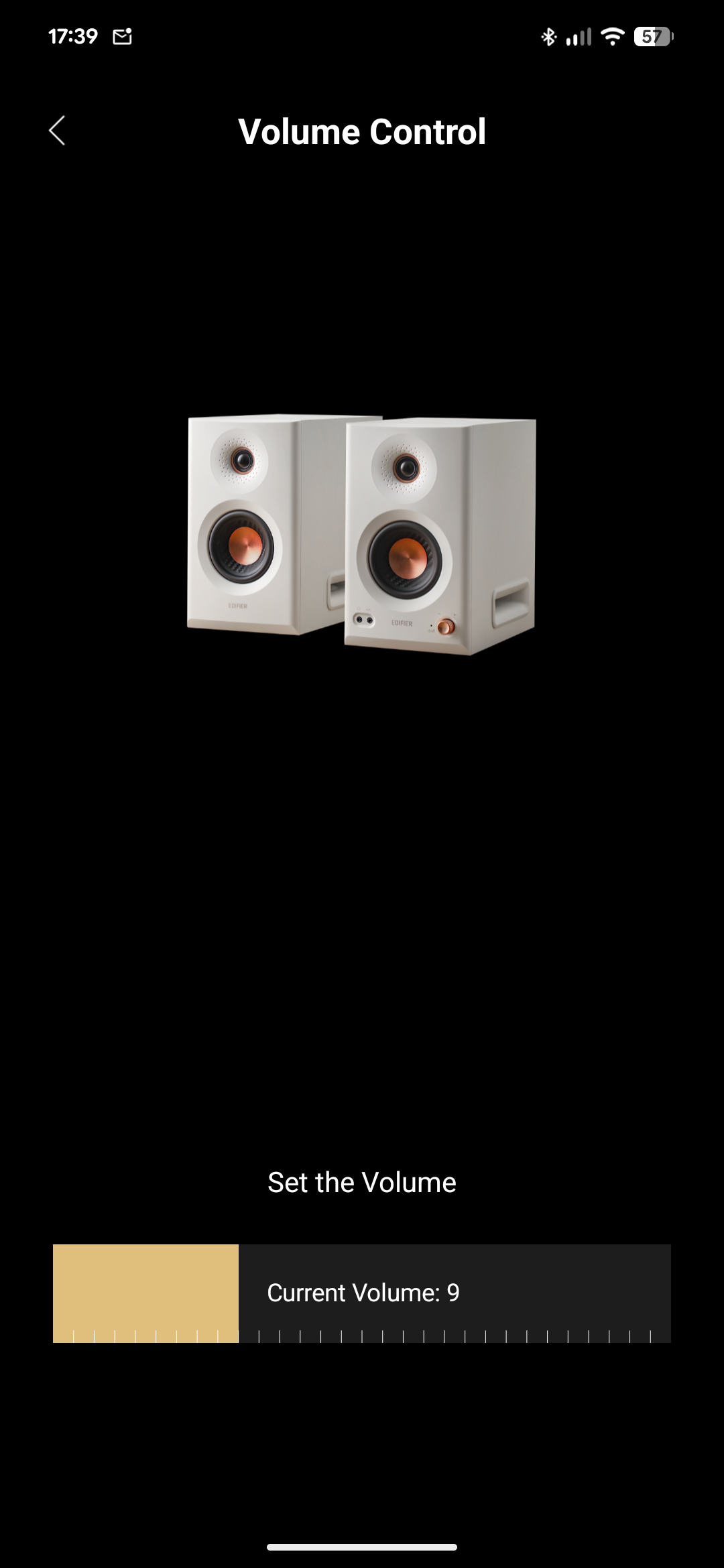

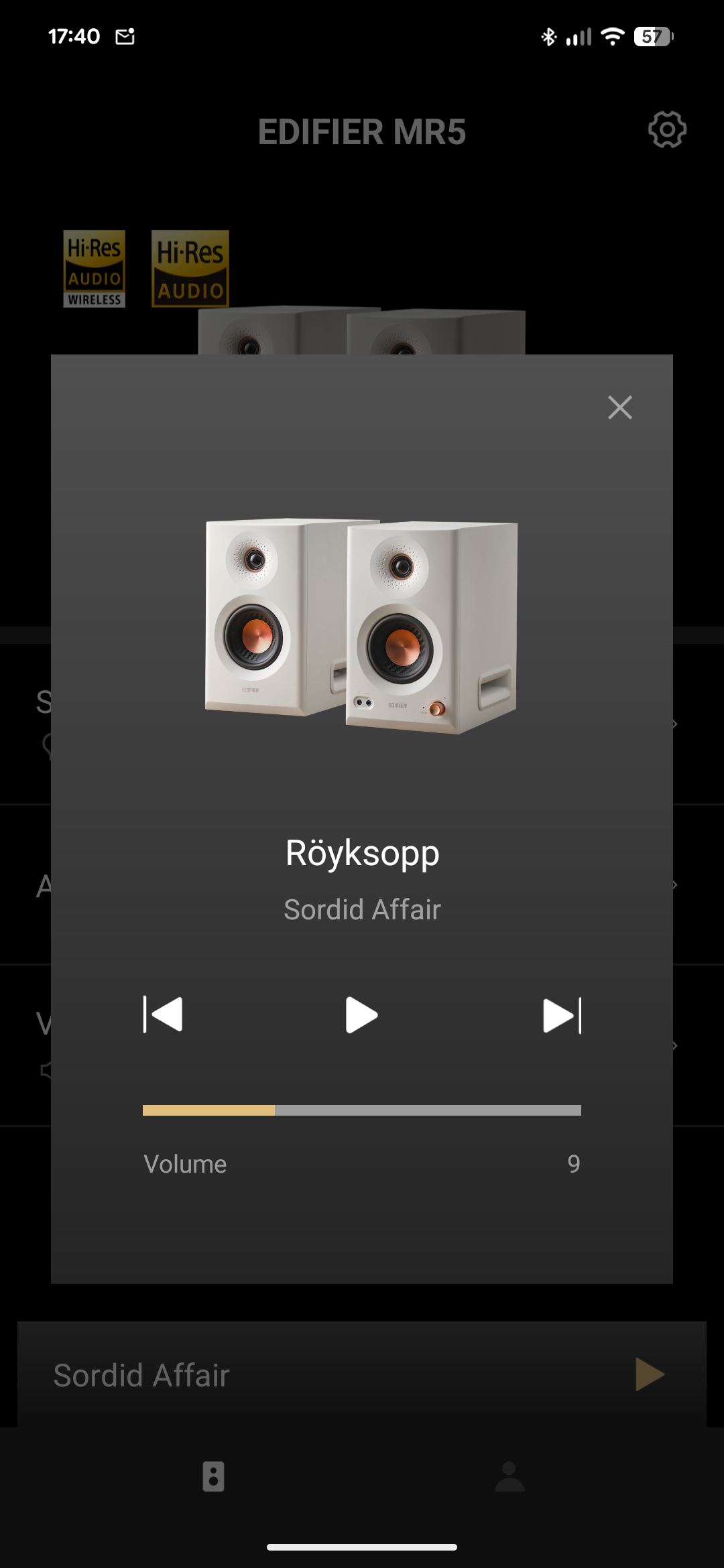
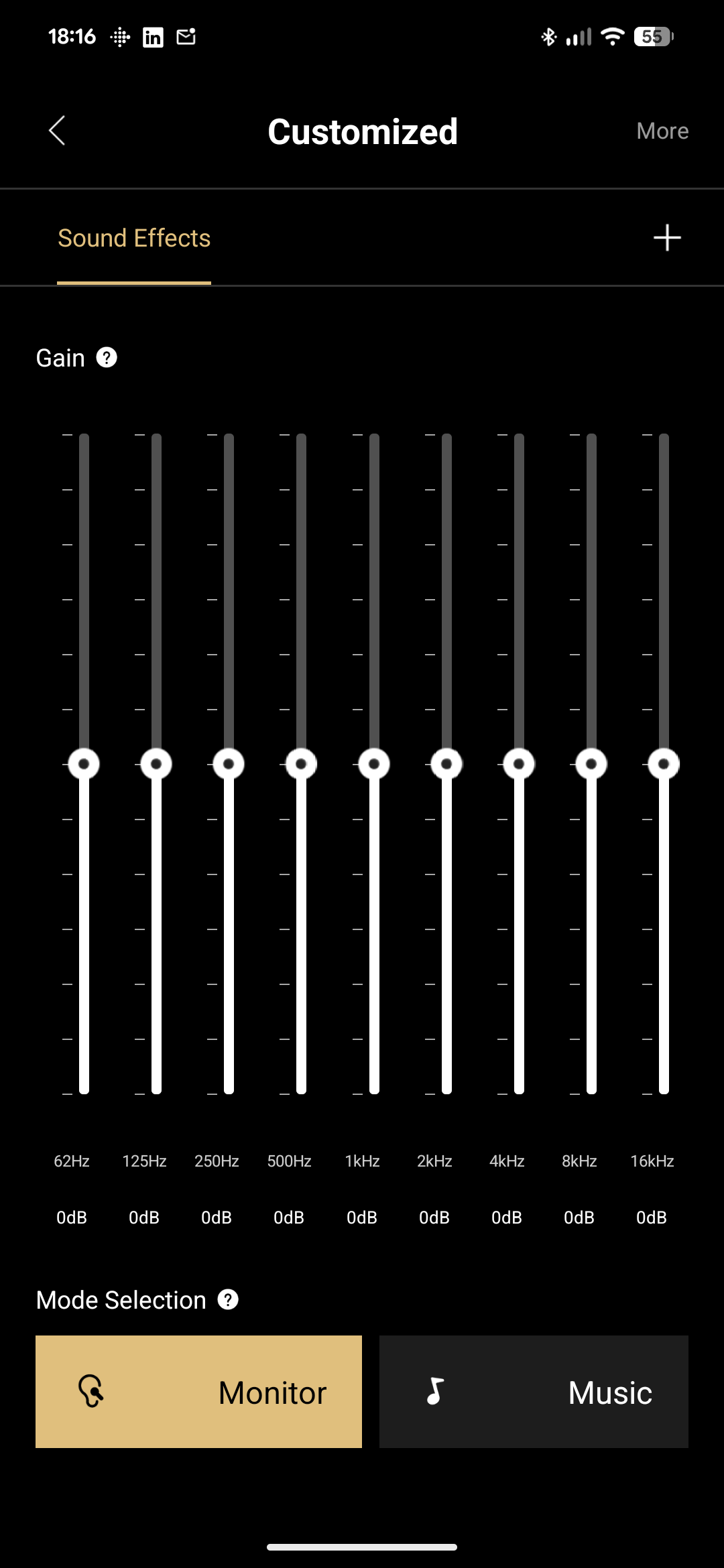
On top of having the knobs on the back, Edifier offers an application for Android and iOS to customise the sound of the speakers. The Edifier ConneX application allows you to alter many settings, including volume, equalisation, available codecs, active speaker positioning, cutoff frequency and room correction. The active speaker positioning options makes it so that you can place active speaker on either the left or the right hand side; in my case, as an example, I have my DAC on the left hand side and it is therefore more convenient to have the speaker on that side.
The equaliser offers 9 bands (62 Hz, 125 Hz, 250 Hz, 500 Hz, 1 kHz, 2 kHz , 4 kHz, 8 kHz, 16 kHz) and the ability to adjust the response to ±3 dB.
As with the M3, upon restart volume is reset when it is set too low (below 6) or too high (above 24). While it is understandable on one hand, as it makes sure you never forget the volume on a level that’s too high or too low, there are valid use cases where you want to keep a low or a high volume level, so a future update to fix this would be ideal.
Sound
I tested the Edifier MR5 using various DACs, including the Fosi Audio ZH3, the SMSL DO200 MKII and the SMSL C200 Pro.
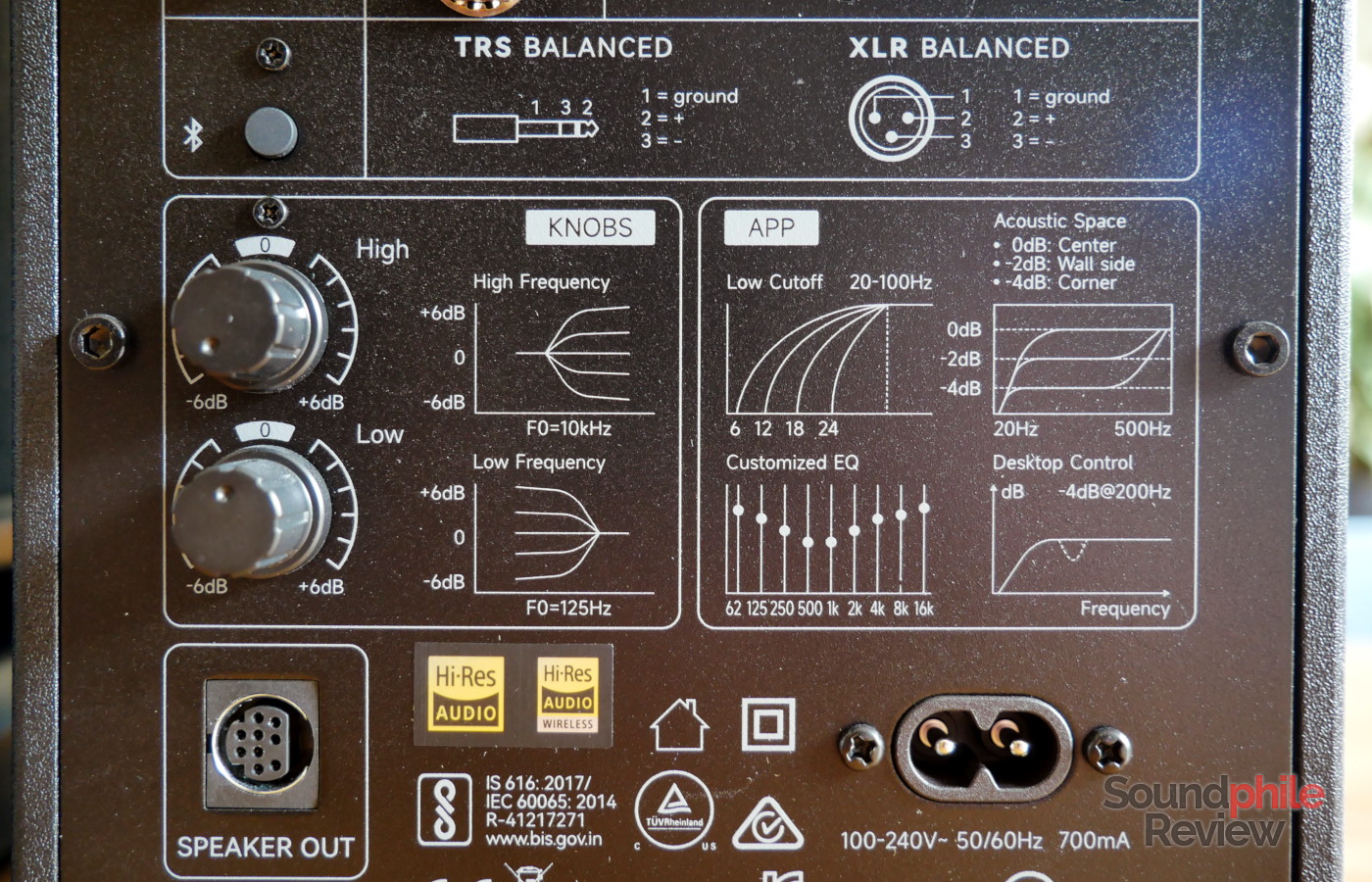
You can adjust the response of the speakers through both the knobs on the back and the smartphone application. This allows you to modify the frequency response of the speakers based on your specific acoustic environment as well as taste. The application gives you an option to reduce bass to take into account reflections from the bass reflex when the speakers are close to a wall behind them; I found that in my case, with the speakers placed ~10 cm away from the wall, simply removing 2 dB led to the best results. This will be entirely dependent on your specific acoustic environment and you will need to do a few tests to understand what works for you. Enabling “desktop control” removes some bass and makes it sound less bloated, and it makes the mids clearer and cleaner as well. Overall, I find that this option worked best in my case rather than using the bass adjustment.
I can’t hear any hiss or hum coming from the speakers when they’re powered on, whether they are playing sounds or not.
The MR5 offer a reasonably wide soundstage which appears to extend beyond the physical positioning of the speakers when closing my eyes; it offers a hint of depth as well, although this is very limited. Imaging is very good and offers sufficient accuracy in placing the instruments, although you don’t get pinpoint precision, and instruments rarely sound like they’re in an exact spot in space. Instrument separation is also well done and in line with what I would expect from speakers in this category and price range: it is easy to tell instruments apart, but it gets more difficult as the complexity of the track increases.
The speakers aren’t super directional and, although the image will suffer from misalignment, especially vertically, I’m surprised by how not picky these speakers are. I’ve tested them at various heights and angles and they showed a remarkable versatility. They did sound best on stands that lifted them away from the desk and sat at an angle that made them point towards my ears, but they were not too fussed if I just placed them perpendicular to the wall behind.
When trying out the MR3 I thought that those speakers sounded great, but lacked a bit of bass, especially in the lowest area. This is exactly the main difference between the MR3 and the MR5: thanks to the 5-inch woofer, the MR5 are able to go much deeper and offer a bass section that’s a lot stronger. As a result, it is much more engaging and it feels like it envelops you much more, almost like it happens with headphones. While bass doesn’t reach sub-bass territory, it stops just short of it at about 60 Hz, with a rapid decrease as the frequency goes down – even if you configure the speakers to extend as low as possible and to reduce the slope to -6 dB per octave. However, you still do get that depth which makes tracks more impactful and enveloping: as an example, in Smoke n’ Oakum from the Master and Commander soundtrack you get the “kick” from the bass drum. This brings us to the point of transients: they’re fast enough to offer a good physical kick and to maintain decent speed. They’re not blazing-fast, however, and there is some overhang – as in, decay is a bit slow and you don’t get that sense of immediacy and crispiness. This has an impact on detail, which is often reduced in more complex and layered tracks.
Midrange sits roughly in line with bass, with a slight emphasis on the upper area that makes the sound slightly bright. This is especially evident if you listen to female vocals or instruments with a larger high-frequency component such as electric guitars, trumpets or violins. This emphasis simply adds a bit of colour to the sound, however, and is not overwhelming. Contrary to bass, and probably due to the different driver being employed, transients in the midrange are very fast and offer that sort of immediacy and crispiness which make them sound impactful and natural: as an example, HUVA Network’s Cobalt has a beat section at the start which sounds very fast; similarly, Rodrigo & Gabriela’s Diablo Rojo has convincingly fast hits on the guitar’s body. Another good example is the tenor saxophone in Snarky Puppy’s East Bay. There is a great deal of detail which is presented clearly, even in moderately busy tracks.
Treble is overall balanced with the rest of the sound, although it is the only area which sees a consistent emphasis. It starts from the already-emphasised level of upper midrange and increases it gradually until about 10 kHz, where it levels out. This adds quite a bit of brightness and “zing” to the sound: it is enough to make instruments with a high-frequency component stand out quite a lot, especially when it comes to cymbals. Sometimes it can become a bit aggressive, however this emphasis can be controlled quite easily by using the adjustment knob on the back of the active speaker, as removing 4 dB from treble seems to level things out and lead to a more balanced presentation. One thing that really impressed me is how crisp treble sounds: listening to Aes Dana’s A Carmine Day, the subtle static-like sounds at the beginning of the track sound very dry and clear-cut, and therefore they emerge very clearly from the background, almost popping out of the scene. The level of detail offered by the tweeters is excellent and frankly unexpected at this price point, as well as contrasting positively with that of the other two drivers.
Final Thoughts
The Edifier MR5 are interesting speakers for near-field monitoring as well as multimedia applications. They offer many of the qualities that make their smaller siblings, the MR3 and the MR4, attractive: an overall flat frequency response, good overall level of detail and decent technicalities. They differentiate themselves by adding a third 5-inch driver which gives them a lot more presence in the bass area, a valuable addition given the bass-shyness of the MR3. Everything else stays the same and that’s a good thing; further additions include two XLR3 connectors as well as physical knobs to adjust bass and treble.
Overall, the Edifier MR5 are a very good option when it comes to sub-$350 active speakers, as they offer pretty much everything you could want or need in a neat package. Their only real drawback is that their 5″ driver is not as tight and punchy as the other ones, and bass suffers as a result. So while they do offer more bass and better extension than their smaller siblings, there is a trade-off to be made there in terms of technicalities. Still, for non-professional monitoring or simply to enjoy music from your computer, the MR5 offer great value and are easy to recommend.